Birth flower
Aster
Symphyotrichum. In the language of flowers, as lists print it today, it stands for patience. Kate Greenaway's dictionary of 1884 gives it another: “Afterthought”. It is a custom of sentiment, not a scientific or official designation.
- Latin name
- Symphyotrichum
- Month
- September
- Meaning today
- patienceNot the reading of 1884: Kate Greenaway gives “Afterthought”.
The plant itself
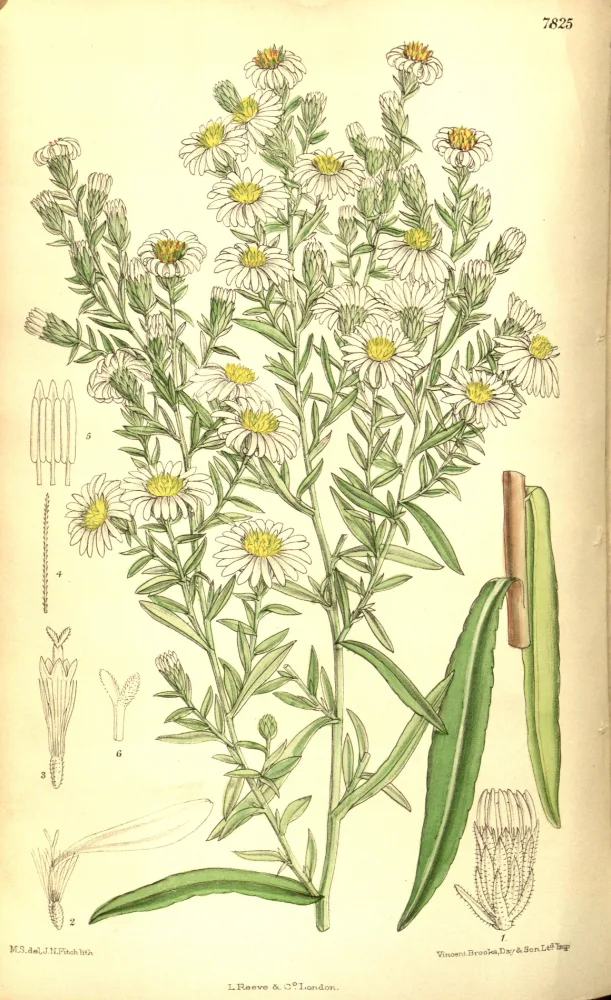
Symphyotrichum is a genus. The figures below are for one species of it, Symphyotrichum novae-angliae, the New England aster, which the RHS also calls the hairy Michaelmas daisy; the plate above shows another American aster, Tradescant's aster.
| Family | Asteraceae |
|---|---|
| Native to | central and eastern North America |
| Habit | perennial |
| Height | 30–120 cm in the wild, often 0.9–1.8 m in gardens |
| Flowers | August to October |
Most of what is sold as a garden "aster" is no longer botanically an Aster. The plant Linnaeus named Aster novae-angliae in 1753 kept that name for 242 years until Nesom moved it to Symphyotrichum in 1995; true Aster is now restricted to Eurasian species such as Aster amellus.
Where the names come from
Aster is Latin for a star, from the Greek aster, and the flower is so called for its radiating heads. The flower sense in English dates from 1706; an earlier use, around 1600, meant a star and is now obsolete. The genus on this page, Symphyotrichum, is from the Greek for growing together and hair, and holds many American asters that were once placed in Aster itself.
Where the meaning is written down
- As the dictionary prints it
- AfterthoughtUnder the heading “Michaelmas Daisy” in Kate Greenaway, Language of Flowers, 1884.
- As lists print it today
- PatienceA different reading from the entry quoted here; the note below says where it differs.
Greenaway prints two entries for the Michaelmas daisy, and they disagree: "Michaelmas Daisy — Afterthought" and, under "Daisy, Michaelmas", "Farewell". Ingram's Flora Symbolica (1869) gives the aster a chapter of its own under "after-thought". The China aster, Callistephus chinensis, is a different plant with entries of its own, and none of them is "patience".
Is it poisonous?
Not assessed. Symphyotrichum is not in the ASPCA's database and the New England aster carries no Royal Horticultural Society harm rating. The ASPCA's "China aster", listed as non-toxic, is Callistephus chinensis, a different plant, and says nothing about this one. No finding either way is an absence of evidence, not a clean bill of health.
This is general information and not veterinary advice — if an animal or a person has eaten part of a plant, ring a vet or a poison line rather than reading a website.