Birth flower
Chrysanthemum
In the language of flowers, as lists print it today, it stands for loyalty. Kate Greenaway's dictionary of 1884 gives it another: “I love”. It is a custom of sentiment, not a scientific or official designation.
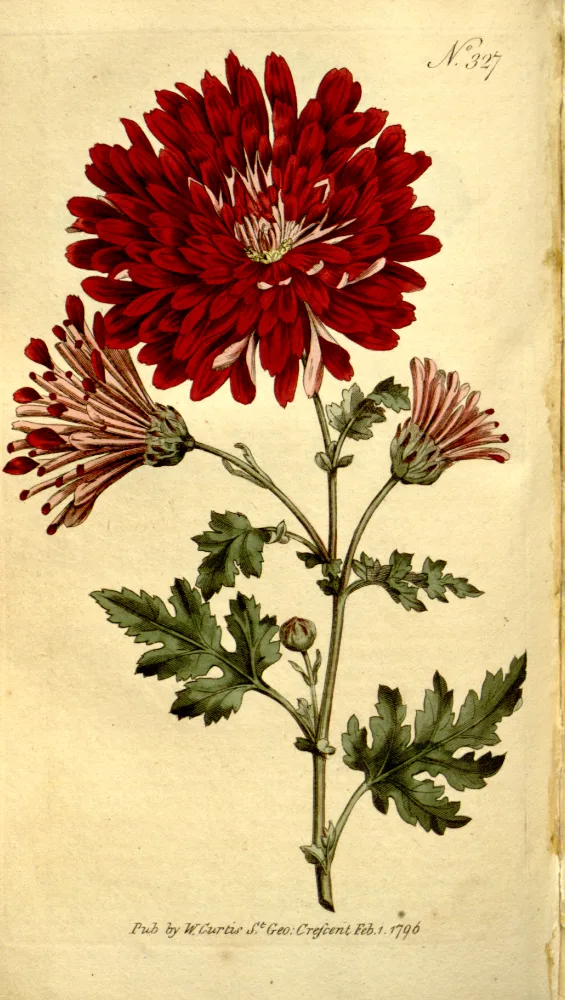
- Latin name
- Chrysanthemum
- Month
- November
- Meaning today
- loyaltyNot the reading of 1884: Kate Greenaway gives “I love”.
The plant itself
| Family | Asteraceae |
|---|---|
| Native to | south-east China |
| Habit | perennial |
| Height | 60–90 cm |
| Flowers | September until the first frost |
The florist's chrysanthemum is not a species but a hybrid of five wild Chinese species: Kew records its parentage as Chrysanthemum argyrophyllum × dichrum × indicum × nankingense × zawadzkii. Its name has also moved twice, out of Chrysanthemum into Dendranthema and back again after the genus was conserved with a new type in the 1990s.
Where the names come from
The name, in English from the 1550s, is the Latin chrysanthemum, from the Greek khrysanthemon, which meant a marigold and literally means golden flower, from khrysos, gold, and anthemon, flower. It seldom fits the plant now, since few species are actually yellow.
Where the meaning is written down
- As the dictionary prints it
- I loveUnder the heading “Chrysanthemum, Red” in Kate Greenaway, Language of Flowers, 1884.
- As lists print it today
- LoyaltyA different reading from the entry quoted here; the note below says where it differs.
Greenaway has no entry for a plain chrysanthemum: she gives "I love" for the red, "truth" for the white, "slighted love" for the yellow and "cheerfulness under adversity" for the Chinese chrysanthemum.
Is it poisonous?
The ASPCA lists Chrysanthemum species as toxic to dogs, cats and horses through sesquiterpene lactones, pyrethrins and other irritants, causing vomiting, diarrhoea, drooling, incoordination and dermatitis; in people the documented hazard is allergic contact dermatitis, an occupational problem for florists.
Each finding above names who made it: the ASPCA's poisonous plant database, the Royal Horticultural Society's harm ratings, or a published report. This is general information and not veterinary advice — if an animal or a person has eaten part of a plant, ring a vet or a poison line rather than reading a website.