Birth flower
Daisy
Bellis perennis. In the language of flowers, as lists print it today, it stands for innocence, the reading Kate Greenaway printed for it in 1884. It is a custom of sentiment, not a scientific or official designation.
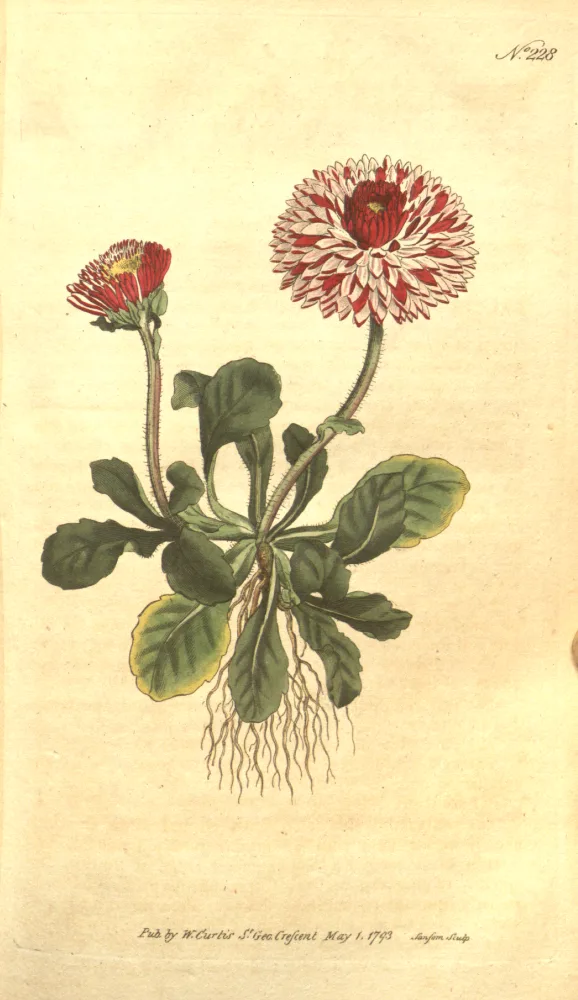
- Latin name
- Bellis perennis
- Month
- April
- Meaning today
- innocenceThe same reading Kate Greenaway printed in 1884.
The plant itself
| Family | Asteraceae |
|---|---|
| Native to | Europe to the Mediterranean and Central Asia |
| Habit | perennial |
| Height | 5–15 cm |
| Flowers | March to September |
Each "flower" is not one flower but a capitulum, a head of many small florets packed together: the white rays round the edge and the yellow disc in the middle are all separate flowers.
Where the names come from
The name is the Old English dægesege, from dæges eage, the day's eye, because the petals open at dawn and shut at nightfall; Medieval Latin called it solis oculus, the eye of the sun. The genus name, Bellis, is the Latin for the ox-eye daisy. The species name, perennis, is Latin for perennial, from per, through, and annus, a year.
Where the meaning is written down
- As the dictionary prints it
- InnocenceUnder the heading “Daisy” in Kate Greenaway, Language of Flowers, 1884.
- As lists print it today
- InnocenceThe same reading, in today's wording.
Greenaway lists several daisies with different meanings; "innocence" is her entry for the plain daisy, and Ingram's Flora Symbolica (1869) gives the same.
Is it poisonous?
Not assessed. Bellis perennis is not in the ASPCA's database and carries no Royal Horticultural Society harm rating. The ASPCA's entry titled "Daisy" is a different plant, Chrysanthemum, which it lists as toxic to dogs and cats, so it says nothing about this one. No finding either way is an absence of evidence, not a clean bill of health.
This is general information and not veterinary advice — if an animal or a person has eaten part of a plant, ring a vet or a poison line rather than reading a website.