Birth flower
Larkspur
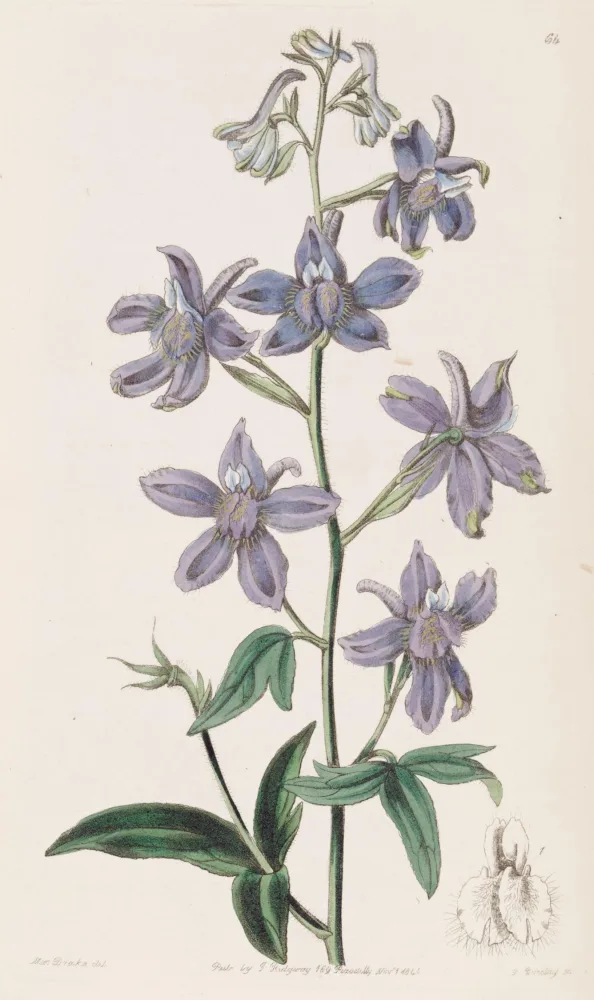
Delphinium. In the language of flowers, as lists print it today, it stands for an open heart. Kate Greenaway's dictionary of 1884 gives it another: “Lightness. Levity”. It is a custom of sentiment, not a scientific or official designation.
- Latin name
- Delphinium
- Month
- July
- Meaning today
- an open heartNot the reading of 1884: Kate Greenaway gives “Lightness. Levity”.
The plant itself
| Family | Ranunculaceae |
|---|---|
| Native to | the temperate and subtropical Old World and North America; the coast larkspur on the plate is Californian |
| Habit | annual or perennial by species; the coast larkspur is a perennial |
| Height | varies by species; the coast larkspur 5–42 cm |
| Flowers | varies by species; the coast larkspur March to June |
Methyllycaconitine, one of the larkspurs' alkaloids, is a potent and highly selective blocker of the alpha-7 nicotinic acetylcholine receptor, acting much like the alpha-bungarotoxin of snake venom, and is used in laboratories as a probe for that receptor.
Where the names come from
The name, from the 1570s, joins lark and spur, because the calyx and petals look like the bird's long, straight hind claw; an older folk name was lark-heel. The genus name, Delphinium, is from the Greek delphinion, because the shape of the flower was thought to resemble the back of a dolphin.
Where the meaning is written down
- As the dictionary prints it
- Lightness. LevityUnder the heading “Larkspur” in Kate Greenaway, Language of Flowers, 1884.
- As lists print it today
- An open heartA different reading from the entry quoted here; the note below says where it differs.
Greenaway gives "lightness, levity" for the plain larkspur and separate meanings for the pink and purple forms; her own index disagrees with her main list, printing "naughtiness" where the list has "haughtiness" for the purple larkspur.
Is it poisonous?
Toxic. The ASPCA lists larkspurs, Delphinium species, as toxic to dogs, cats and horses: their diterpene alkaloids cause neuromuscular paralysis, and heart failure, or death from paralysis of the breathing, can follow. It notes that the plants generally become less toxic as they mature.
Each finding above names who made it: the ASPCA's poisonous plant database, the Royal Horticultural Society's harm ratings, or a published report. This is general information and not veterinary advice — if an animal or a person has eaten part of a plant, ring a vet or a poison line rather than reading a website.