Birth flower
Marigold
Tagetes. In the language of flowers, as lists print it today, it stands for warmth. Kate Greenaway's dictionary of 1884 gives it another: “Grief”. It is a custom of sentiment, not a scientific or official designation.
- Latin name
- Tagetes
- Month
- October
- Meaning today
- warmthNot the reading of 1884: Kate Greenaway gives “Grief”.
The plant itself
| Family | Asteraceae |
|---|---|
| Native to | Mexico to Guatemala |
| Habit | annual |
| Height | 50 cm–1.2 m; French-marigold types about 30 cm |
| Flowers | June until the first frost |
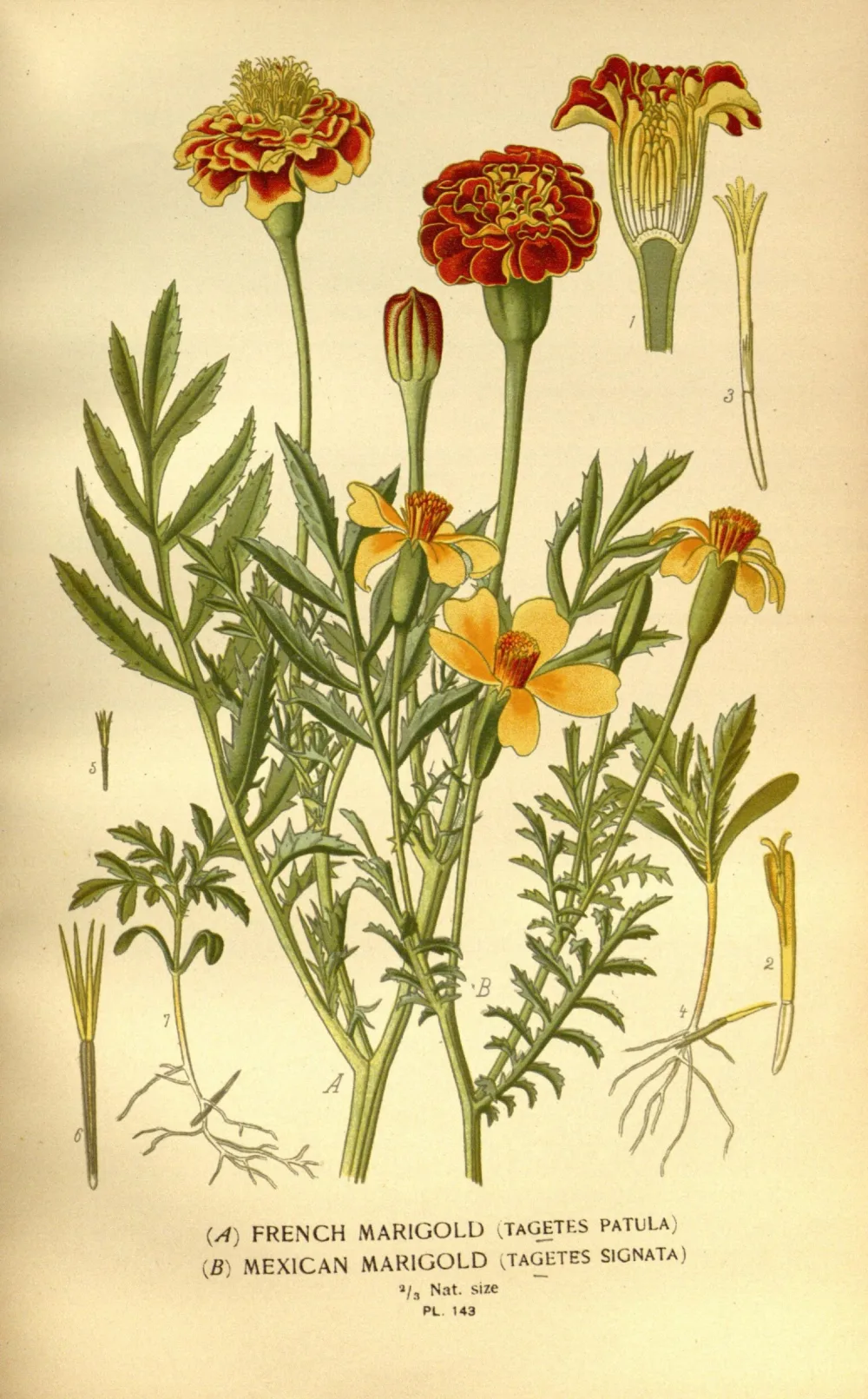
This page describes Tagetes, the French and African marigolds of the plate above. "Marigold" also names the pot marigold, Calendula officinalis, a different plant of the same daisy family, which the ASPCA lists as non-toxic to dogs and cats. The "African marigold" is a misnomer: it is native to Mexico and Guatemala, not Africa. Kew's Plants of the World Online now treats the French marigold, Tagetes patula, as the same species as Tagetes erecta.
Where the names come from
Marygolde is recorded from the late 1300s, from Mary, probably meaning the Virgin, and gold, for the colour; Old English called the flower simply golde. The English name is older than the plant on this page and is shared with the related Calendula: Tagetes was first brought into European cultivation in 1535, and its genus name comes from a Medieval Latin word, a Berber borrowing, fixed by an association with the Etruscan god Tages.
Where the meaning is written down
- As the dictionary prints it
- GriefUnder the heading “Marigold” in Kate Greenaway, Language of Flowers, 1884.
- As lists print it today
- WarmthA different reading from the entry quoted here; the note below says where it differs.
Greenaway gives "grief" for the plain marigold, and Ingram's Flora Symbolica (1869) gives the same; Greenaway adds "vulgar minds" for the African marigold and "jealousy" for the French. The cheerful modern meanings of warmth and creativity appear in no historical source consulted.
Is it poisonous?
Not assessed for eating. Tagetes is not in the ASPCA's database, and the RHS gives it no "harmful if eaten" rating; it notes only that the foliage may aggravate skin allergies. The ASPCA's "marigold" entries are the pot marigold, Calendula officinalis, a different plant, which it lists as non-toxic to dogs and cats. No finding either way on eating it is an absence of evidence, not a clean bill of health.
This is general information and not veterinary advice — if an animal or a person has eaten part of a plant, ring a vet or a poison line rather than reading a website.