Birth flower
Narcissus
Narcissus papyraceus. In the language of flowers, as lists print it today, it stands for good wishes. Kate Greenaway's dictionary of 1884 gives it another: “Egotism”. It is a custom of sentiment, not a scientific or official designation.
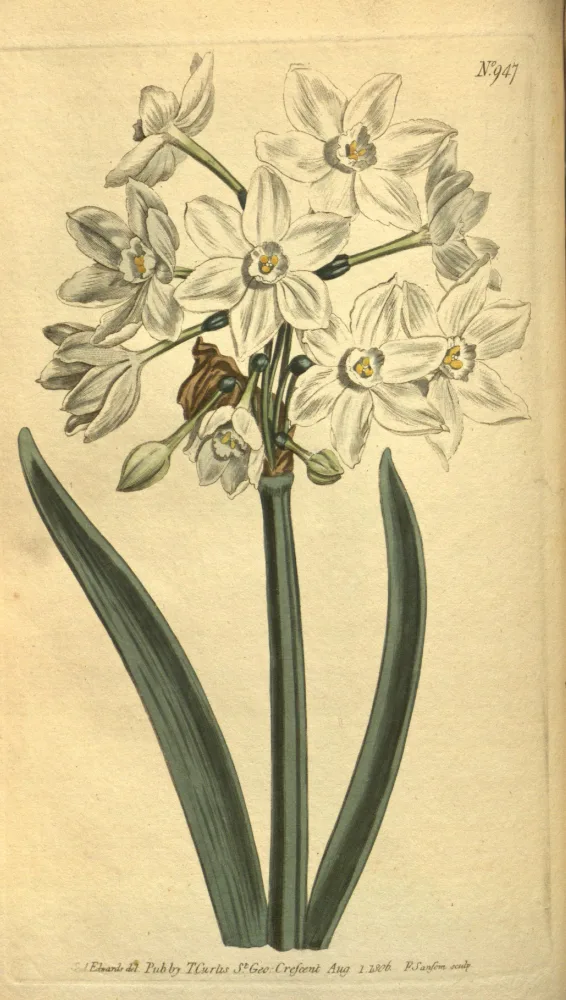
- Latin name
- Narcissus papyraceus
- Month
- December
- Meaning today
- good wishesNot the reading of 1884: Kate Greenaway gives “Egotism”.
The plant itself
| Family | Amaryllidaceae |
|---|---|
| Native to | the western Mediterranean — Portugal, Spain, Morocco and Algeria |
| Habit | perennial |
| Height | 30–45 cm |
| Flowers | November to March |
It flowers in midwinter without needing a cold period first, which is why paperwhite bulbs are sold to be grown in a bowl of pebbles indoors rather than planted out.
Where the names come from
The name, in English from the 1540s, is the Latin narcissus, from the Greek narkissos, a plant name that did not mean the modern narcissus and was possibly a kind of iris or lily. It has traditionally been linked with the Greek narkē, numbness, as in narcotic, for the plant's sedative alkaloids, though that link is now treated as folk etymology and the word's ending as a sign that it is older than Greek. The species name, papyraceus, is Latin for made of papyrus.
Where the meaning is written down
- As the dictionary prints it
- EgotismUnder the heading “Narcissus” in Kate Greenaway, Language of Flowers, 1884.
- As lists print it today
- Good wishesA different reading from the entry quoted here; the note below says where it differs.
Greenaway gives "egotism" for the narcissus, and Ingram's Flora Symbolica (1869) "self-love". Ingram's chapter is about "the white or poetical Narcissus", N. poeticus, so the sentiment belongs to the genus rather than to the paperwhite on this page, Narcissus papyraceus, which is the one forced indoors to flower at Christmas.
Is it poisonous?
Every part is harmful if eaten, the bulb most of all, because of lycorine; the RHS also lists it as a skin irritant, and the ASPCA lists Narcissus as toxic to dogs, cats and horses.
Each finding above names who made it: the ASPCA's poisonous plant database, the Royal Horticultural Society's harm ratings, or a published report. This is general information and not veterinary advice — if an animal or a person has eaten part of a plant, ring a vet or a poison line rather than reading a website.