Birthstone
Lapis lazuli
Usually described as deep blue flecked with gold.
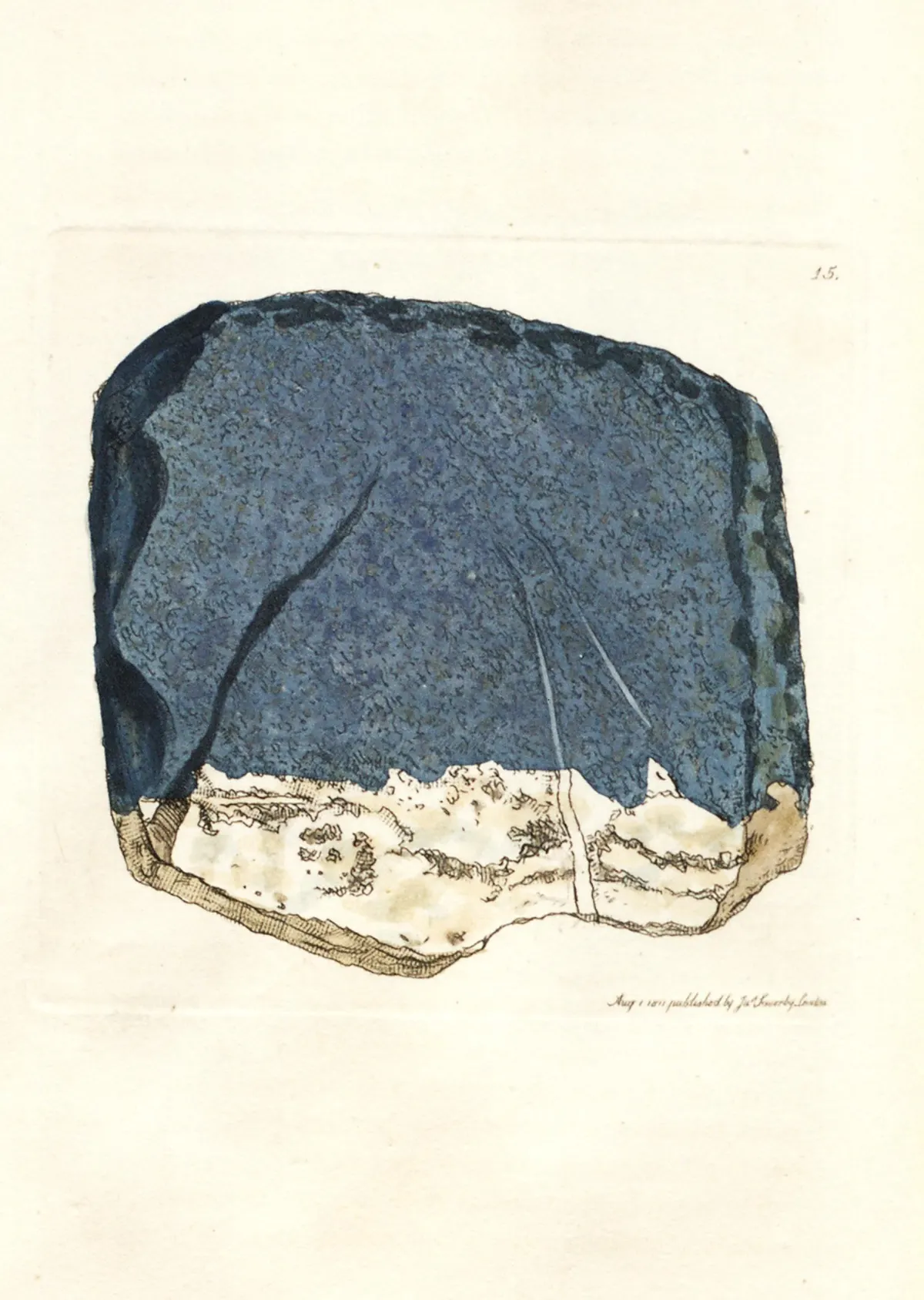
- Colour
- deep blue flecked with gold
- Month
- December
- Status
- 1912 onlyLapis lazuli was December's alternate stone on the 1912 list, and was taken off it in 1952 in favour of zircon. The two lists compared.
Name and history
The name is Medieval Latin for stone of azure: lapis, a stone, and lazuli, the genitive of lazulum, from the Arabic lazuward, the same word that gave English azure. Behind the Arabic is the Persian lajward, from Lajward, a place in Turkestan where the stone was collected, which Marco Polo mentions.
What it actually is
| Species | Lazurite — the principal mineral of the rock lapis lazuli, which also contains calcite, pyrite and diopside |
|---|---|
| Composition | (Na,Ca)₈(AlSiO₄)₆(SO₄,S,Cl)₂ |
| Crystal system | cubic |
| Hardness | 5–6 on the Mohs scale. Softer than the quartz in household dust, so it dulls with everyday wear. |
| Cleavage | imperfect on {110} in lazurite; the rock itself breaks unevenly |
| What makes the colour | not a transition metal at all — the blue comes from the trisulfur radical anion S₃⁻ trapped inside the lazurite framework; the brassy flecks are pyrite and the white veining is calcite |
| Mined in | Afghanistan, Chile, Russia, Pakistan, Tajikistan |
Hardness, composition and crystal system are standard mineralogical values. Where published sources disagree, the range given covers them.
How it gets damaged
Soft, porous and part calcite, so acids attack it — lemon juice, household cleaners and perspiration all dull the surface; solvents strip wax and dye, and ultrasonic and steam cleaners can loosen the rock's grain boundaries.
What is routinely done to it
Dyeing to deepen the blue and waxing or resin impregnation to improve polish are common, particularly on paler, calcite-rich material.
This describes the physical stone. Nothing on this site claims a gemstone has any therapeutic or healing effect — see the disclaimer.
Which list it is on
| Month | The 1912 list | Today's list |
|---|---|---|
| December | Alternate | — |