Birthstone
Opal
Usually described as iridescent.
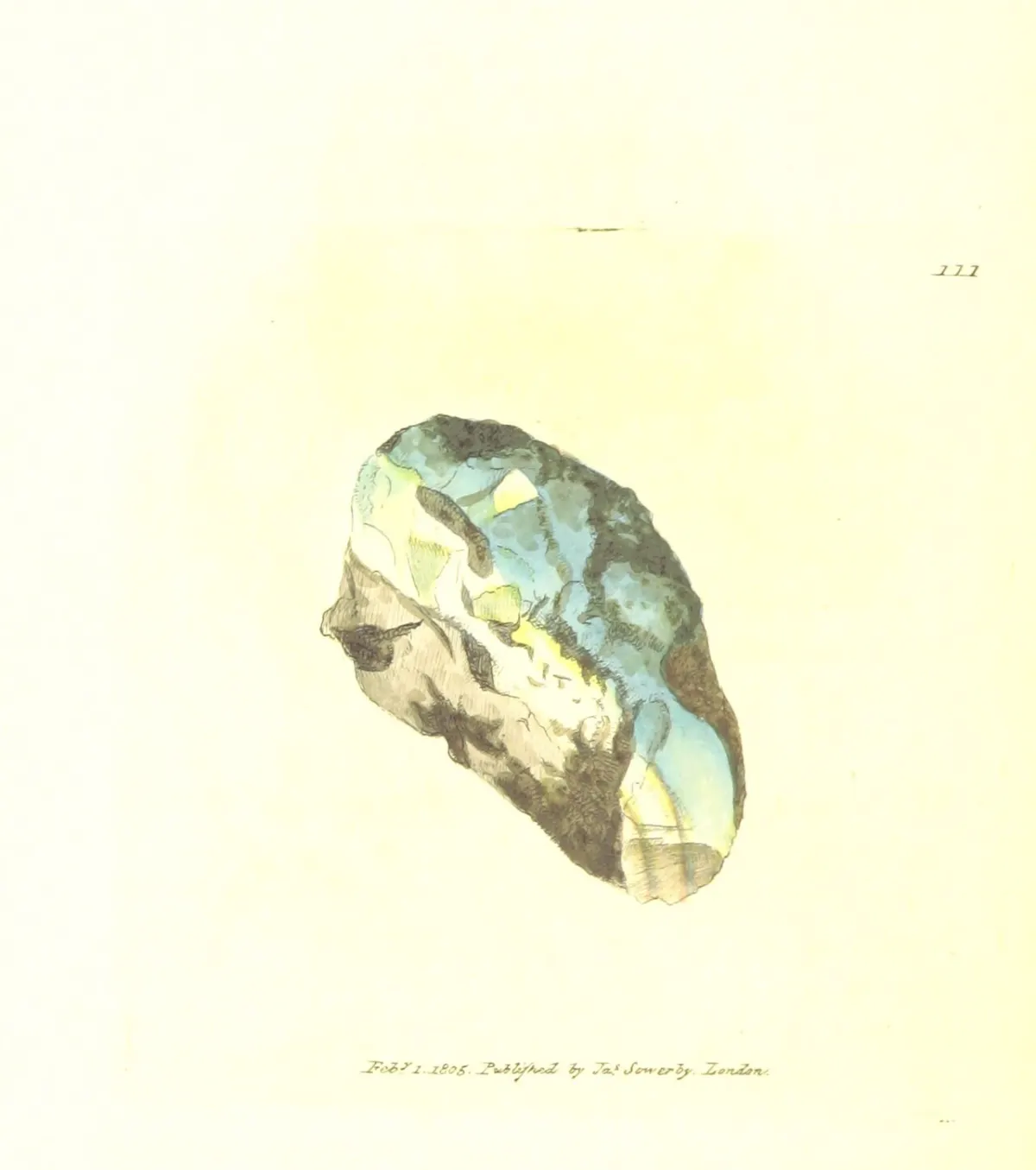
- Colour
- iridescent
- Month
- October
- Status
- 1912 and todayOn the list adopted in 1912, as a birth-stone, and still on today's. The two lists compared.
Name and history
The word came through French opalle from the Latin opalus used by Pliny, supposedly from a Greek opallios and possibly, further back, the Sanskrit upala, a gem or precious stone.
What it actually is
| Species | Opal — a mineraloid, not a mineral: amorphous hydrated silica |
|---|---|
| Composition | SiO₂·nH₂O |
| Crystal system | amorphous |
| Hardness | 5.5–6.5 on the Mohs scale. Softer than the quartz in household dust, so it dulls with everyday wear. |
| Cleavage | none; conchoidal to uneven fracture |
| What makes the colour | play-of-colour is not caused by any trace element: it is diffraction of light by a regular three-dimensional lattice of silica spheres roughly 150–300 nm across, with the colours set by sphere diameter and spacing according to Bragg's law; the separate body colour (white, grey, black, orange) comes from impurities such as iron oxides and from included carbon |
| Mined in | Australia, Ethiopia, Mexico, Brazil, United States |
Hardness, composition and crystal system are standard mineralogical values. Where published sources disagree, the range given covers them.
How it gets damaged
It holds 3–21% water, so heat, dry air and sudden temperature change can craze it into a network of fine surface cracks; porous hydrophane opal absorbs water, oils and dyes and may go temporarily transparent, and ultrasonic and steam cleaners must never be used.
What is routinely done to it
Australian opal is usually untreated, but Ethiopian material is frequently smoke-, sugar- or dye-treated to darken the body tone and make the play-of-colour read more strongly, and impregnation with oil, wax or polymer is also seen.
This describes the physical stone. Nothing on this site claims a gemstone has any therapeutic or healing effect — see the disclaimer.
Which list it is on
| Month | The 1912 list | Today's list |
|---|---|---|
| October | Birth-stone | Yes |