Birthstone
Sapphire
Usually described as blue, and most other colours.
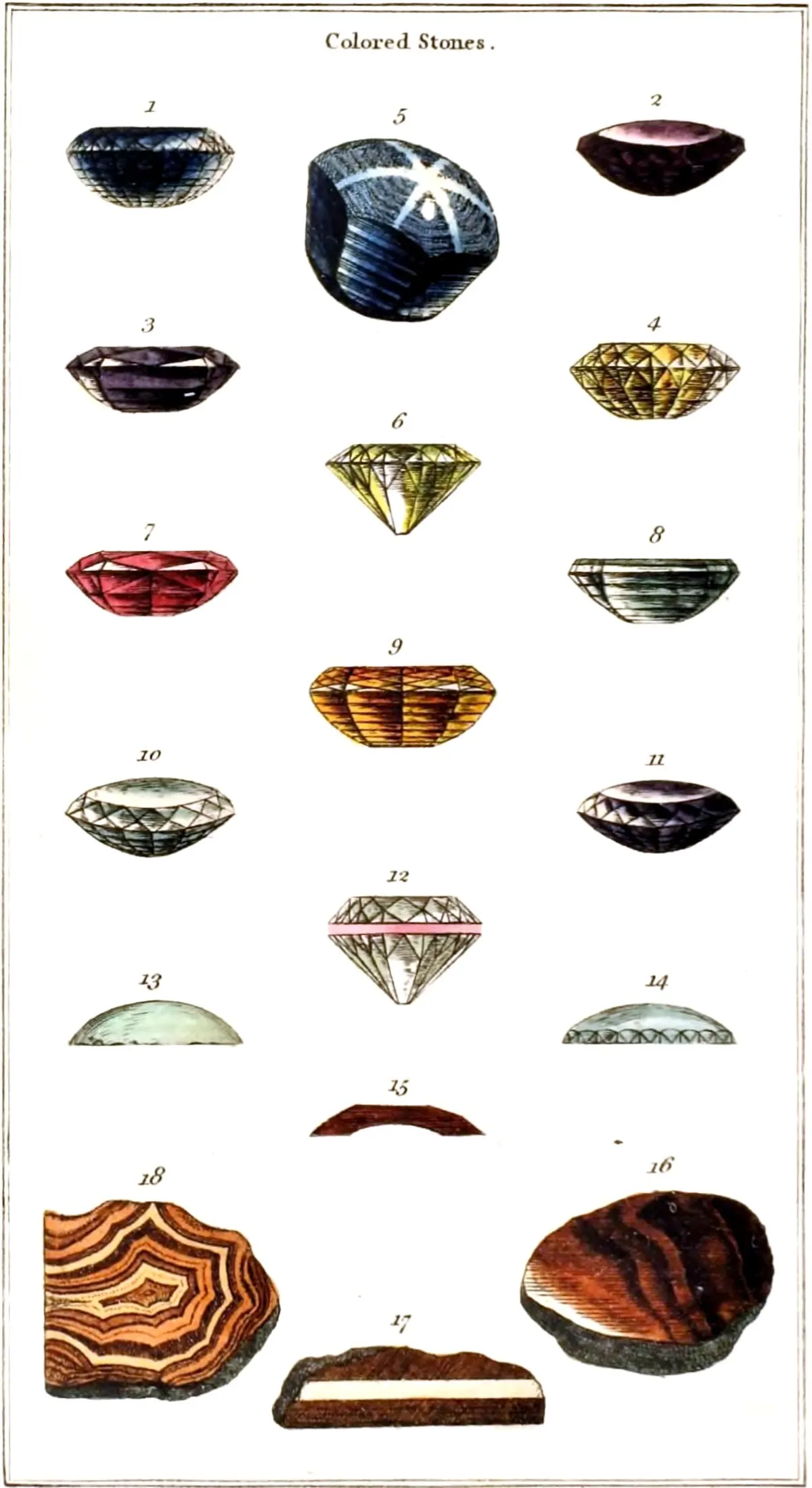
- Colour
- blue, and most other colours
- Month
- September
- Status
- 1912 and todayOn the list adopted in 1912, as a birth-stone, and still on today's. The two lists compared.
Name and history
The word came through Old French saphir and Latin sapphirus from the Greek sappheiros, the name of a blue precious stone, though the stone the Greeks meant was apparently not today's sapphire and was perhaps lapis lazuli.
What it actually is
| Species | Corundum |
|---|---|
| Composition | Al₂O₃ |
| Crystal system | trigonal |
| Hardness | 9 on the Mohs scale. Harder than anything it is likely to meet. |
| Cleavage | none; parting in up to three directions |
| What makes the colour | iron and titanium together — blue comes from Fe²⁺–Ti⁴⁺ intervalence charge transfer, needing only a few hundredths of a percent of each; iron alone gives yellow and green, and chromium with iron and titanium gives the orange-pink of padparadscha |
| Mined in | Sri Lanka, Madagascar, Myanmar, Australia, United States |
Hardness, composition and crystal system are standard mineralogical values. Where published sources disagree, the range given covers them.
How it gets damaged
Extremely hard and suitable for everyday wear, but parting planes make it brittle under a hard blow; diffusion-treated stones can lose colour if recut or repolished, and fracture-filled material should stay out of ultrasonic cleaners and away from a torch.
What is routinely done to it
Heating between roughly 800 °C and 1,800 °C is routine and can induce as well as improve blue; lattice diffusion with beryllium or titanium is used on some material and must be disclosed, as it colours only a shallow layer.
This describes the physical stone. Nothing on this site claims a gemstone has any therapeutic or healing effect — see the disclaimer.
Which list it is on
| Month | The 1912 list | Today's list |
|---|---|---|
| September | Birth-stone | Yes |