Birthstone
Topaz
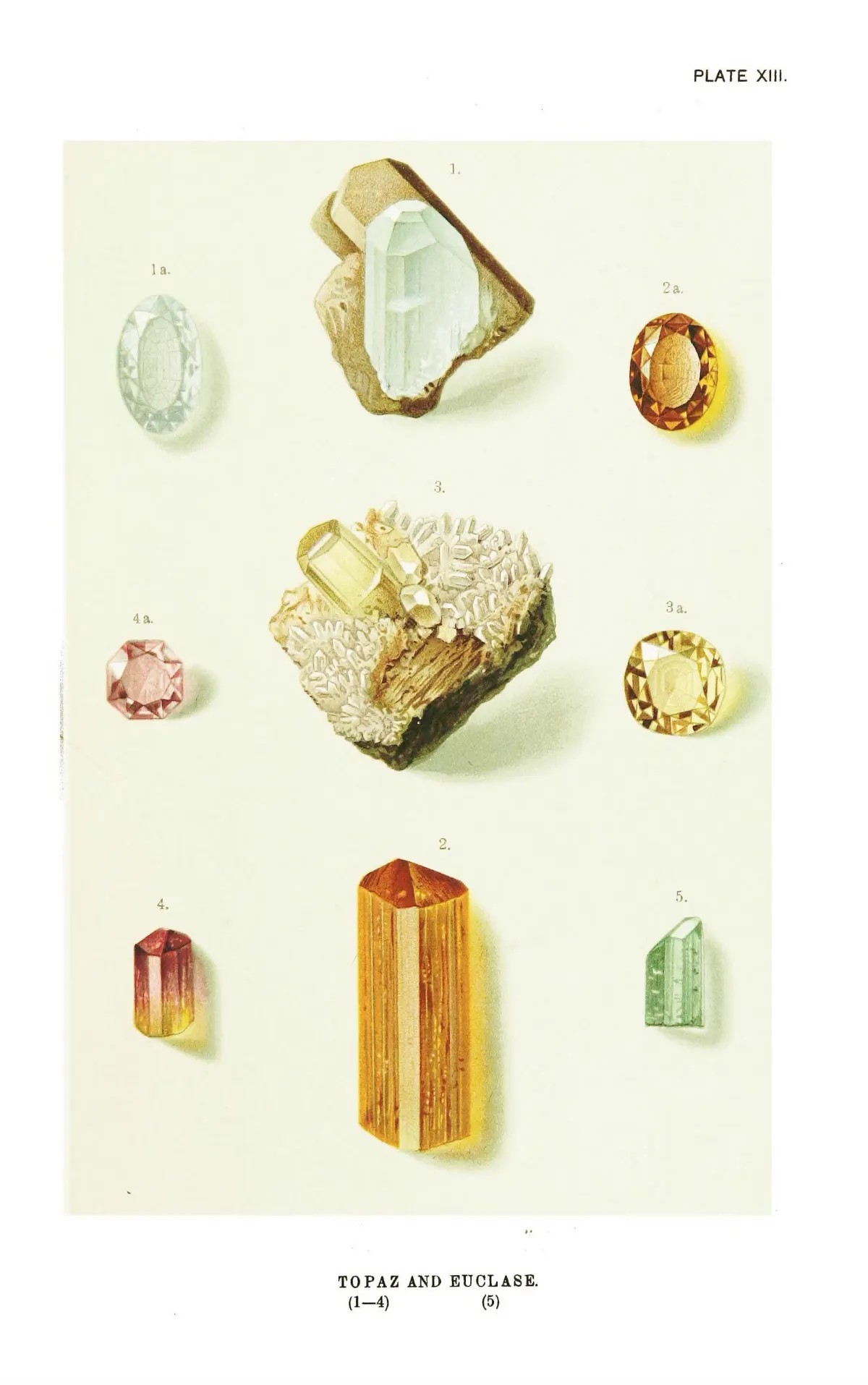
Usually described as golden to blue.
- Colour
- golden to blue
- Month
- November
- Status
- 1912 and todayOn the list adopted in 1912, as a birth-stone, and still on today's. The two lists compared.
Name and history
The name comes through Old French topace and Latin topazus from the Greek topazos, of obscure origin. Pliny said it was named after a remote island in the Red Sea, a story that may be folk etymology.
What it actually is
| Species | Topaz |
|---|---|
| Composition | Al₂SiO₄(F,OH)₂ |
| Crystal system | orthorhombic |
| Hardness | 8 on the Mohs scale. Hard enough for daily wear; dust will not scratch it. |
| Cleavage | perfect in one direction (basal, {001}) |
| What makes the colour | chromium replacing aluminium gives pink, red and the red-orange of imperial topaz; brown, yellow, and the rare natural blue come from colour centres in the lattice rather than from a metal ion |
| Mined in | Brazil, Nigeria, Sri Lanka, Pakistan, Mexico |
Hardness, composition and crystal system are standard mineralogical values. Where published sources disagree, the range given covers them.
How it gets damaged
Hard but with one perfect cleavage running right through the crystal, so a sharp knock or thermal shock can split it cleanly in two; keep it out of ultrasonic and steam cleaners, and note that some brown and orange topaz fades in sunlight.
What is routinely done to it
Almost all blue topaz on the market is colourless material that has been irradiated and then heated; pink is produced by heating yellowish-pink stones to burn off the yellow.
This describes the physical stone. Nothing on this site claims a gemstone has any therapeutic or healing effect — see the disclaimer.
Which list it is on
| Month | The 1912 list | Today's list |
|---|---|---|
| November | Birth-stone | Yes |