Birthstone
Tourmaline
Usually described as almost any colour.
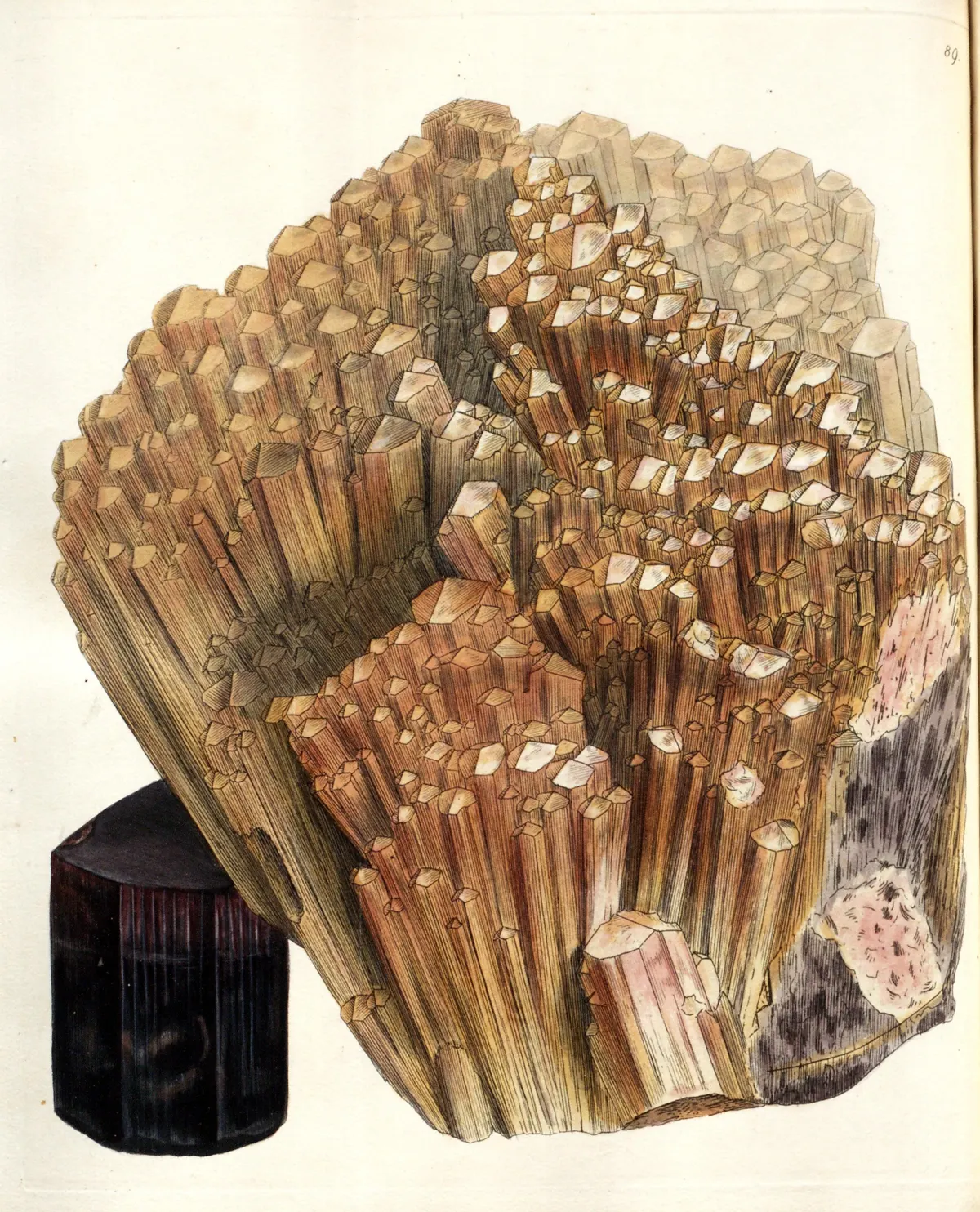
- Colour
- almost any colour
- Month
- October
- Status
- 1912 and todayOn the list adopted in 1912, as an alternate stone, and still on today's. The two lists compared.
Name and history
The word came into English through French or German and is said to go back to the Sinhalese toramalli, a general name for cornelian; the mineral first came to Europe from Ceylon.
What it actually is
| Species | Tourmaline group (elbaite is the usual gem species) |
|---|---|
| Composition | Na(Li,Al)₃Al₆(Si₆O₁₈)(BO₃)₃(OH)₄ (elbaite) |
| Crystal system | trigonal |
| Hardness | 7–7.5 on the Mohs scale. About as hard as the quartz in household dust. |
| Cleavage | poor (indistinct); uneven to conchoidal fracture |
| What makes the colour | the group takes almost any colour because almost any element fits its lattice — iron for green, blue and near-black, manganese for pink and red, copper for the Paraíba blues and greens, vanadium for chrome tourmaline; some pink and yellow comes from radiation-induced colour centres rather than an element |
| Mined in | Brazil, Nigeria, Mozambique, Madagascar, Afghanistan |
Hardness, composition and crystal system are standard mineralogical values. Where published sources disagree, the range given covers them.
How it gets damaged
Hard enough for most wear but brittle and often internally fractured, and it is strongly pyroelectric and piezoelectric, so it attracts dust when warmed; avoid ultrasonic and steam cleaners and sudden temperature change, which can widen existing fractures.
What is routinely done to it
Heating to lighten over-dark green and blue stones and irradiation to deepen pink and red are both common and should be disclosed.
This describes the physical stone. Nothing on this site claims a gemstone has any therapeutic or healing effect — see the disclaimer.
Which list it is on
| Month | The 1912 list | Today's list |
|---|---|---|
| October | Alternate | Yes |