Birthstone
Turquoise
Usually described as sky blue to green.
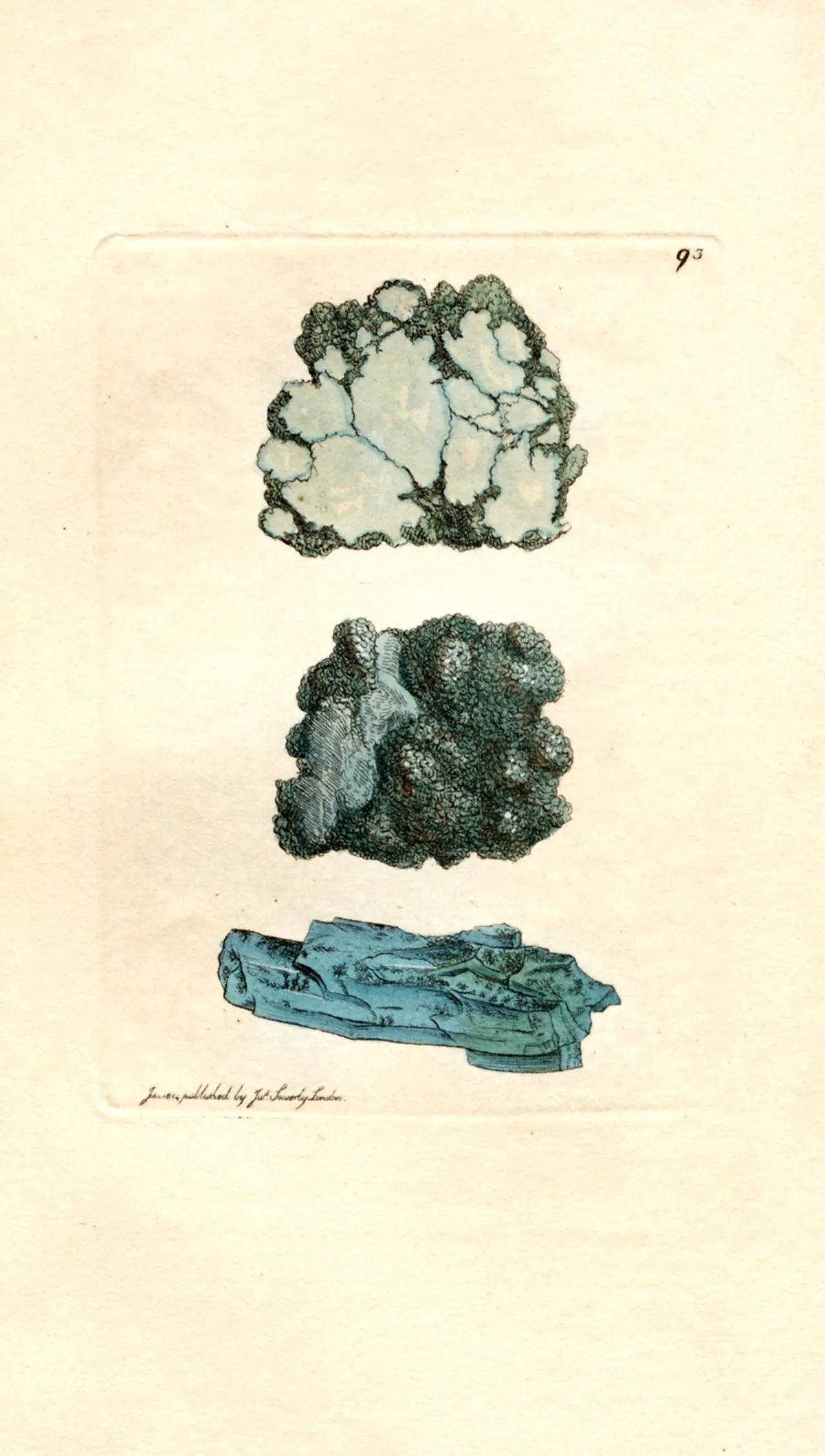
- Colour
- sky blue to green
- Month
- December
- Status
- 1912 and todayOn the list adopted in 1912, as a birth-stone, and still on today's. The two lists compared.
Name and history
The name is French for Turkish, from pierre turqueise, the Turkish stone, because it first reached Europe from Turkestan or through Turkish lands. The English word dates from the 1560s, when it replaced the Middle English turkeis.
What it actually is
| Species | Turquoise |
|---|---|
| Composition | CuAl₆(PO₄)₄(OH)₈·4H₂O |
| Crystal system | triclinic |
| Hardness | 5–6 on the Mohs scale. Softer than the quartz in household dust, so it dulls with everyday wear. |
| Cleavage | perfect on {001} and good on {010}, but almost never seen because gem turquoise is a massive cryptocrystalline aggregate |
| What makes the colour | copper, which is an essential component rather than a trace, gives the blue; iron substituting for aluminium shifts it towards green, and the darker matrix is the host rock |
| Mined in | China, United States, Iran, Mexico, Egypt |
Hardness, composition and crystal system are standard mineralogical values. Where published sources disagree, the range given covers them.
How it gets damaged
Soft and porous, so it absorbs whatever it meets: perspiration, cosmetics, sunscreen and oils discolour it permanently, solvents lift dye and wax, heat dehydrates and cracks it, and ultrasonic and steam cleaners must not be used.
What is routinely done to it
Most commercial turquoise is stabilised — impregnated with polymer, wax or plastic to harden it and deepen the colour — and dyeing and reconstitution from powder are also common.
This describes the physical stone. Nothing on this site claims a gemstone has any therapeutic or healing effect — see the disclaimer.
Which list it is on
| Month | The 1912 list | Today's list |
|---|---|---|
| December | Birth-stone | Yes |