Birthstone
Zircon
Usually described as blue, golden, colourless.
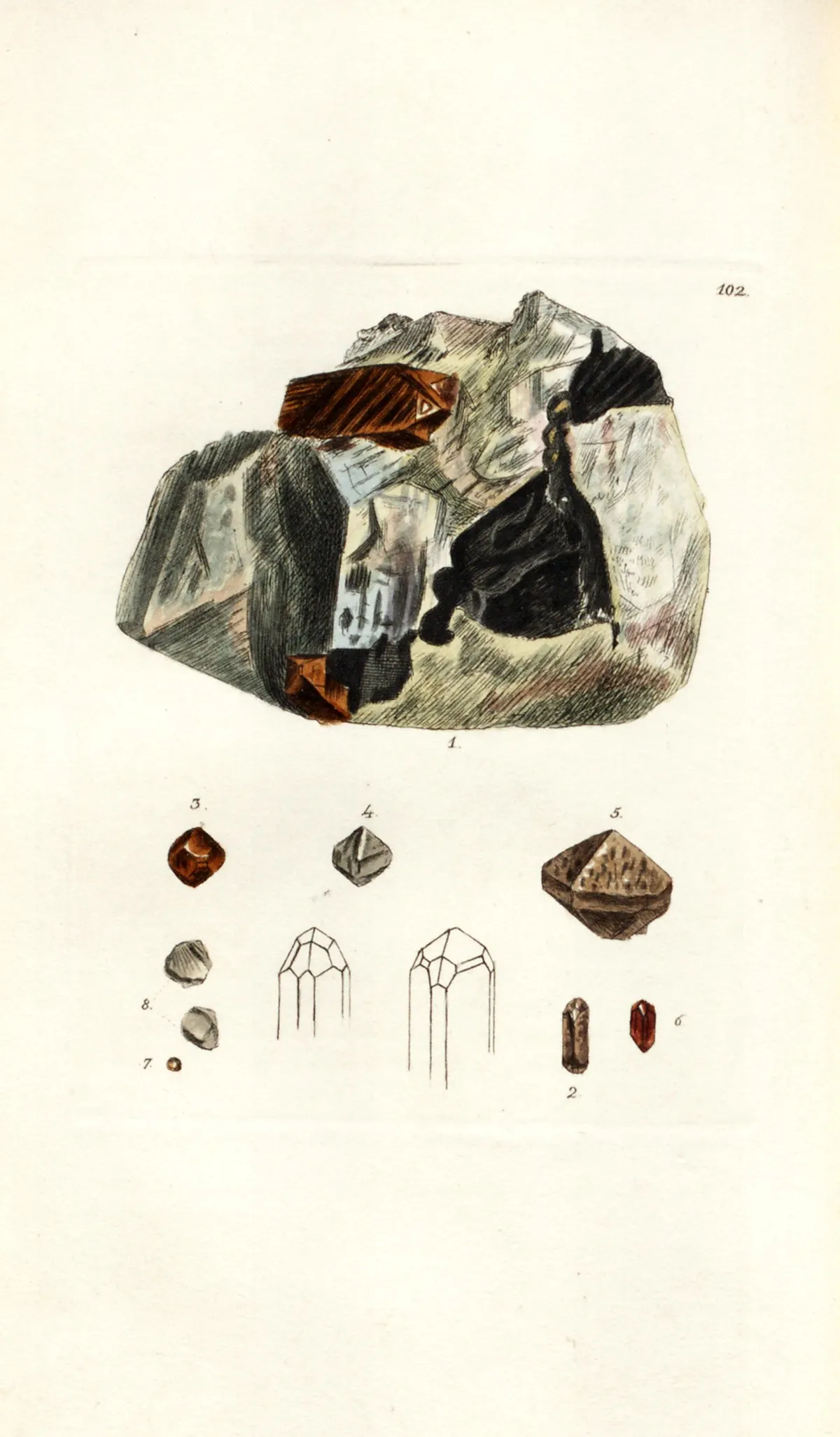
- Colour
- blue, golden, colourless
- Month
- December
- Status
- Added laterZircon was added to December in 1952 by the Jewelry Industry Council of America, in place of lapis lazuli. The two lists compared.
Name and history
The name is the German Zirkon, probably from the French jargon, a loose name for fine stones that looked like diamonds, and behind that the Medieval Latin jargonce, whose origin is uncertain.
What it actually is
| Species | Zircon |
|---|---|
| Composition | ZrSiO₄ |
| Crystal system | tetragonal |
| Hardness | 6–7.5 on the Mohs scale. Some stones are softer than the quartz in household dust and some a little harder, so it varies with the stone. |
| Cleavage | imperfect on {110}, poor on {111}; brittle, conchoidal fracture |
| What makes the colour | traces of uranium, thorium, rare earth elements and iron, compounded by radiation damage from the uranium and thorium the crystal contains; that damage (metamictisation) breaks the lattice down over geological time, lowering hardness, density and refractive index and shifting the colour, while the common blue is almost always produced by heating brown stones |
| Mined in | Cambodia, Sri Lanka, Myanmar, Tanzania, Australia |
Hardness, composition and crystal system are standard mineralogical values. Where published sources disagree, the range given covers them.
How it gets damaged
Hardness varies with how metamict the stone is, from about 6 for low-type material to 7.5 for high-type, and it is brittle enough that facet edges abrade in wear; avoid ultrasonic cleaners and prolonged sunlight on heat-treated blue and colourless stones.
What is routinely done to it
Heating brown zircon to 800–1,000 °C to produce blue or colourless stones is routine; some heat-induced colour is unstable and can revert with strong light or further heat.
This describes the physical stone. Nothing on this site claims a gemstone has any therapeutic or healing effect — see the disclaimer.
Which list it is on
| Month | The 1912 list | Today's list |
|---|---|---|
| December | — | Yes |