Minor arcana
Swords
Fourteen cards — ace to ten, then Page, Knight, Queen and King. Attributed to air, and the counterpart of spades in an ordinary playing-card pack.
- Element
- AirAttributed by the Golden Dawn, which Waite's deck follows.
- Taken to cover
- thought, conflict and the trouble thinking bringsReported from tradition, not asserted.
- Playing-card suit
- SpadesThe tarot pack and the 52-card pack share an ancestor.
- Cards
- 14Ten numbered, four court.
The ten numbered cards
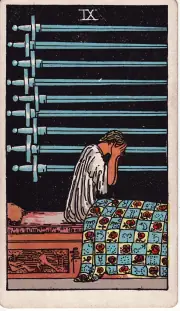
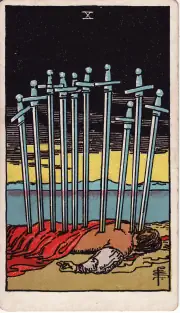
Smith's number cards were the innovation of this deck. The court cards had always shown figures, but the packs in ordinary use printed the Five of Swords as five swords set out in a pattern, and Smith drew a scene on every one of the forty. A few older packs had pictures on their number cards too, the Sola Busca of about 1490 among them, but this was the one that made it usual, and it is the main reason this deck, rather than any older one, is the deck most people picture.
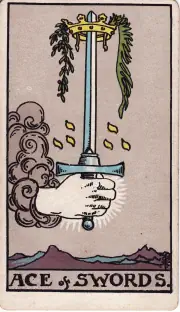
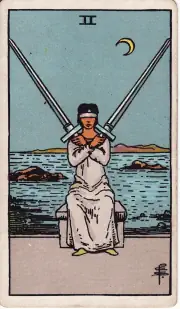
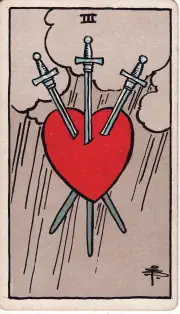
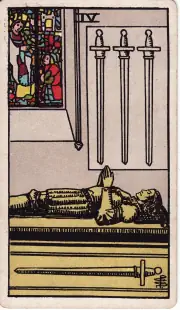
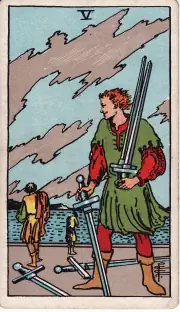
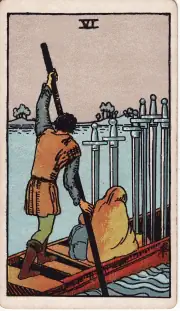
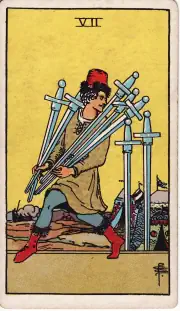
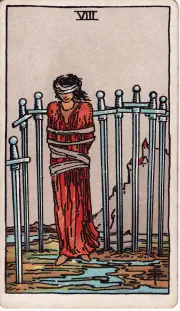
The court
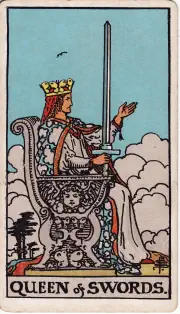
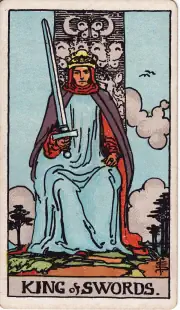
Waite's meanings, all fourteen
| Card | Upright |
|---|---|
| Ace | Triumph, the excessive degree in everything, conquest, triumph of force. It is a card of great force, in love as well as in hatred. The crown may carry a much higher significance than comes usually within the sphere of fortune-telling. |
| Two | Conformity and the equipoise which it suggests, courage, friendship, concord in a state of arms; another reading gives tenderness, affection, intimacy. The suggestion of harmony and other favourable readings must be considered in a qualified manner, as Swords generally are not symbolical of beneficent forces in human affairs. |
| Three | Removal, absence, delay, division, rupture, dispersion, and all that the design signifies naturally, being too simple and obvious to call for specific enumeration. |
| Four | Vigilance, retreat, solitude, hermit's repose, exile, tomb and coffin. It is these last that have suggested the design. |
| Five | Degradation, destruction, revocation, infamy, dishonour, loss, with the variants and analogues of these. |
| Six | Journey by water, route, way, envoy, commissionary, expedient. |
| Seven | Design, attempt, wish, hope, confidence; also quarrelling, a plan that may fail, annoyance. The design is uncertain in its import, because the significations are widely at variance with each other. |
| Eight | Bad news, violent chagrin, crisis, censure, power in trammels, conflict, calumny; also sickness. |
| Nine | Death, failure, miscarriage, delay, deception, disappointment, despair. |
| Ten | Whatsoever is intimated by the design; also pain, affliction, tears, sadness, desolation. It is not especially a card of violent death. |
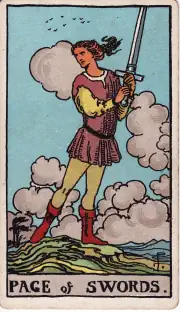
| Page | Authority, overseeing, secret service, vigilance, spying, examination, and the qualities thereto belonging. |
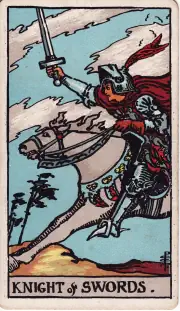
| Knight | Skill, bravery, capacity, defence, address, enmity, wrath, war, destruction, opposition, resistance, ruin. There is therefore a sense in which the card signifies death, but it carries this meaning only in its proximity to other cards of fatality. |
| Queen | Widowhood, female sadness and embarrassment, absence, sterility, mourning, privation, separation. |
| King | Whatsoever arises out of the idea of judgment and all its connexions—power, command, authority, militant intelligence, law, offices of the crown, and so forth. |
Quoted, not summarised. Nothing here is a claim that a card means anything.