Birth flower
Carnation
Dianthus caryophyllus. In the language of flowers, as lists print it today, it stands for devotion. Kate Greenaway's dictionary of 1884 gives it another: “Woman's love”. It is a custom of sentiment, not a scientific or official designation.
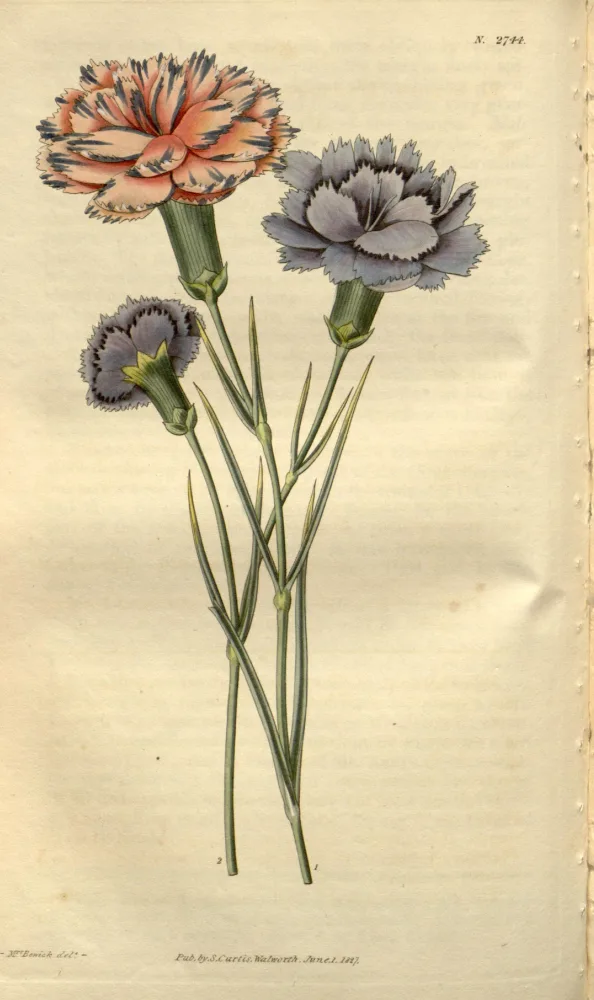
- Latin name
- Dianthus caryophyllus
- Month
- January
- Meaning today
- devotionNot the reading of 1884: Kate Greenaway gives “Woman's love”.
The plant itself
| Family | Caryophyllaceae |
|---|---|
| Native to | the Balkan Peninsula |
| Habit | perennial |
| Height | 30–80 cm |
| Flowers | May to August |
Wild carnations cannot make a blue or violet pigment because the genus lacks the flavonoid 3',5'-hydroxylase gene needed for delphinidin; the violet 'Moondust' and 'Moonshadow' carnations are transgenic plants given that gene, and were among the first genetically modified ornamental flowers sold commercially.
Where the names come from
Where the English name comes from is uncertain. It is recorded from the 1530s, and its early spellings suggest a corruption of coronation, perhaps because the flowers were worn in garlands or because the toothed petals look like a crown; the rival idea is the French carnation, the colour of flesh, from the Latin caro, though that colour does not fit every carnation. The genus name, Dianthus, is made from the Greek for holy and flower. The species name, caryophyllus, was first given to the clove and then, for the similar smell, to the clove pink.
Where the meaning is written down
- As the dictionary prints it
- Woman's loveUnder the heading “Pink, Carnation” in Kate Greenaway, Language of Flowers, 1884.
- As lists print it today
- DevotionA different reading from the entry quoted here; the note below says where it differs.
Greenaway has no entry for a plain carnation: she lists it only by colour (deep red, striped, yellow) and gives "woman's love" under "Pink, Carnation".
Is it poisonous?
The ASPCA lists Dianthus caryophyllus as toxic to dogs, cats and horses, causing mild gastrointestinal signs and mild dermatitis from an unidentified irritant; the RHS separately flags the plant as a skin allergen.
Each finding above names who made it: the ASPCA's poisonous plant database, the Royal Horticultural Society's harm ratings, or a published report. This is general information and not veterinary advice — if an animal or a person has eaten part of a plant, ring a vet or a poison line rather than reading a website.