Birth flower
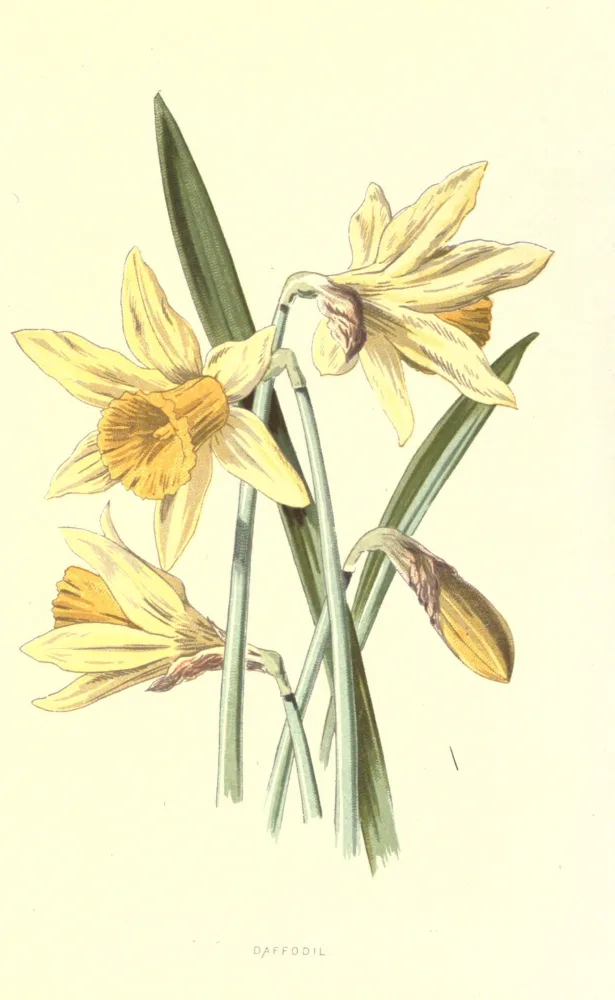
Daffodil
Narcissus pseudonarcissus. In the language of flowers, as lists print it today, it stands for new beginnings. Kate Greenaway's dictionary of 1884 gives it another: “Regard”. It is a custom of sentiment, not a scientific or official designation.
- Latin name
- Narcissus pseudonarcissus
- Month
- March
- Meaning today
- new beginningsNot the reading of 1884: Kate Greenaway gives “Regard”.
The plant itself
| Family | Amaryllidaceae |
|---|---|
| Native to | western Europe |
| Habit | perennial |
| Height | 25–50 cm |
| Flowers | March to April |
Daffodils are a pharmaceutical crop: galanthamine, one of the few drugs approved for the palliative treatment of mild to moderate Alzheimer's disease, is extracted in Europe at industrial scale from the bulbs of the cultivar 'Carlton'.
Where the names come from
Daffodil began as a variant of the Middle English affodill, asphodel, from the Medieval Latin affodillus and the Latin asphodelus. In the 1540s the word still meant the asphodel, and it was first used for the yellow spring narcissus in the 1590s. The d at the front may be the Dutch article fused onto the word, since the Netherlands supplied the bulbs. The genus name, Narcissus, is the Greek Narkissos, the youth of Greek myth known for his beauty and his pride.
Where the meaning is written down
- As the dictionary prints it
- RegardUnder the heading “Daffodil” in Kate Greenaway, Language of Flowers, 1884.
- As lists print it today
- New beginningsA different reading from the entry quoted here; the note below says where it differs.
The sources disagree: Greenaway gives "regard", while Ingram's Flora Symbolica (1869) gives "unrequited love".
Is it poisonous?
The ASPCA lists Narcissus species as toxic to dogs, cats and horses through lycorine and related alkaloids, and states that the bulbs are the most poisonous part. Separately, the sap contains calcium oxalate crystals, the cause of the irritant dermatitis known as daffodil pickers' rash.
Each finding above names who made it: the ASPCA's poisonous plant database, the Royal Horticultural Society's harm ratings, or a published report. This is general information and not veterinary advice — if an animal or a person has eaten part of a plant, ring a vet or a poison line rather than reading a website.