Birth flower
Gladiolus
In the language of flowers, as lists print it today, it stands for strength of character. John Ingram's dictionary of 1869 gives it another: “Ready armed”. It is a custom of sentiment, not a scientific or official designation.
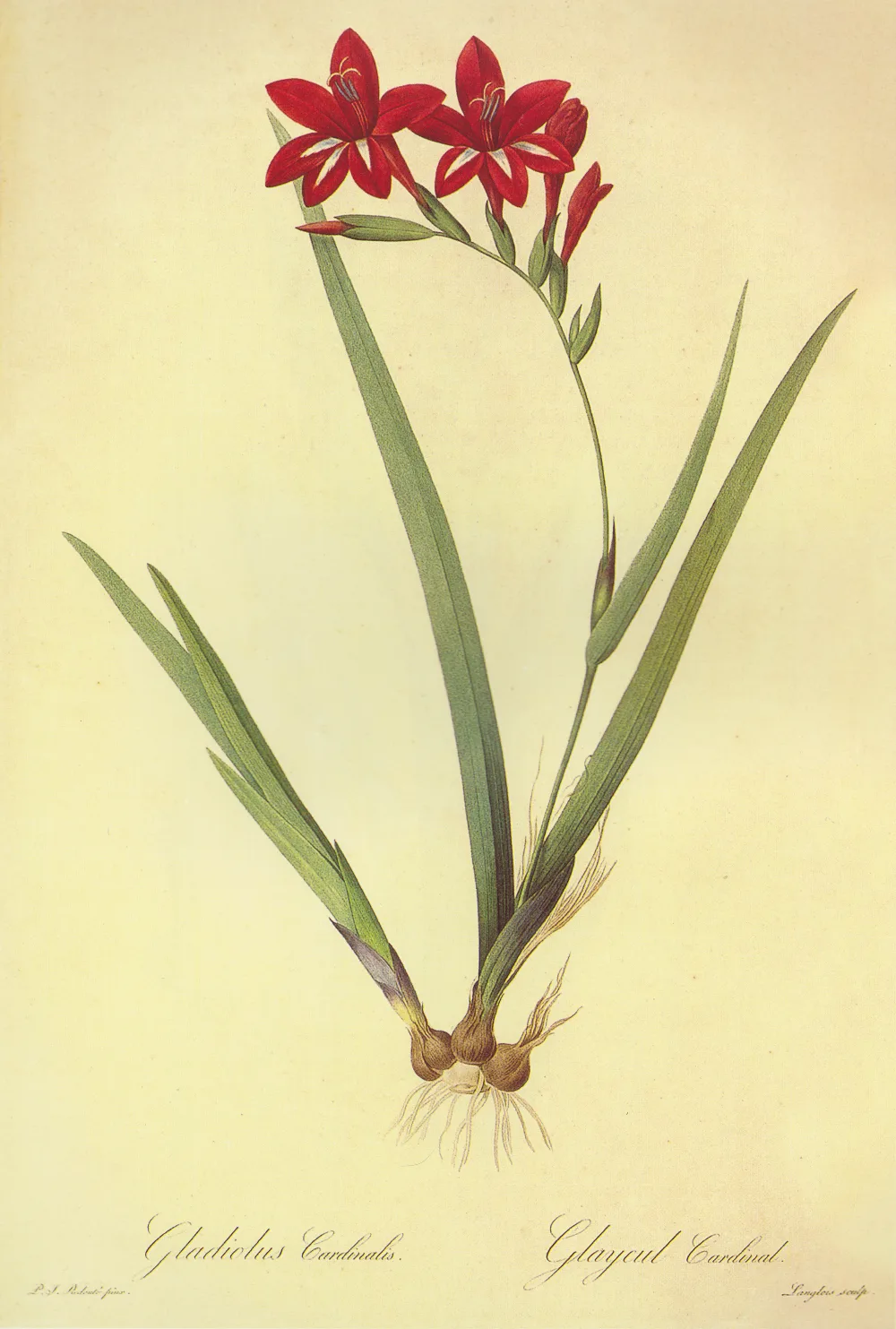
- Latin name
- Gladiolus
- Month
- August
- Meaning today
- strength of characterNot the reading of 1869: John Ingram gives “Ready armed”.
The plant itself
| Family | Iridaceae |
|---|---|
| Native to | Europe to Iran and Arabia and across Africa, with most species in southern Africa |
| Habit | perennial |
| Height | 45 cm–1.8 m |
| Flowers | August to September |
Of roughly 300 accepted species the great majority are southern African, and the summer-flowering garden hybrids were bred from them.
Where the names come from
Gladiolus is Latin for a little sword, the diminutive of gladius, the word behind gladiator; Pliny gave the plant the name for its sword-shaped leaves. It has been in English since about the year 1000, when it meant the wild iris and the Old English form was gladdon, and the modern use may be a fresh borrowing from Latin in the 1560s.
Where the meaning is written down
- As the dictionary prints it
- Ready armedUnder the heading “Gladioli” in John H. Ingram, Flora Symbolica, 1869.
- As lists print it today
- Strength of characterA different reading from the entry quoted here; the note below says where it differs.
Ingram's entry is "gladioli: ready armed", a pun on the sword-shaped leaves. The gladiolus is absent from Greenaway (1884), Shoberl (1836), Tyas (1842) and Dumont (1851); the modern "strength of character" and "remembrance" meanings appear in no historical source consulted.
Is it poisonous?
The ASPCA lists Gladiolus species as toxic to dogs, cats and horses, causing salivation, drooling, vomiting, lethargy and diarrhoea, with the highest concentration in the corms.
Each finding above names who made it: the ASPCA's poisonous plant database, the Royal Horticultural Society's harm ratings, or a published report. This is general information and not veterinary advice — if an animal or a person has eaten part of a plant, ring a vet or a poison line rather than reading a website.