The month

Born in August

Written . By the BirthAlmanac team.

Star signs
Leo, then VirgoThe sun moves into Virgo on the 22nd, 23rd or 24th.
Birthstones
Peridot, spinel and sardonyxThe 1912 list gave sardonyx and peridot.
Birth flowers
Gladiolus and poppyThe gladiolus for strength of character, the poppy for remembrance, as usually given today.
Days
31Days 213 to 243 of a common year, 214 to 244 of a leap year.

Where the name comes from

August was Sextilis, the sixth month, until 8 BC, when it was renamed in honour of the emperor Augustus. The story that a day was taken from February to make his month as long as Julius Caesar's is a medieval invention, traced to the thirteenth-century scholar Johannes de Sacrobosco: Sextilis already had 31 days in Caesar's calendar.

The season, north and south

In the north August is late summer, the holiday month across much of Europe, with the evenings starting to shorten noticeably. In the south it is late winter turning to spring: the days lengthen and the first fruit blossom appears, while in the summer-rainfall regions of South Africa the dry season, and the risk of veld fires, lasts until the spring rain. On the West Coast and in Namaqualand the winter rain brings out the wild flowers from the second half of the month.

The star signs of August

An August birthday begins as Leo. Between 1920 and 2026 the sun moved into Virgo on the 22nd of August in 17 years (the first in 1980), the 23rd in 83 and the 24th in 7 (the last in 1947), in universal time. A birthday on 22 August, 23 August or 24 August is therefore Leo or Virgo depending on the year, and in the year of a crossing on the hour; the page for each of those dates gives the sign and the moment of the crossing for every year.

Every other date in August had one sign all day in every one of those years: Leo up to the 21st and Virgo from the 25th.

In the astrological tradition Leo is a fire sign and a fixed one, ruled by the Sun. Printed tables give it as 23 July – 22 August; between 1920 and 2026 the sun entered it on the 22nd or 23rd of July and left it on the 22nd, 23rd or 24th of August.

In the astrological tradition Virgo is an earth sign and a mutable one, ruled by Mercury. Printed tables give it as 23 August – 22 September; between 1920 and 2026 the sun entered it on the 22nd, 23rd or 24th of August and left it on the 22nd, 23rd or 24th of September.

Every date in August. The marked dates are the ones on which the sun changed sign in at least one year since 1920.

August's birthstones

August's list has grown from two stones to three. The list drawn up in 1912 made sardonyx the birth-stone and peridot its alternate; today's gives peridot, spinel, the newest stone on the whole list, and sardonyx. Peridot is the gem form of olivine, and because the iron that colours it is part of the mineral rather than a trace, it is one of the few gems that only ever come in one colour, green. Spinel was mistaken for ruby for centuries: the Black Prince's Ruby, set in the front of the Imperial State Crown, is a spinel. Sardonyx is banded chalcedony, reddish-brown sard layered with white, and Roman engravers cut seals and cameos in it because a carving through the layers shows one colour against the other.

Stone1912 listToday's listChange
PeridotAlternateYes—
Spinel—YesAdded to August in 2016 by the American Gem Trade Association and Jewelers of America.
SardonyxBirth-stoneYes—

The 1912 list is the one the National Association of Jewelers adopted at Kansas City that August, as G. F. Kunz printed it in The Curious Lore of Precious Stones (1913), with a birth-stone for each month and an alternate for some; today's list is the one GIA publishes. The two lists compared →
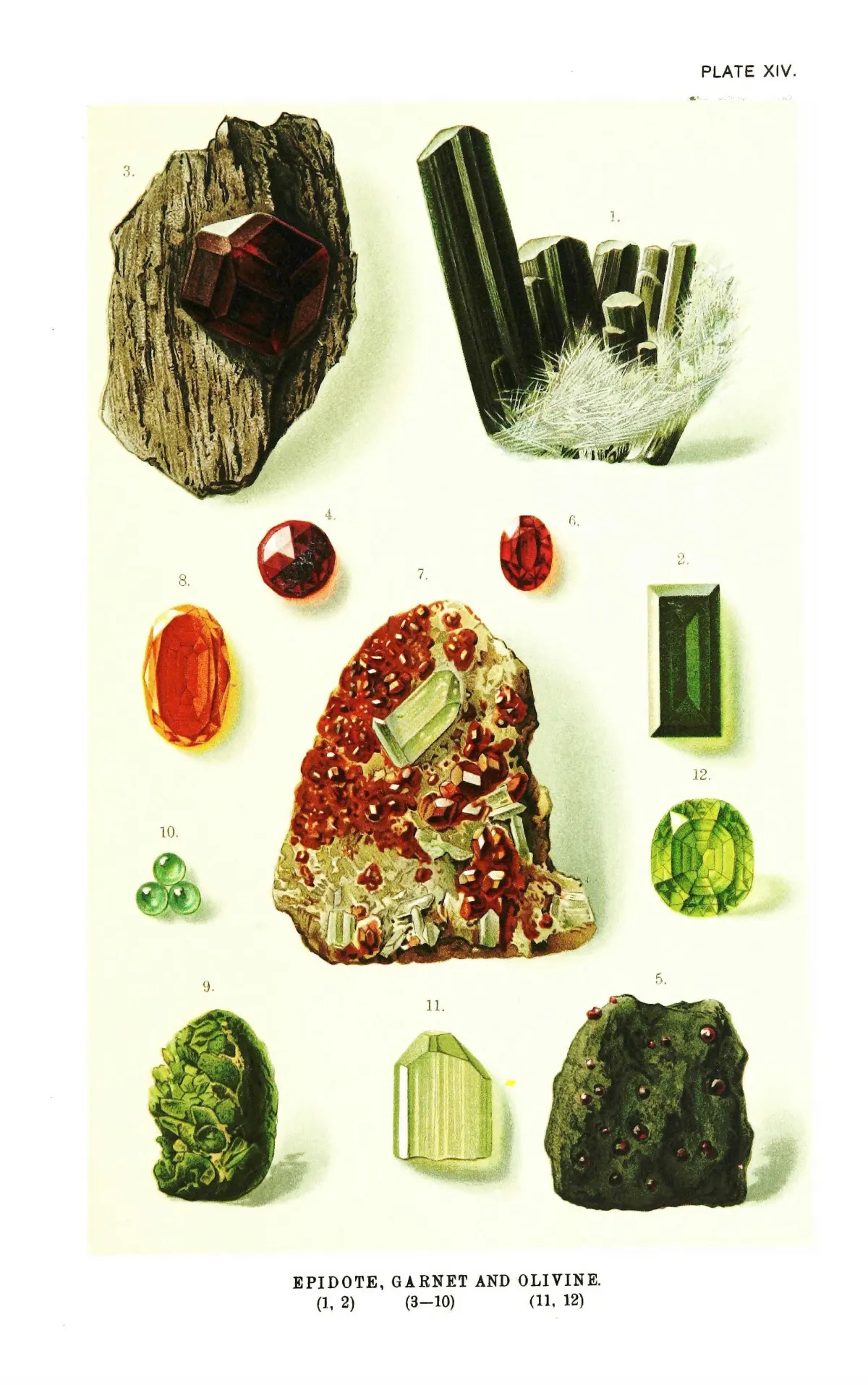
A chromolithograph headed Epidote, Garnet and Olivine. Low on the plate a pale yellow-green olivine crystal with a flat terminated top, and at the right the same stone cut as a vivid grass-green oval, among dark red garnets and green epidote.
Olivine (Chrysolite) · E. Ohmann, figures 11 and 12 · Precious Stones (Max Bauer, English edition translated by L. J. Spencer), Plate XIV, 1904
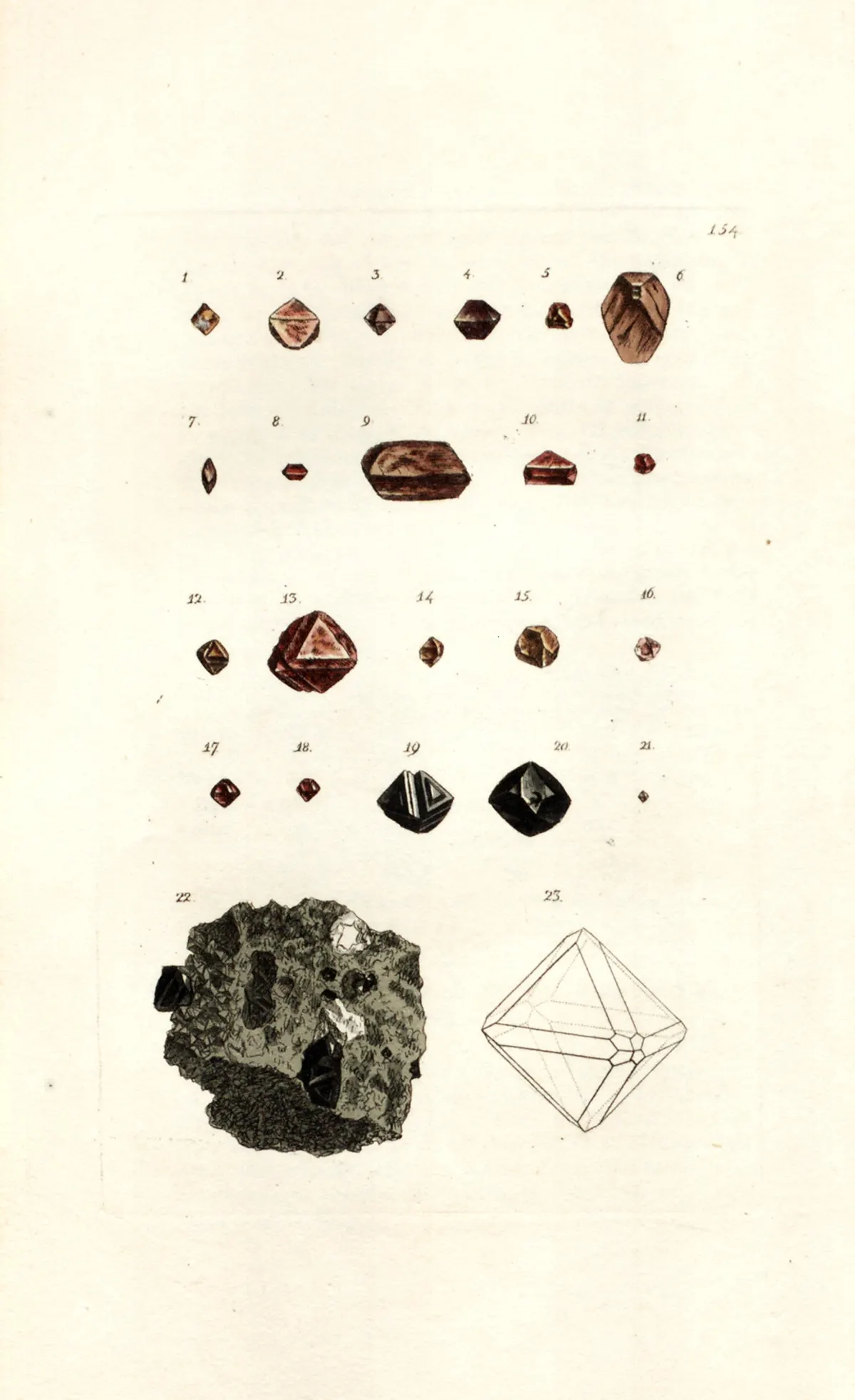
A hand-coloured engraving of twenty-three spinel crystals set out in rows: small red, rose and chocolate-brown octahedra and flattened twins, two black crystals, a grey rock fragment holding embedded dark crystals, and an outline diagram of the octahedron.
Argilla Spinellus, Spinel · James Sowerby · Exotic Mineralogy, or, Coloured Figures of Foreign Minerals, Volume 2, Tab. 154, 1817
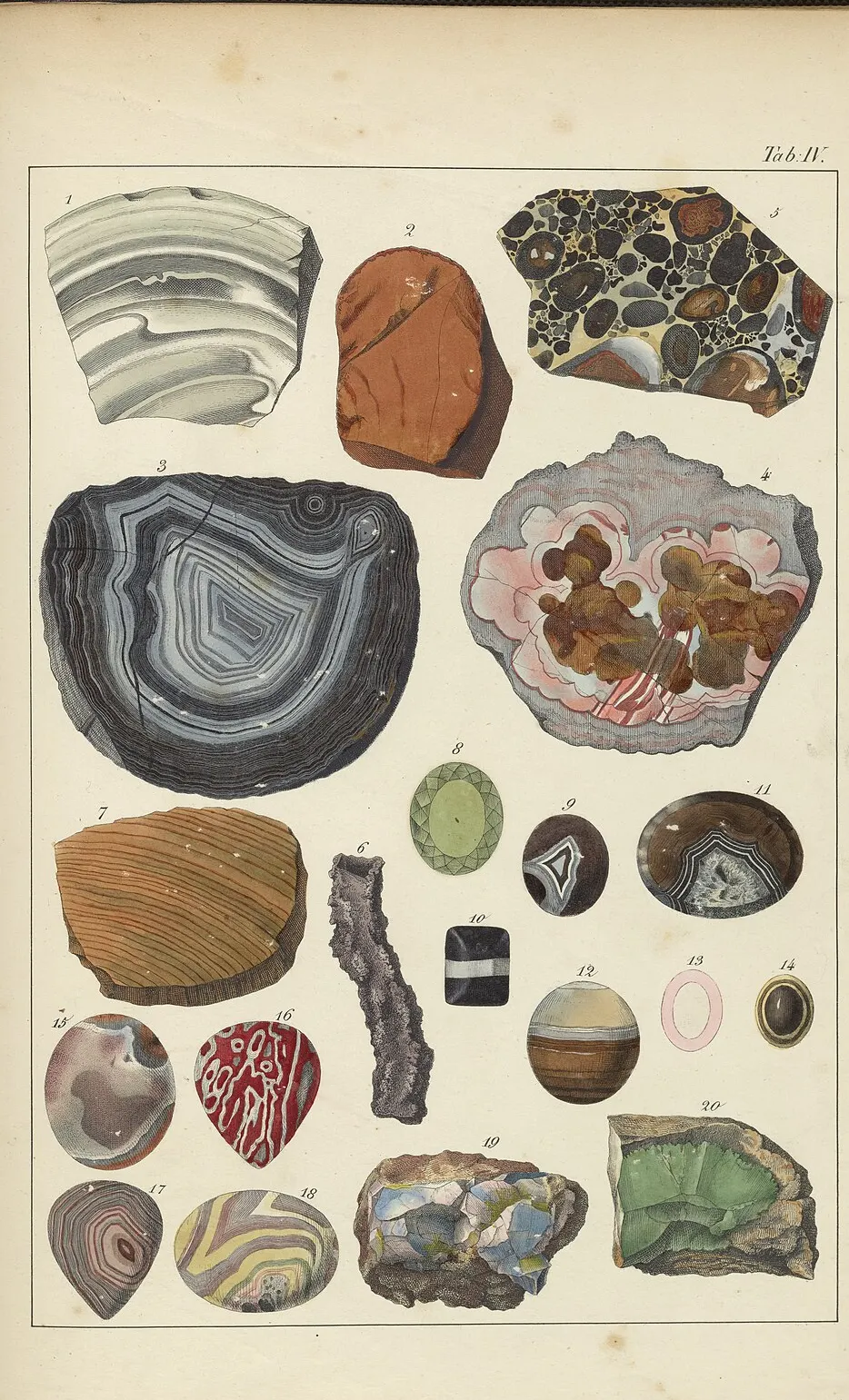
A hand-coloured lithograph of twenty banded quartz specimens: a black-and-white banded onyx square, a brown-and-white ribbon agate ball, a small dark onyx ring-stone rimmed with gold, sliced fortification and clouded agates, red carnelian and two opals.
Quartz: Sardonyx, or Sard, and Onyx · Johann Gottlob von Kurr, figures 10, 13 and 14 · The Mineral Kingdom (English edition of Das Mineralreich in Bildern), Plate IV, 1859

August's birth flowers

The gladiolus and the poppy are August's flowers. Gladiolus is Latin for a little sword, from the shape of the leaves, and the plant is more South African than most people expect: most of its species are from southern Africa, and the tall garden hybrids were bred from them. The poppy's meaning was changed by the First World War. Before it, the poppy stood for sleep and death: the Greeks showed Hypnos and Thanatos, the gods of sleep and death, with the poppy, opium is made from one species of it, and Kate Greenaway's Language of Flowers of 1884 gives the white poppy as sleep. Remembrance came with John McCrae's poem of 1915, In Flanders Fields, about the poppies growing among the graves in Belgium; the American Legion adopted the poppy in 1920, and Britain held its first Poppy Day on 11 November 1921.

FlowerUsually given todayIn a nineteenth-century dictionary
GladiolusStrength of character“Ready armed”John H. Ingram, Flora Symbolica, 1869, under “Gladioli”
PoppyRemembrance“Consolation”Kate Greenaway, Language of Flowers, 1884, under “Poppy, Red”

The meanings usually given today are a summary of the birth-flower lists printed now. The older ones are quoted from the dictionary named, under the heading it prints them. Birth flowers and the language of flowers →
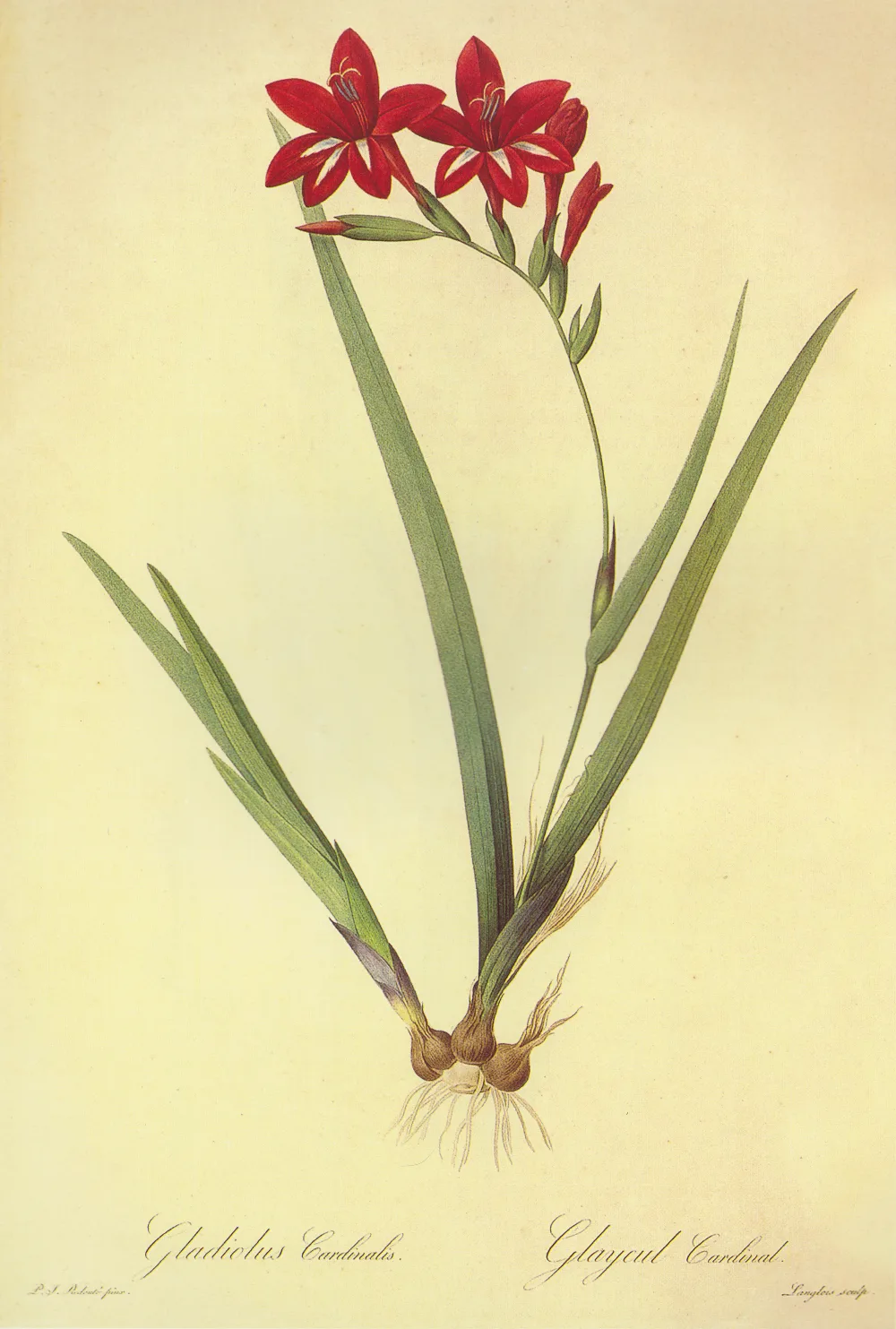
A botanical plate of a scarlet gladiolus: an arched spike of five red flowers above long sword-shaped leaves, with the corm drawn at the base.
Gladiolus cardinalis · Pierre-Joseph Redouté · Les Liliacées, 1805

Dates to know in August

South Africa marks National Women's Day on the 9th, the anniversary of the march of some twenty thousand women on the Union Buildings in Pretoria in 1956 against the pass laws. India's Independence Day is the 15th. The Perseid meteor shower peaks around the 12th and 13th, best seen from the northern hemisphere. In England, Wales and Northern Ireland the summer bank holiday falls on the last Monday of the month, and in Scotland on the first.

Which weekday it falls on

The 1st of August is a Saturday in 2026 and a Sunday in 2027, then jumps two days to a Tuesday in 2028, because 29 February 2028 comes between: a date moves on one day of the week a year, and two across a leap day.

In a leap year August starts on the same day of the week as February. Between 1920 and 2026 the 13th of August fell on a Friday in 15 years, most recently in 2021, and it next does in 2027.

August, day by day

DateBorn on the day
1 August
  • Herman Melville (1819–1891), American writer and poet
  • Jean-Baptiste Lamarck (1744–1829), French naturalist
  • Claudius (10 BC–54 AD), fourth Roman emperor (41–54)
2 August
  • Shimon Peres (1923–2016), President of Israel from 2007 to 2014, and twice Prime Minister
  • JD Vance (1984–), Vice President of the United States since 2025
  • Peter O'Toole (1932–2013), British-Irish actor
3 August
  • James Hetfield (1963–), American guitarist and singer
  • Evangeline Lilly (1979–), Canadian actress
  • Habib Bourguiba (1903–2000), Tunisian politician
4 August
  • Barack Obama (1961–), 44th President of the United States (2009–2017)
  • Louis Armstrong (1901–1971), American jazz musician, trumpeter and singer
  • Percy Bysshe Shelley (1792–1822), British Romantic poet
5 August
  • Neil Armstrong (1930–2012), American astronaut and lunar explorer
  • Guy de Maupassant (1850–1893), French writer
  • Marine Le Pen (1968–), French politician
6 August
  • Andy Warhol (1928–1987), American artist, film director, and producer
  • Alexander Fleming (1881–1955), Scottish physician and microbiologist
  • Alfred, Lord Tennyson (1809–1892), British Poet Laureate
7 August
  • Charlize Theron (1975–), South African and American actress
  • Elinor Ostrom (1933–2012), American political economist
  • Mata Hari (1876–1917), Dutch exotic dancer, courtesan and spy
8 August
  • Jimmy Wales (1966–), co-founder of Wikipedia
  • Roger Federer (1981–), Swiss tennis player
  • Paul Dirac (1902–1984), British theoretical physicist
9 August
  • Whitney Houston (1963–2012), American singer, actress, and film producer
  • Jean Piaget (1896–1980), Swiss psychologist, biologist, logician, philosopher and academic
  • Gillian Anderson (1968–), American actress
10 August
  • Herbert Hoover (1874–1964), president of the United States from 1929 to 1933
  • Juan Manuel Santos (1951–), president of Colombia from 2010 to 2018
  • Antonio Banderas (1960–), Spanish actor
11 August
  • Pervez Musharraf (1943–2023), Pakistani soldier and politician
  • Steve Wozniak (1950–), American computer pioneer, inventor, computer engineer and programmer; co-founder of Apple Inc.
  • Chris Hemsworth (1983–), Australian actor
12 August
  • François Hollande (1954–), President of France from 2012 to 2017
  • Erwin Schrödinger (1887–1961), Austrian physicist
  • George Soros (1930–), Hungarian-American investor and philanthropist
13 August
  • Fidel Castro (1926–2016), Cuban politician, author and revolutionary
  • Alfred Hitchcock (1899–1980), British filmmaker
  • Frederick Sanger (1918–2013), British biochemist
14 August
  • John Galsworthy (1867–1933), English novelist and playwright
  • Halle Berry (1966–), American actress
  • Mila Kunis (1983–), American actress
15 August
  • Napoleon (1769–1821), French military leader, French Emperor 1804–1814 and again in 1815
  • Walter Scott (1771–1832), Scottish novelist, poet and playwright
  • Jennifer Lawrence (1990–), American actress and producer
16 August
  • Madonna (1958–), American singer
  • James Cameron (1954–), Canadian filmmaker and explorer
  • Charles Bukowski (1920–1994), German-American writer
17 August
  • Robert De Niro (1943–), American actor
  • Herta Müller (1953–), German-Romanian novelist, poet and essayist
  • Mae West (1893–1980), American actress, singer, screenwriter, and writer
18 August
  • Roman Polanski (1933–), French-Polish filmmaker
  • Franz Joseph I (1830–1916), Emperor of Austria and King of Hungary
  • Robert Redford (1936–2025), American actor and director
19 August
  • Bill Clinton (1946–), 42nd President of the United States (1993–2001)
  • Coco Chanel (1883–1971), French fashion designer
  • John Dryden (1631–1700), 17th-century English poet and playwright
20 August
  • Benjamin Harrison (1833–1901), President of the United States, 1889-1893
  • Demi Lovato (1992–), American singer-songwriter and actress
  • Andrew Garfield (1983–), English and American actor
21 August
  • Usain Bolt (1986–), Jamaican sprinter
  • Robert Lewandowski (1988–), Polish association football player
  • Mohammed VI of Morocco (1963–), king of Morocco since 1999
22 AugustLeo or Virgo
  • Deng Xiaoping (1904–1997), Chinese politician and paramount leader from 1978 to 1989
  • Claude Debussy (1862–1918), French classical composer
  • Ray Bradbury (1920–2012), American author and screenwriter
23 AugustLeo or Virgo
  • Louis XVI (1754–1793), King of France and Navarre from 1774 to 1791, then King of the French from 1791 to 1792
  • Kobe Bryant (1978–2020), American basketball player
  • Edgar de Wahl (1867–1948), Estonian teacher and linguist
24 AugustLeo or Virgo
  • Jorge Luis Borges (1899–1986), Argentine writer, essayist, poet and translator
  • Paulo Coelho (1947–), Brazilian lyricist and novelist
  • Sauli Niinistö (1948–), Finnish politician and the 12th President of Finland (2012-2024)
25 August
  • Sean Connery (1930–2020), Scottish actor
  • Ivan the Terrible (1530–1584), Tsar of all Russia from 1547 to 1584
  • Johann Gottfried Herder (1744–1803), German philosopher, theologian, poet
26 August
  • Mother Teresa (1910–1997), Albanian-Indian Catholic nun and missionary
  • Antoine Lavoisier (1743–1794), French nobleman and chemist
  • Chris Pine (1980–), American actor
27 August
  • Georg Wilhelm Friedrich Hegel (1770–1831), German philosopher and theologian
  • Lyndon B. Johnson (1908–1973), president of the United States from 1963 to 1969
  • Abu Bakr al-Razi (865–925), Persian physician, philosopher and alchemist
28 August
  • Johann Wolfgang von Goethe (1749–1832), German writer, artist, natural scientist and politician
  • Shania Twain (1965–), Canadian country music singer and songwriter
  • Ivo Josipović (1957–), Croatian politician, President of Croatia from 2010 to 2015
29 August
  • Michael Jackson (1958–2009), American singer, songwriter, record producer, and dancer
  • John Locke (1632–1704), English philosopher and physician; born 29 August in the Julian calendar, which is 8 September in the Gregorian
  • Jean-Auguste-Dominique Ingres (1780–1867), French painter
30 August
  • Ernest Rutherford (1871–1937), New Zealand physicist
  • Alexander Lukashenko (1954–), President of the Republic of Belarus
  • Warren Buffett (1930–), American investor, entrepreneur and businessman
31 August
  • Tsai Ing-wen (1956–), President of the Republic of China (Taiwan) from 2016 to 2024
  • Maria Montessori (1870–1952), Italian physician and educator
  • Hassan Nasrallah (1960–2024), Leader of Hezbollah

Three people for each date, from English Wikipedia's list of births for the day, chosen by how many Wikipedia and other Wikimedia projects have a page about them; each date's page lists more. Names are the titles of the English Wikipedia articles; years and descriptions are from Wikidata (CC0), checked and corrected by hand where they needed it. Ask for a removal.

Read on