Birth flower
Lily of the valley
Convallaria majalis. In the language of flowers, as lists print it today, it stands for returning happiness, the reading Kate Greenaway printed for it in 1884. It is a custom of sentiment, not a scientific or official designation.
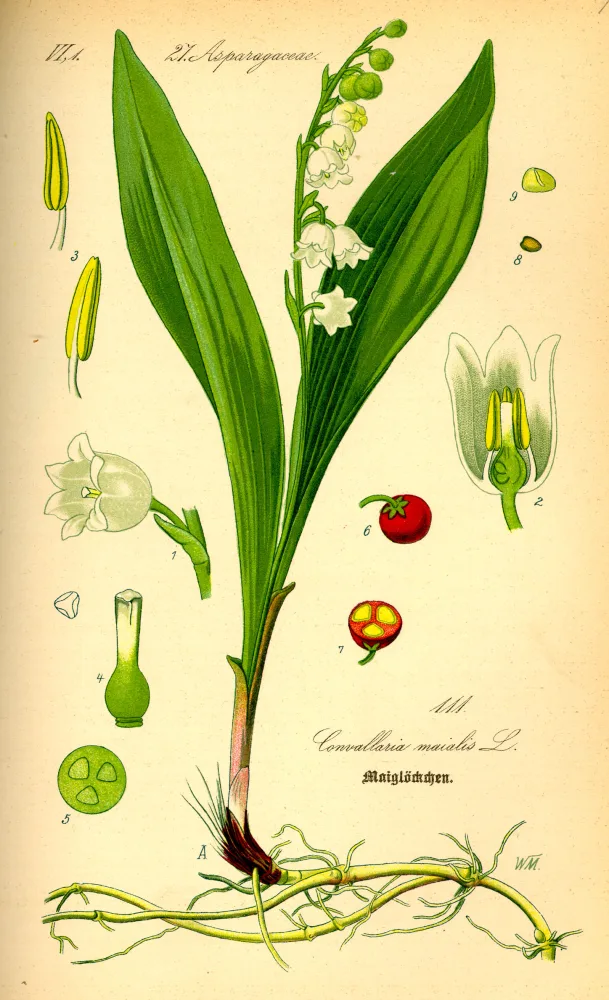
- Latin name
- Convallaria majalis
- Month
- May
- Meaning today
- returning happinessThe same reading Kate Greenaway printed in 1884.
The plant itself
| Family | Asparagaceae |
|---|---|
| Native to | Europe to the Caucasus |
| Habit | perennial |
| Height | 15–25 cm |
| Flowers | April to May |
Where the names come from
The name translates the Latin lilium convallium of the Vulgate Bible, itself a literal rendering of a Hebrew phrase in the Song of Solomon, chapter 2, verse 1. German herbal writers of the 1500s seem to have been the first to attach it to this plant. The genus name, Convallaria, was coined by Linnaeus from the Latin convallis, a valley. The species name, majalis, refers to the month of May.
Where the meaning is written down
- As the dictionary prints it
- Return of happinessUnder the heading “Lily of the Valley” in Kate Greenaway, Language of Flowers, 1884.
- As lists print it today
- Returning happinessThe same reading, in today's wording.
Greenaway and Ingram's Flora Symbolica (1869) both give the same meaning, "return of happiness".
Is it poisonous?
Seriously toxic. It contains cardiac glycosides, and the ASPCA lists it as toxic to dogs, cats and horses, with vomiting, irregular heartbeat, low blood pressure, disorientation, coma and seizures; the RHS rates it toxic if eaten, for people and for pets.
Each finding above names who made it: the ASPCA's poisonous plant database, the Royal Horticultural Society's harm ratings, or a published report. This is general information and not veterinary advice — if an animal or a person has eaten part of a plant, ring a vet or a poison line rather than reading a website.