The month

Born in May

Written . By the BirthAlmanac team.

Star signs
Taurus, then GeminiThe sun moves into Gemini on the 20th, 21st or 22nd.
Birthstone
EmeraldThe same as on the 1912 list.
Birth flowers
Lily of the valley and hawthornThe lily of the valley for returning happiness, the hawthorn for hope, as usually given today.
Days
31Days 121 to 151 of a common year, 122 to 152 of a leap year.

Where the name comes from

May is named after Maia, a Roman goddess of growth, to whom a sacrifice was made on the first day of the month. Its spring customs are much younger than its name. The maypole, often assumed to be ancient, is first recorded in the fourteenth century, in a Welsh poem by Gruffudd ab Adda describing a birch pole set up at Llanidloes, some fourteen hundred years after the Romans were naming the month.

The season, north and south

In the north May is late spring, with long evenings and the hawthorn in flower along the hedges. In the south it is late autumn turning to winter: the first frosts usually arrive on the Highveld during May, the grass dries off to the colour of straw, and the Western Cape's winter rain has usually begun.

The star signs of May

A May birthday begins as Taurus. Between 1920 and 2026 the sun moved into Gemini on the 20th of May in 21 years (the first in 1972), the 21st in 82 and the 22nd in 4 (1923, 1927, 1931 and 1935), in universal time. A birthday on 20 May, 21 May or 22 May is therefore Taurus or Gemini depending on the year, and in the year of a crossing on the hour; the page for each of those dates gives the sign and the moment of the crossing for every year.

Every other date in May had one sign all day in every one of those years: Taurus up to the 19th and Gemini from the 23rd.

In the astrological tradition Taurus is an earth sign and a fixed one, ruled by Venus. Printed tables give it as 20 April – 20 May; between 1920 and 2026 the sun entered it on the 19th, 20th or 21st of April and left it on the 20th, 21st or 22nd of May.

In the astrological tradition Gemini is an air sign and a mutable one, ruled by Mercury. Printed tables give it as 21 May – 20 June; between 1920 and 2026 the sun entered it on the 20th, 21st or 22nd of May and left it on the 20th, 21st or 22nd of June.

Every date in May. The marked dates are the ones on which the sun changed sign in at least one year since 1920.

May's birthstone

Emerald has been May's stone since 1912, unchanged. It is beryl, the same mineral as aquamarine, coloured green by traces of chromium or vanadium. Nearly every emerald has inclusions, which the trade calls the jardin, the garden, and nearly every emerald sold has had its fractures filled with oil or resin to hide them, a treatment that is routine but not permanent. Colombia is the best-known source, and Zambia and Brazil are among the largest producers now.

Stone1912 listToday's listChange
EmeraldBirth-stoneYes—

The 1912 list is the one the National Association of Jewelers adopted at Kansas City that August, as G. F. Kunz printed it in The Curious Lore of Precious Stones (1913), with a birth-stone for each month and an alternate for some; today's list is the one GIA publishes. The two lists compared →
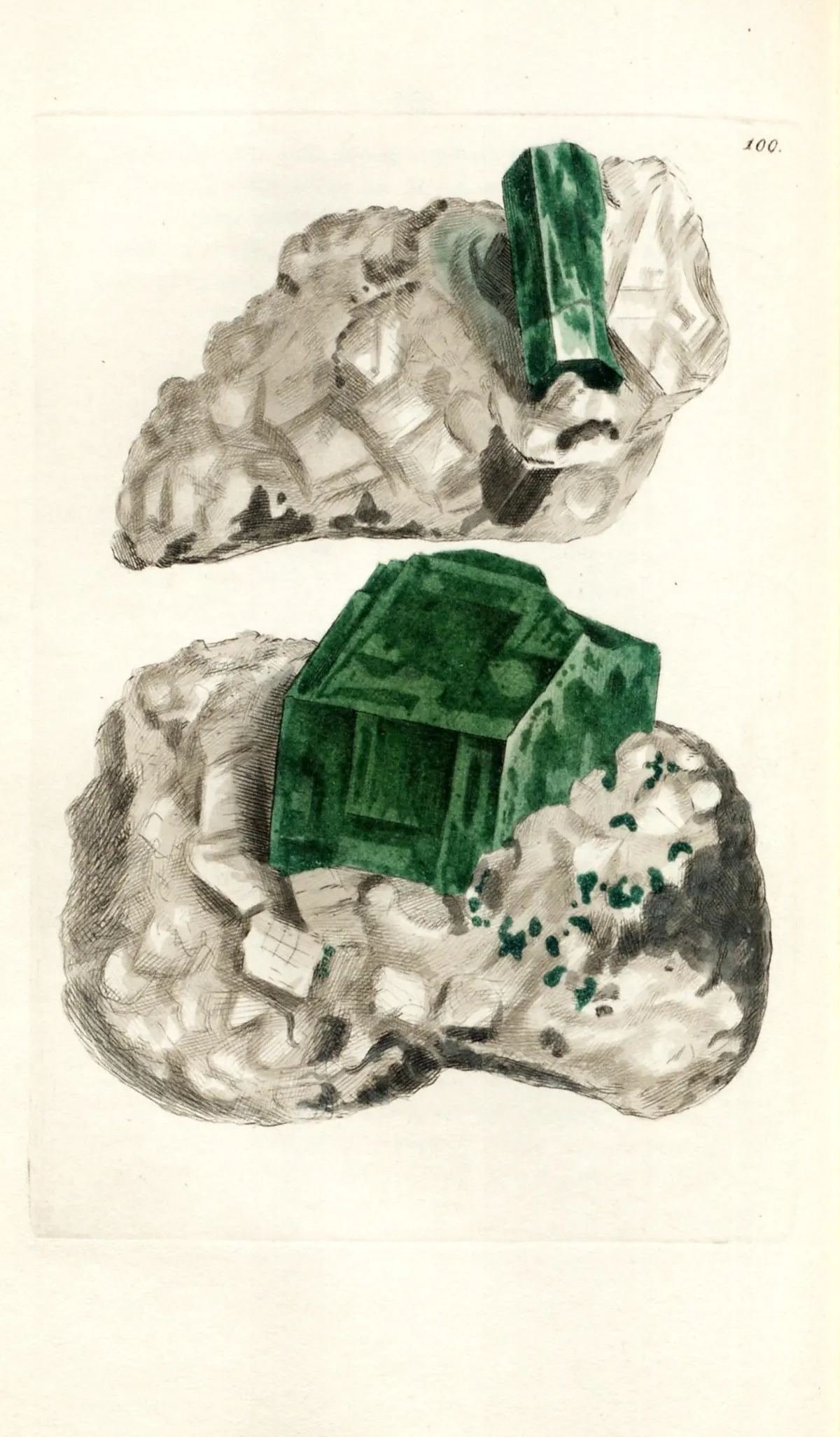
A hand-coloured engraving of two emerald specimens: a slender deep-green hexagonal prism lying across a pale grey calcite matrix, and below it a large blocky green crystal seated in white rock speckled with small green grains.
Silex Smaragdus (var. pretiosus), Emerald · James Sowerby · Exotic Mineralogy, or, Coloured Figures of Foreign Minerals, Volume 2, Tab. 100, 1817

May's birth flowers

Lily of the valley and hawthorn are May flowers by their very names. The botanical name of the lily of the valley, Convallaria majalis, says both where it grows and when: convallis is a valley, and majalis means of May. It is also one of the most poisonous plants in an ordinary garden, with heart-affecting glycosides in every part, so it is a flower to look at and not one to leave where a child or a pet can reach it. Hawthorn is so tied to the month in England that its blossom is simply called may, and its own name is the hedge thorn, from haw, an old word for a hedge, after the shrub that fills so many of them.

FlowerUsually given todayIn a nineteenth-century dictionary
Lily of the valleyReturning happiness“Return of happiness”Kate Greenaway, Language of Flowers, 1884
HawthornHope“Hope”Kate Greenaway, Language of Flowers, 1884

The meanings usually given today are a summary of the birth-flower lists printed now. The older ones are quoted from the dictionary named, under the heading it prints them. Birth flowers and the language of flowers →
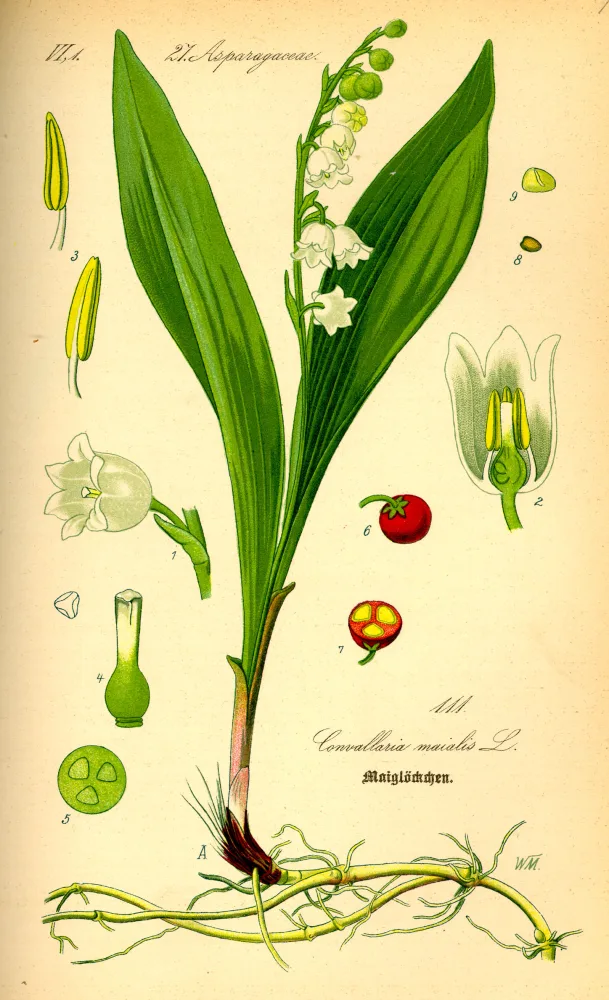
A botanical plate labelled Convallaria majalis (Maiglöckchen), showing a lily of the valley plant with two broad lance-shaped leaves sheathing a single arching stem hung with small bell-shaped white flowers, a spray of red berries, a creeping underground rhizome, and numbered dissections of the flower, fruit and seed.
Convallaria majalis · Flora von Deutschland, Österreich und der Schweiz, 1885

Dates to know in May

May Day on the 1st is both an old spring festival and, as International Workers' Day, a public holiday in many countries, among them South Africa, where it is Workers' Day. Europe Day on the 9th marks the Schuman Declaration of 1950, and Africa Day on the 25th the founding of the Organisation of African Unity in Addis Ababa in 1963. Mother's Day falls on the second Sunday of May in South Africa, the United States and many other countries, while Britain keeps Mothering Sunday in March or early April, three weeks before Easter.

Which weekday it falls on

The 1st of May is a Friday in 2026 and a Saturday in 2027, then jumps two days to a Monday in 2028, because 29 February 2028 comes between: a date moves on one day of the week a year, and two across a leap day.

May and June are the only months that never start on the same day of the week as another month of the same year. Between 1920 and 2026 the 13th of May fell on a Friday in 16 years, most recently in 2022, and it next does in 2033.

May, day by day

DateBorn on the day
1 May
  • Arthur Wellesley, 1st Duke of Wellington (1769–1852), British Field Marshal, Prime Minister of the United Kingdom, 1828–1830, 1834
  • Santiago Ramón y Cajal (1852–1934), Spanish scientist
  • Joseph Addison (1672–1719), English essayist, poet, playwright and politician
2 May
  • Catherine the Great (1729–1796), Empress of Russia from 1762 to 1796
  • Satyajit Ray (1921–1992), Indian filmmaker and writer
  • David Beckham (1975–), English footballer
3 May
  • Niccolò Machiavelli (1469–1527), Florentine statesman, diplomat, and political theorist
  • Golda Meir (1898–1978), Prime Minister of Israel from 1969 to 1974
  • Bing Crosby (1903–1977), American singer and actor
4 May
  • Audrey Hepburn (1929–1993), British actress
  • Hosni Mubarak (1928–2020), President of Egypt from 1981 to 2011
  • Thomas Henry Huxley (1825–1895), British biologist and comparative anatomist
5 May
  • Karl Marx (1818–1883), German-born philosopher
  • Søren Kierkegaard (1813–1855), Danish theologian, philosopher, poet and social critic
  • Henryk Sienkiewicz (1846–1916), Polish writer, novelist, journalist, philanthropist and Nobel Prize laureate
6 May
  • Sigmund Freud (1856–1939), Austrian neurologist and founder of psychoanalysis
  • Tony Blair (1953–), Prime Minister of the United Kingdom from 1997 to 2007
  • Maximilien Robespierre (1758–1794), French revolutionary lawyer and politician
7 May
  • Rabindranath Tagore (1861–1941), Bengali poet, philosopher and polymath
  • Pyotr Ilyich Tchaikovsky (1840–1893), Russian composer
  • Johannes Brahms (1833–1897), German composer
8 May
  • Harry S. Truman (1884–1972), President of the United States from 1945 to 1953
  • Friedrich Hayek (1899–1992), Austrian and British economist
  • Henry Dunant (1828–1910), Swiss businessman and co-founder of the Red Cross
9 May
  • J. M. Barrie (1860–1937), Scottish writer and playwright
  • Howard Carter (1874–1939), British archaeologist and Egyptologist
  • José Ortega y Gasset (1883–1955), Spanish liberal philosopher and essayist
10 May
  • Fred Astaire (1899–1987), American dancer, choreographer, actor, and singer
  • Heydar Aliyev (1923–2003), President of Azerbaijan from 1993 to 2003
  • Bono (1960–), Irish singer
11 May
  • Salvador Dalí (1904–1989), Spanish artist
  • Richard Feynman (1918–1988), American theoretical physicist
  • Jiddu Krishnamurti (1895–1986), Indian spiritual philosopher, mystic, speaker and writer
12 May
  • Florence Nightingale (1820–1910), English social reformer, statistician, and founder of modern nursing
  • Rishi Sunak (1980–), Prime Minister of the United Kingdom from 2022 to 2024
  • Katharine Hepburn (1907–2003), American actress
13 May
  • Pope Pius IX (1792–1878), Pope of the Catholic Church from 1846 to 1878
  • Alphonse Daudet (1840–1897), French novelist, playwright, and poet
  • Maria Theresa (1717–1780), ruler of the Habsburg Dominions
14 May
  • Mark Zuckerberg (1984–), American Internet entrepreneur
  • George Lucas (1944–), American filmmaker and philanthropist
  • Cate Blanchett (1969–), Australian actor and producer
15 May
  • Pierre Curie (1859–1906), French physicist and chemist
  • Mikhail Bulgakov (1891–1940), Russian author
  • Madeleine Albright (1937–2022), United States Secretary of State from 1997 to 2001
16 May
  • Megan Fox (1986–), American actress and model
  • Pierce Brosnan (1953–), Irish actor
  • Janet Jackson (1966–), American singer, songwriter, dancer and actress
17 May
  • Edward Jenner (1749–1823), English physician, scientist and pioneer of vaccination
  • Enya (1961–), Irish singer
  • Henri Barbusse (1873–1935), French author
18 May
  • Pope John Paul II (1920–2005), Pope from 1978 to 2005
  • Bertrand Russell (1872–1970), British philosopher and logician
  • Omar Khayyam (1048–1131), Persian mathematician and poet
19 May
  • Mustafa Kemal Atatürk (1881–1938), founding father of the Republic of Turkey
  • Ho Chi Minh (1890–1969), Vietnamese communist leader, founder of North Vietnam
  • Malcolm X (1925–1965), American Black rights activist
20 MayTaurus or Gemini
  • Honoré de Balzac (1799–1850), French novelist and playwright
  • John Stuart Mill (1806–1873), British philosopher and political economist
  • Cher (1946–), American musician, singer, actress and television personality
21 MayTaurus or Gemini
  • Albrecht Dürer (1471–1528), German painter, printmaker, mathematician, and theorist
  • Andrei Sakharov (1921–1989), Soviet nuclear physicist and human rights activist
  • Philip II of Spain (1527–1598), King of Spain, Portugal, Naples and Sicily; King consort of England
22 MayTaurus or Gemini
  • Richard Wagner (1813–1883), German composer
  • Arthur Conan Doyle (1859–1930), British writer and physician
  • Novak Djokovic (1987–), Serbian tennis player
23 May
  • Carl Linnaeus (1707–1778), Swedish botanist, physician, and zoologist
  • Pär Lagerkvist (1891–1974), Swedish writer
  • John Bardeen (1908–1991), American physicist and engineer
24 May
  • Bob Dylan (1941–), American singer-songwriter
  • Queen Victoria (1819–1901), Queen of the United Kingdom from 1837 to 1901
  • Joseph Brodsky (1940–1996), Russian-American poet
25 May
  • Ralph Waldo Emerson (1803–1882), American philosopher
  • Pieter Zeeman (1865–1943), Dutch physicist
  • Ian McKellen (1939–), British actor
26 May
  • John Wayne (1907–1979), American actor
  • Miles Davis (1926–1991), American jazz trumpeter, bandleader, and composer
  • Sally Ride (1951–2012), American astronaut and physicist
27 May
  • Ibn Khaldun (1332–1406), historiographer and historian
  • Henry Kissinger (1923–2023), United States Secretary of State from 1973 to 1977
  • Christopher Lee (1922–2015), English actor and singer
28 May
  • Kylie Minogue (1968–), Australian singer and actress
  • Ian Fleming (1908–1964), British author
  • Patrick White (1912–1990), English-born Australian writer
29 May
  • John F. Kennedy (1917–1963), president of the United States from 1961 to 1963
  • G. K. Chesterton (1874–1936), English author and Christian apologist
  • Charles II of England (1630–1685), King of England, Scotland, and Ireland; born 29 May in the Julian calendar, which is 8 June in the Gregorian
30 May
  • Mikhail Bakunin (1814–1876), Russian revolutionary anarchist and philosopher
  • Steven Gerrard (1980–), English association football player and manager
  • Alexei Leonov (1934–2019), Soviet pilot and cosmonaut, first human to conduct a spacewalk
31 May
  • Walt Whitman (1819–1892), American poet, essayist and journalist
  • Clint Eastwood (1930–), American actor and film director
  • Pope Pius XI (1857–1939), pope of the Catholic Church from 1922 to 1939

Three people for each date, from English Wikipedia's list of births for the day, chosen by how many Wikipedia and other Wikimedia projects have a page about them; each date's page lists more. Names are the titles of the English Wikipedia articles; years and descriptions are from Wikidata (CC0), checked and corrected by hand where they needed it. Ask for a removal.

Read on