Birth flower
Rose
Rosa. In the language of flowers, as lists print it today, it stands for love, the reading Kate Greenaway printed for it in 1884. It is a custom of sentiment, not a scientific or official designation.
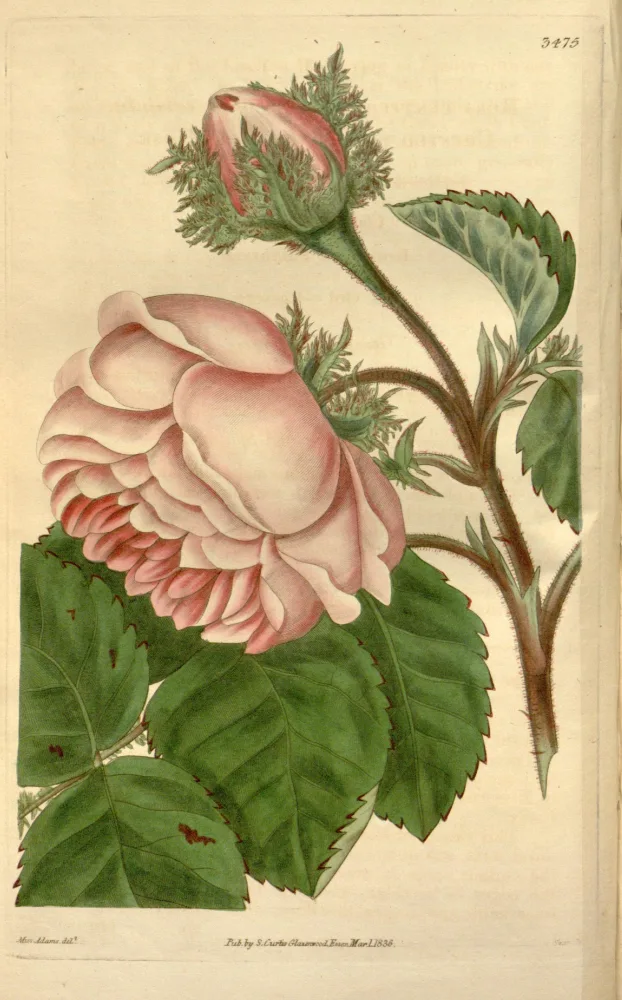
- Latin name
- Rosa
- Month
- June
- Meaning today
- loveThe same reading Kate Greenaway printed in 1884.
The plant itself
| Family | Rosaceae |
|---|---|
| Native to | the temperate and subtropical northern hemisphere |
| Habit | shrub |
| Height | 0.1–5 m across the genus; the apothecary's rose about 90 cm |
| Flowers | June to September |
A rose hip is not the fruit. The true fruits are the bony achenes inside it; the fleshy red part is the swollen hypanthium, the cup of the flower itself, which is why botanists class the hip as an accessory fruit rather than a berry.
Where the names come from
Old English had rose, from the Latin rosa, which probably reached Latin through Italian and Greek dialect forms of the Greek rhodon; the Greek word itself is probably from an Old Iranian source. French later shaped the English form of the word, and the genus name, Rosa, is the Latin unchanged.
Where the meaning is written down
- As the dictionary prints it
- LoveUnder the heading “Rose” in Kate Greenaway, Language of Flowers, 1884.
- As lists print it today
- LoveThe same reading, in today's wording.
Greenaway gives "love" for the plain rose and then more than thirty further meanings for named and coloured roses; Ingram's Flora Symbolica (1869) also opens with the rose as love.
Is it poisonous?
The ASPCA lists it as non-toxic to cats, dogs and horses.
Each finding above names who made it: the ASPCA's poisonous plant database, the Royal Horticultural Society's harm ratings, or a published report. This is general information and not veterinary advice — if an animal or a person has eaten part of a plant, ring a vet or a poison line rather than reading a website.