The month

Born in June

Written . By the BirthAlmanac team.

Star signs
Gemini, then CancerThe sun moves into Cancer on the 20th, 21st or 22nd.
Birthstones
Pearl, moonstone and alexandriteThe 1912 list gave pearl and moonstone.
Birth flowers
Rose and honeysuckleThe rose for love, the honeysuckle for bonds of affection, as usually given today.
Days
30Days 152 to 181 of a common year, 153 to 182 of a leap year.

Where the name comes from

June is usually said to be named after Juno, the Roman goddess of marriage and childbirth and the wife of Jupiter. Ovid, in his poem on the Roman calendar, has three goddesses argue for it: Juno for herself, Juventas, the goddess of youth, for the iuniores, the younger men, and Concordia for the joining of two peoples. He walks away without deciding, so, as with April, the name is better described as probably Juno's than certainly.

The season, north and south

Between 1920 and 2026 the June solstice fell on the 20th, 21st or 22nd in universal time. It is the longest day of the year in the north and the shortest in the south: London has about sixteen and a half hours of daylight on it and Cape Town just under ten. A June birthday is a midsummer one in Europe and North America, and a midwinter one in South Africa, Australia and much of South America.

The star signs of June

A June birthday begins as Gemini. Between 1920 and 2026 the sun moved into Cancer, at the June solstice, on the 20th of June in 5 years (2008, 2012, 2016, 2020 and 2024), the 21st in 81 and the 22nd in 21 (the last in 1975), in universal time. A birthday on 20 June, 21 June or 22 June is therefore Gemini or Cancer depending on the year, and in the year of a crossing on the hour; the page for each of those dates gives the sign and the moment of the crossing for every year.

Every other date in June had one sign all day in every one of those years: Gemini up to the 19th and Cancer from the 23rd.

In the astrological tradition Gemini is an air sign and a mutable one, ruled by Mercury. Printed tables give it as 21 May – 20 June; between 1920 and 2026 the sun entered it on the 20th, 21st or 22nd of May and left it on the 20th, 21st or 22nd of June.

In the astrological tradition Cancer is a water sign and a cardinal one, ruled by the Moon. Printed tables give it as 21 June – 22 July; between 1920 and 2026 the sun entered it on the 20th, 21st or 22nd of June and left it on the 22nd or 23rd of July.

Every date in June. The marked dates are the ones on which the sun changed sign in at least one year since 1920.

June's birthstones

June is one of three months with three stones, with August and December. The list drawn up in 1912 gave pearl, with moonstone as its alternate, and alexandrite joined them later. The pearl is an organic gem, grown inside a living mollusc that coats an irritant in layers of nacre, and most pearls sold today are cultured, the process started by hand in a farmed oyster or mussel. Moonstone is a feldspar whose soft blue sheen, which seems to float across the stone as it moves, comes from light scattered between thin alternating layers of two feldspars. Alexandrite was found in the Ural Mountains around 1830 and named after the young heir who became Tsar Alexander II, and it changes colour with the light: bluish green by day, purplish red under a lamp.

Stone1912 listToday's listChange
PearlBirth-stoneYes—
MoonstoneAlternateYes—
Alexandrite—YesAdded to June in 1952 by the Jewelry Industry Council of America.

The 1912 list is the one the National Association of Jewelers adopted at Kansas City that August, as G. F. Kunz printed it in The Curious Lore of Precious Stones (1913), with a birth-stone for each month and an alternate for some; today's list is the one GIA publishes. The two lists compared →
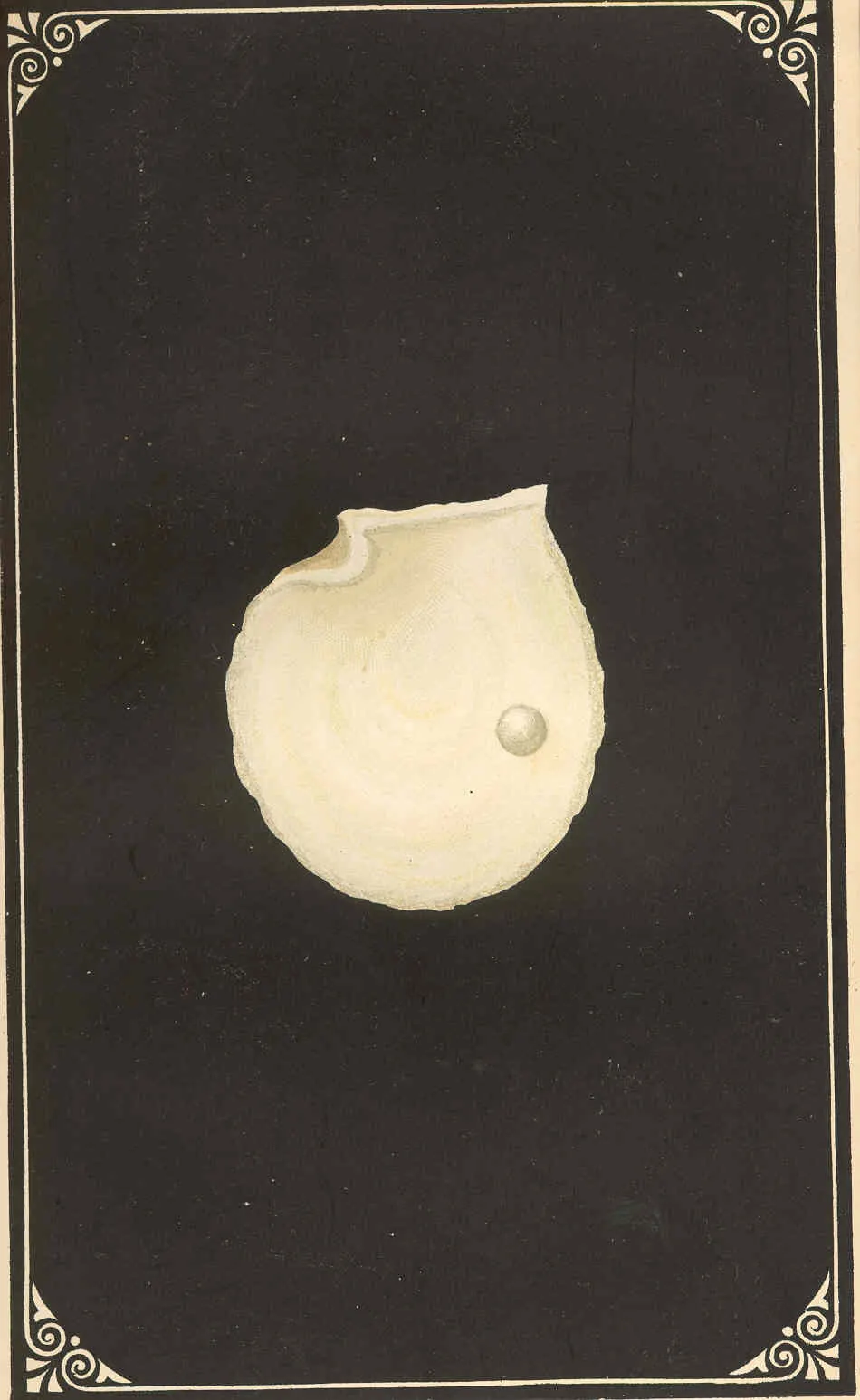
A single valve of the pearl oyster shown against a black ground inside an ornamental printed border: the shell is creamy white with concentric growth lines and a notched hinge, and one small round pearl sits attached to the nacre near its right edge.
Valve of Pearl Oyster (Meleagrina margaritifera) with a Pearl · Pearls and Pearling Life (Edwin W. Streeter, London: George Bell & Sons), 1886
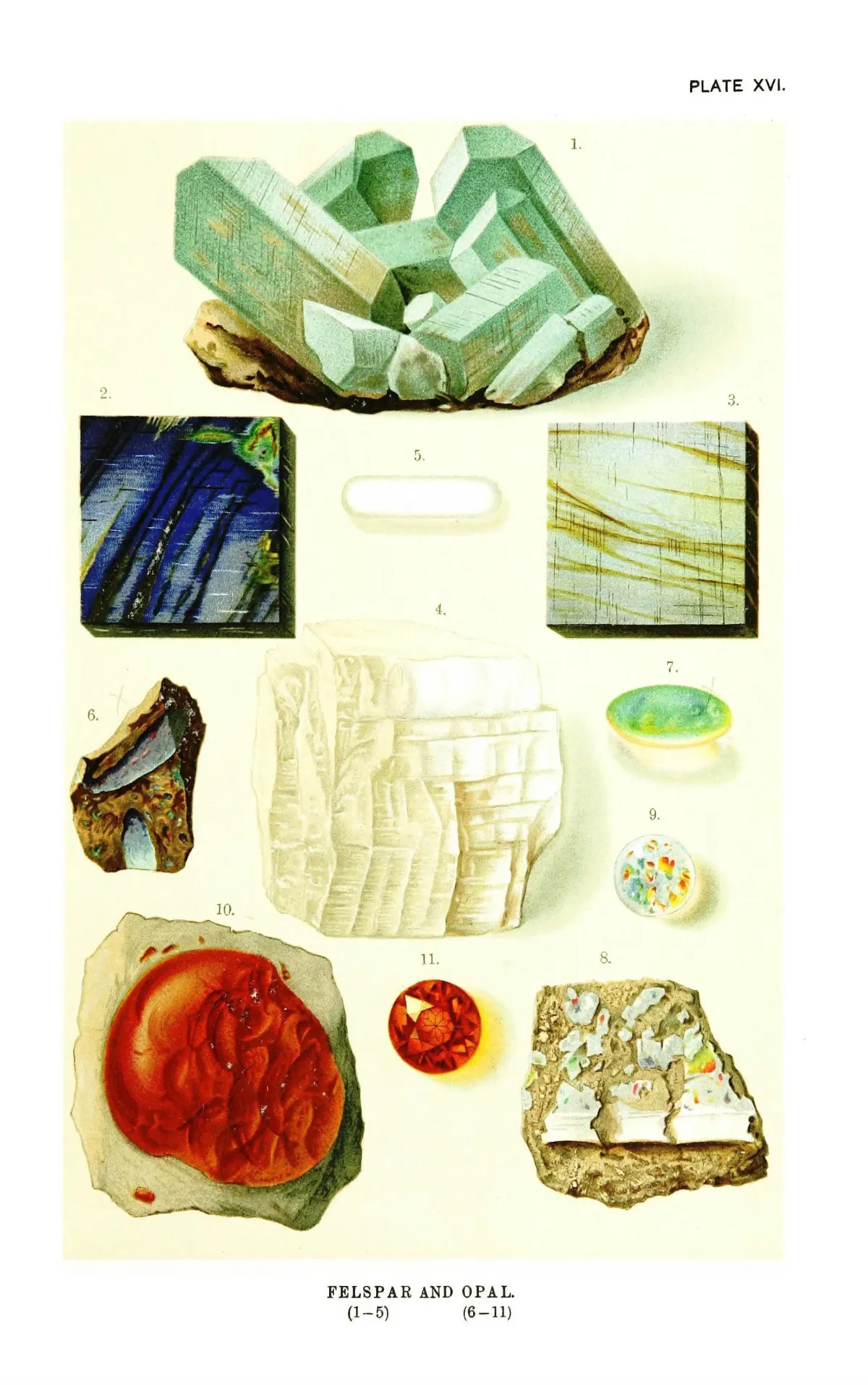
A chromolithograph headed Felspar and Opal. At its centre a large rough white moonstone with a stepped, cleaved surface, and beside it a small cut oval moonstone; above are pale green amazon-stone crystals, and around them rough and cut precious and fire opals.
Felspar, var. Moon-stone (Adularia) · E. Ohmann, figures 4 and 5 · Precious Stones (Max Bauer, English edition translated by L. J. Spencer), Plate XVI, 1904
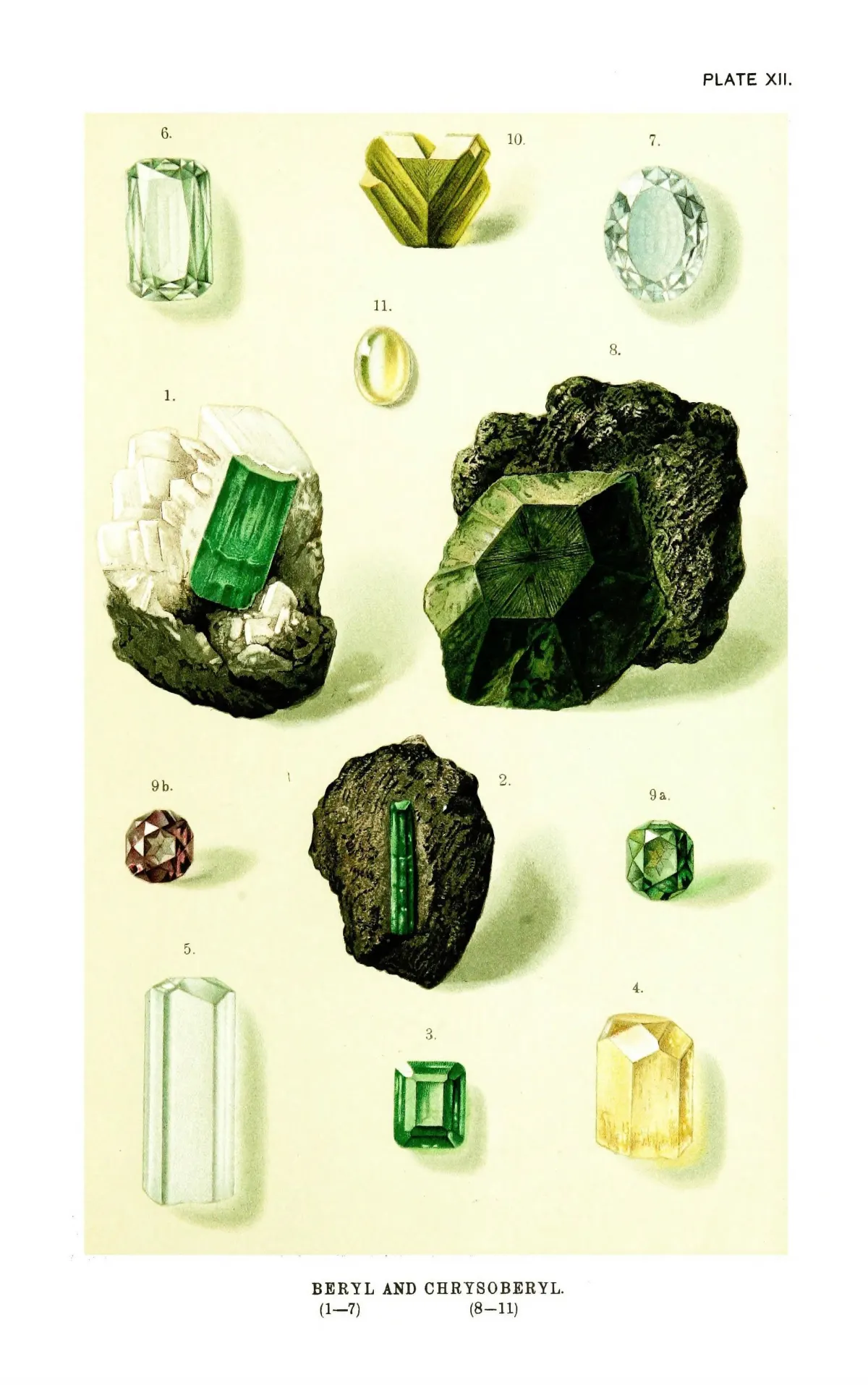
A chromolithograph headed Beryl and Chrysoberyl. Low on the plate the same alexandrite is cut twice, green by daylight and raspberry-red by candlelight, beside a dark olive chrysoberyl crystal in rough matrix, with emerald prisms in white calcite above.
Chrysoberyl (Alexandrite) · E. Ohmann, figures 8, 9a and 9b · Precious Stones (Max Bauer, English edition translated by L. J. Spencer), Plate XII, 1904

June's birth flowers

The rose and the honeysuckle both flower in a northern June. What looks like a rose's fruit, the hip, is really the swollen cup of the flower with the true fruits inside it. The rose is also the flower the language of flowers had most to say about: Kate Greenaway's Language of Flowers of 1884 gives the plain rose as love and then more than thirty further meanings for roses by colour and kind, the yellow one standing for decrease of love and jealousy. Honeysuckle takes its name from the nectar that bees and children suck from its flowers; the name was used for clover around 1300 and had settled on the scented climber by about 1400.

FlowerUsually given todayIn a nineteenth-century dictionary
RoseLove“Love”Kate Greenaway, Language of Flowers, 1884
HoneysuckleBonds of affection“Generous and devoted affection”Kate Greenaway, Language of Flowers, 1884

The meanings usually given today are a summary of the birth-flower lists printed now. The older ones are quoted from the dictionary named, under the heading it prints them. Birth flowers and the language of flowers →
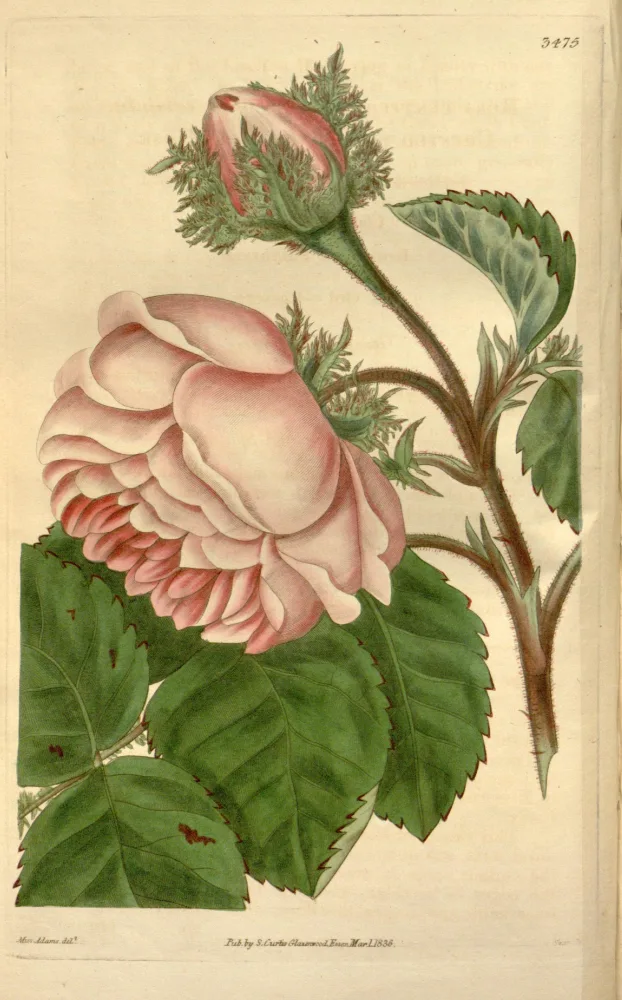
A botanical plate of a cabbage rose, showing one fully open, densely double pale pink bloom and one furled pink bud with mossy sepals, on a thorny, bristled stem with toothed, dark green pinnate leaves.
Rosa centifolia · Curtis's Botanical Magazine, 1836

Dates to know in June

In South Africa, Youth Day on the 16th marks the Soweto uprising of 1976, which began when schoolchildren marched against being taught in Afrikaans. Juneteenth, on the 19th, has been a federal holiday in the United States since 2021; it marks the day in 1865 when Union troops brought word to Galveston that the enslaved people of Texas were free. Midsummer is celebrated around the solstice across Scandinavia and the Baltic countries, and Father's Day falls on the third Sunday of June in many countries, including South Africa, the United Kingdom and the United States.

Which weekday it falls on

The 1st of June is a Monday in 2026 and a Tuesday in 2027, then jumps two days to a Thursday in 2028, because 29 February 2028 comes between: a date moves on one day of the week a year, and two across a leap day.

May and June are the only months that never start on the same day of the week as another month of the same year. Between 1920 and 2026 the 13th of June fell on a Friday in 15 years, most recently in 2025, and it next does in 2031.

June, day by day

DateBorn on the day
1 June
  • Marilyn Monroe (1926–1962), American actress and model
  • Morgan Freeman (1937–), American actor and producer
  • Tom Holland (1996–), English actor
2 June
  • Pope Pius X (1835–1914), Pope of the Catholic Church from 1903 to 1914, saint
  • Thomas Hardy (1840–1928), English novelist and poet
  • Marquis de Sade (1740–1814), French nobleman, revolutionary politician, philosopher and writer of erotic works
3 June
  • Rafael Nadal (1986–), Spanish tennis player
  • Raúl Castro (1931–), former First Secretary of the Communist Party of Cuba
  • George V (1865–1936), King of the United Kingdom from 1910 to 1936
4 June
  • Angelina Jolie (1975–), American actress
  • Alexei Navalny (1976–2024), Russian jurist and opposition leader
  • George III (1738–1820), King of Great Britain and Ireland from 1760 to 1820
5 June
  • John Maynard Keynes (1883–1946), British economist
  • Federico García Lorca (1898–1936), Spanish poet, dramatist and prose writer
  • Mark Wahlberg (1971–), American actor
6 June
  • Alexander Pushkin (1799–1837), Russian poet, playwright, and novelist
  • Diego Velázquez (1599–1660), Spanish painter
  • Thomas Mann (1875–1955), German novelist and Nobel Prize laureate
7 June
  • Orhan Pamuk (1952–), Turkish novelist, academic and Nobel laureate
  • Paul Gauguin (1848–1903), French painter and printmaker
  • Mike Pence (1959–), Vice President of the United States from 2017 to 2021
8 June
  • Frank Lloyd Wright (1867–1959), American architect
  • Tim Berners-Lee (1955–), English computer scientist
  • Robert Schumann (1810–1856), German composer, pianist and critic
9 June
  • Peter the Great (1672–1725), Tsar of Russia from 1682 and Emperor of Russia from 1721 to 1725
  • Johnny Depp (1963–), American actor
  • Natalie Portman (1981–), Israeli-American actress
10 June
  • Judy Garland (1922–1969), American actress, singer, dancer and vaudevillian
  • Prince Philip, Duke of Edinburgh (1921–2021), consort of Elizabeth II from 1952 to 2021
  • Saul Bellow (1915–2005), Canadian-American writer
11 June
  • Yasunari Kawabata (1899–1972), Japanese novelist
  • Jacques Cousteau (1910–1997), French naval officer, oceanographer, filmmaker and author
  • Gene Wilder (1933–2016), American actor
12 June
  • George H. W. Bush (1924–2018), President of the United States from 1989 to 1993
  • Anne Frank (1929–1945), German-born Dutch Jewish diarist and Holocaust victim
  • Anthony Eden (1897–1977), British soldier, diplomat and politician
13 June
  • James Clerk Maxwell (1831–1879), Scottish physicist
  • W. B. Yeats (1865–1939), Irish poet and playwright
  • Ban Ki-moon (1944–), Secretary-General of the United Nations from 2007 to 2016
14 June
  • Donald Trump (1946–), President of the United States (2017–2021; since 2025)
  • Harriet Beecher Stowe (1811–1896), American abolitionist and author
  • Charles-Augustin de Coulomb (1736–1806), French physicist
15 June
  • Xi Jinping (1953–), General Secretary of the Chinese Communist Party since 2012
  • Yuri Andropov (1914–1984), General Secretary of the Communist Party of the Soviet Union
  • Edvard Grieg (1843–1907), Norwegian composer and pianist
16 June
  • Adam Smith (1723–1790), Scottish moral philosopher and political economist
  • Tupac Shakur (1971–1996), American rapper and actor
  • Barbara McClintock (1902–1992), American scientist and cytogeneticist
17 June
  • Igor Stravinsky (1882–1971), Russian, French, and American composer
  • Venus Williams (1980–), American tennis player
  • Edward I (1239–1307), King of England from 1272 to 1307
18 June
  • Paul McCartney (1942–), English musician and member of the Beatles
  • Lech Kaczyński (1949–2010), President of Poland from 2005 to 2010
  • Thabo Mbeki (1942–), President of South Africa from 1999 to 2008
19 June
  • Blaise Pascal (1623–1662), French mathematician, physicist, inventor, writer, and Christian philosopher
  • Aung San Suu Kyi (1945–), former State Counsellor of Myanmar and Leader of the National League for Democracy
  • Boris Johnson (1964–), Prime Minister of the United Kingdom from 2019 to 2022
20 JuneGemini or Cancer
  • Nicole Kidman (1967–), Australian-American actress, producer, and model
  • Jacques Offenbach (1819–1880), German-born French composer
  • Frank Lampard (1978–), English association football player and manager
21 JuneGemini or Cancer
  • Jean-Paul Sartre (1905–1980), French existentialist philosopher
  • Lana Del Rey (1985–), American singer-songwriter
  • Benazir Bhutto (1953–2007), Prime Minister of Pakistan from 1988 to 1990 and from 1993 to 1996
22 JuneGemini or Cancer
  • Meryl Streep (1949–), American actress
  • Erich Maria Remarque (1898–1970), German-born novelist
  • Dan Brown (1964–), American novelist
23 June
  • Alan Turing (1912–1954), English computer scientist
  • Zinedine Zidane (1972–), French association football player and coach
  • Anna Akhmatova (1889–1966), Russian poet
24 June
  • Lionel Messi (1987–), Argentine association football player
  • Ambrose Bierce (1842–1914), American editorialist, journalist, short story writer, fabulist, and satirist
  • Claudia Sheinbaum (1962–), president of Mexico since 2024
25 June
  • George Orwell (1903–1950), British writer and journalist
  • Antoni Gaudí (1852–1926), Catalan architect
  • George Michael (1963–2016), English singer
26 June
  • Pearl S. Buck (1892–1973), American writer, winner of the 1938 Nobel Prize in Literature
  • Ariana Grande (1993–), American singer, songwriter, and actress
  • Salvador Allende (1908–1973), President of Chile from 1970 to 1973
27 June
  • Helen Keller (1880–1968), American deafblind author, political activist, lecturer, scholar
  • Emma Goldman (1869–1940), Russian-born American anarchist
  • Isabelle Adjani (1955–), French actress
28 June
  • Jean-Jacques Rousseau (1712–1778), Genevan philosopher, writer, and composer
  • Elon Musk (1971–), American businessman
  • Peter Paul Rubens (1577–1640), Flemish painter
29 June
  • Antoine de Saint-Exupéry (1900–1944), French writer and aviator
  • Giacomo Leopardi (1798–1837), Italian noble, poet, philosopher, and writer
  • Giorgio Napolitano (1925–2023), President of Italy from 2006 to 2015
30 June
  • Czesław Miłosz (1911–2004), Polish-American poet and Nobel laureate
  • Mike Tyson (1966–), American boxer and media personality
  • Michael Phelps (1985–), American swimmer

Three people for each date, from English Wikipedia's list of births for the day, chosen by how many Wikipedia and other Wikimedia projects have a page about them; each date's page lists more. Names are the titles of the English Wikipedia articles; years and descriptions are from Wikidata (CC0), checked and corrected by hand where they needed it. Ask for a removal.

Read on