Birth flower
Violet
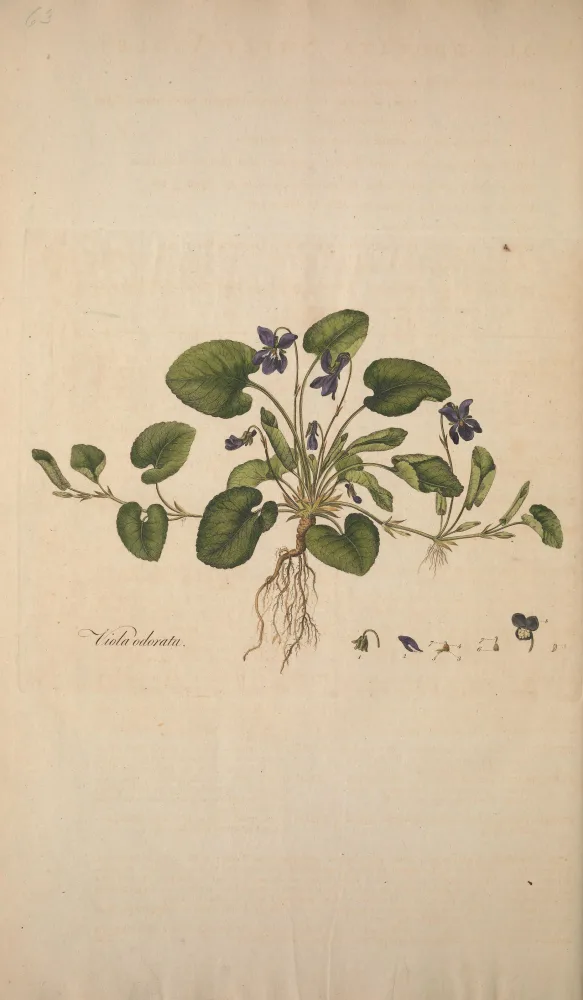
Viola odorata. In the language of flowers, as lists print it today, it stands for faithfulness. Kate Greenaway's dictionary of 1884 gives it another: “Modesty”. It is a custom of sentiment, not a scientific or official designation.
- Latin name
- Viola odorata
- Month
- February
- Meaning today
- faithfulnessNot the reading of 1884: Kate Greenaway gives “Modesty”.
The plant itself
| Family | Violaceae |
|---|---|
| Native to | Europe to Iran and north-west Africa |
| Habit | perennial |
| Height | 4–12 cm |
| Flowers | February to April |
The violet scent comes from ionones, which temporarily desensitise the very olfactory receptors that detect them, so the smell seems to vanish after a few moments and then return once the receptors recover.
Where the names come from
The word came into English around 1300 from the Old French violete, a diminutive of viole, from the Latin viola, which meant both the flower and its colour. The Latin is linked to the Greek ion, and both may come from a Mediterranean language older than Indo-European. The colour word violet, from the late 1300s, was taken from the flower rather than the other way round, and the genus name, Viola, is the Latin word itself. The species name, odorata, is Latin for fragrant, the same word as the sweet pea's odoratus.
Where the meaning is written down
- As the dictionary prints it
- ModestyUnder the heading “Violet, Sweet” in Kate Greenaway, Language of Flowers, 1884.
- As lists print it today
- FaithfulnessA different reading from the entry quoted here; the note below says where it differs.
Greenaway lists violets by colour and kind. For the sweet violet, Viola odorata, the plant on this page, she gives "modesty", and Ingram's Flora Symbolica (1869) gives the same for the violet generally. The "faithfulness" printed today is her entry for the blue violet, a heading that names no species.
Is it poisonous?
No authority has published a finding either way: it is not in the ASPCA's database and carries no Royal Horticultural Society harm rating. That is an absence of evidence, not a clean bill of health.
This is general information and not veterinary advice — if an animal or a person has eaten part of a plant, ring a vet or a poison line rather than reading a website.