Birthstone
Alexandrite
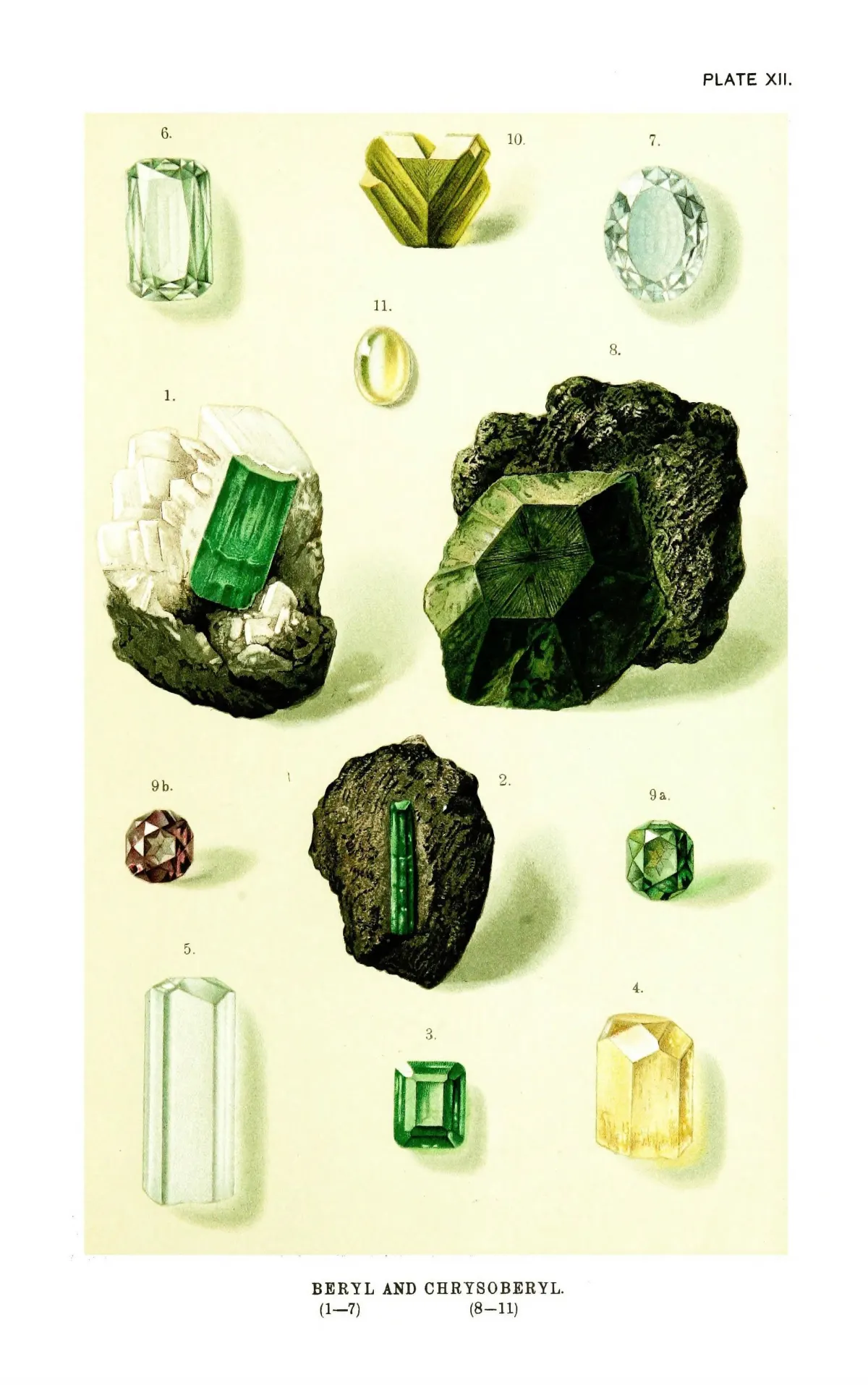
Usually described as green by day, red by lamplight.
- Colour
- green by day, red by lamplight
- Month
- June
- Status
- Added laterAlexandrite was added to June in 1952 by the Jewelry Industry Council of America. The two lists compared.
Name and history
It is named after Alexander II of Russia, with the ending -ite. The stone was discovered in the Ural Mountains around 1830, when he was the young heir to the throne, and the first sample was taken for emerald. Its red and green matched the national military colours of imperial Russia. The Ural deposits did not last, and most alexandrite now comes from Sri Lanka, East Africa and Brazil.
What it actually is
| Species | Chrysoberyl |
|---|---|
| Composition | BeAl₂O₄ |
| Crystal system | orthorhombic |
| Hardness | 8.5 on the Mohs scale. Hard enough for daily wear; dust will not scratch it. |
| Cleavage | distinct on {110}, imperfect on {010}, poor on {001} |
| What makes the colour | chromium (Cr³⁺) replacing aluminium — and the point is the colour change, not the colour: the chromium absorbs a narrow band in the yellow around 520–620 nm, leaving the stone balanced between transmitting red and green, so it reads bluish-green under daylight and purplish-red under incandescent light |
| Mined in | Brazil, Sri Lanka, Tanzania, Madagascar, India |
Hardness, composition and crystal system are standard mineralogical values. Where published sources disagree, the range given covers them.
How it gets damaged
Third hardest of the common gems and hard-wearing, but it has a distinct cleavage direction and is brittle, so a sharp knock can chip it; included or fracture-filled stones should stay out of ultrasonic and steam cleaners.
This describes the physical stone. Nothing on this site claims a gemstone has any therapeutic or healing effect — see the disclaimer.
Which list it is on
| Month | The 1912 list | Today's list |
|---|---|---|
| June | — | Yes |