Birthstone
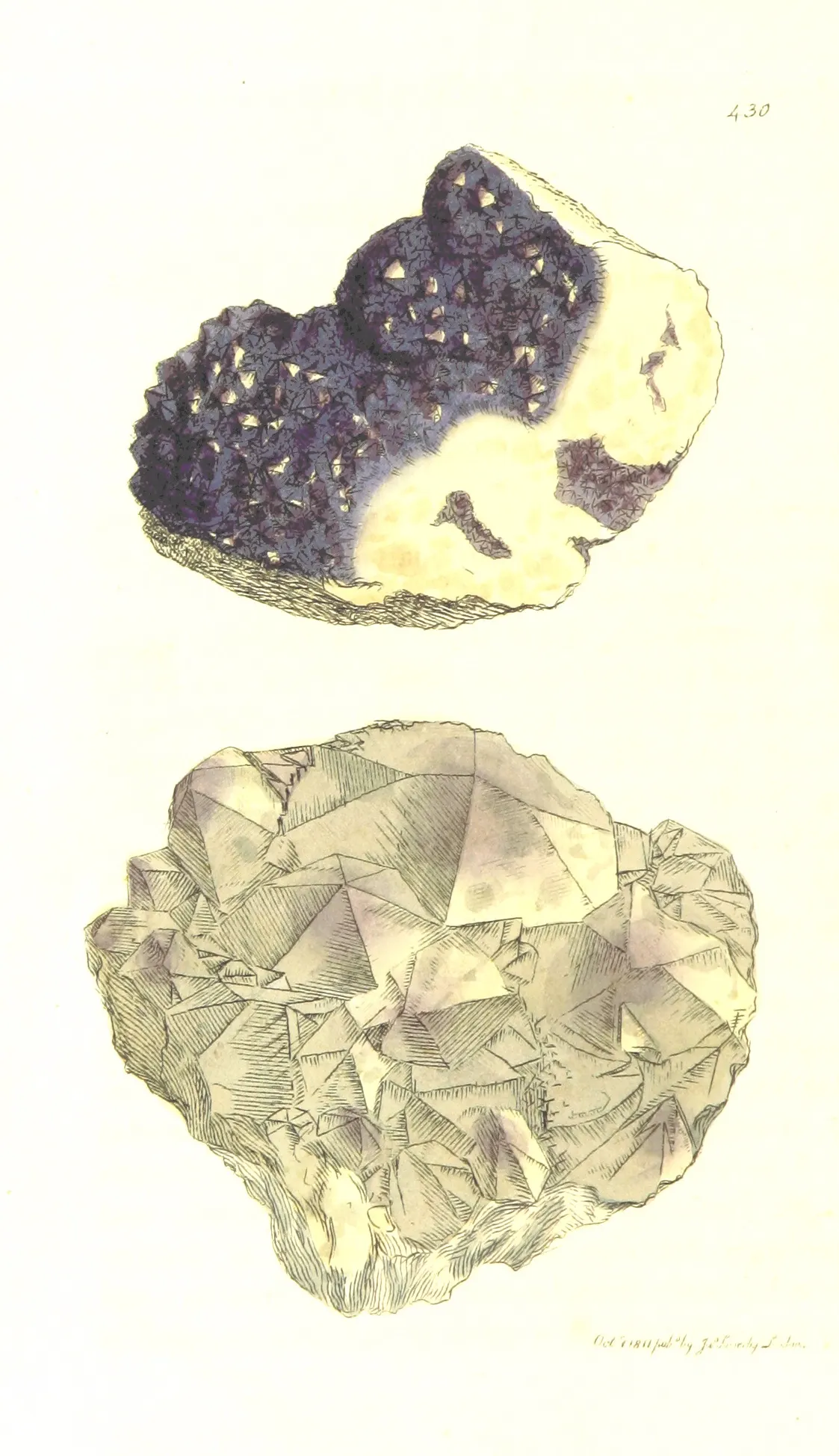
Amethyst
Usually described as purple.
- Colour
- purple
- Month
- February
- Status
- 1912 and todayOn the list adopted in 1912, as a birth-stone, and still on today's. The two lists compared.
Name and history
The Greek amethystos means not drunk, from a-, not, and a verb for making drunk that comes from methy, wine. The word came into English through Latin amethystus and Old French ametiste, and also directly from the Medieval Latin amatistus. It was once counted among the cardinal, or most valuable, gemstones, and lost most of that value after extensive deposits were found in places such as Brazil.
What it actually is
| Species | Quartz |
|---|---|
| Composition | SiO₂ |
| Crystal system | trigonal |
| Hardness | 7 on the Mohs scale. About as hard as the quartz in household dust. |
| Cleavage | none; conchoidal fracture |
| What makes the colour | iron (Fe³⁺) substituting for silicon in the lattice, which natural irradiation converts into an [FeO₄]⁰ colour centre; without the irradiation the iron alone produces no violet |
| Mined in | Brazil, Uruguay, Zambia, Bolivia, Madagascar |
Hardness, composition and crystal system are standard mineralogical values. Where published sources disagree, the range given covers them.
How it gets damaged
Hard and uncleavable but brittle, so it chips on edges and can fracture from thermal shock; prolonged strong sunlight fades the violet, which is why the colour should not be trusted to a shop window.
What is routinely done to it
Heating is routine: gentle heat lightens over-dark material, and above roughly 440 °C the violet colour centre converts to the yellow-orange sold as citrine.
This describes the physical stone. Nothing on this site claims a gemstone has any therapeutic or healing effect — see the disclaimer.
Which list it is on
| Month | The 1912 list | Today's list |
|---|---|---|
| February | Birth-stone | Yes |