Birthstone
Aquamarine
Usually described as pale blue-green.
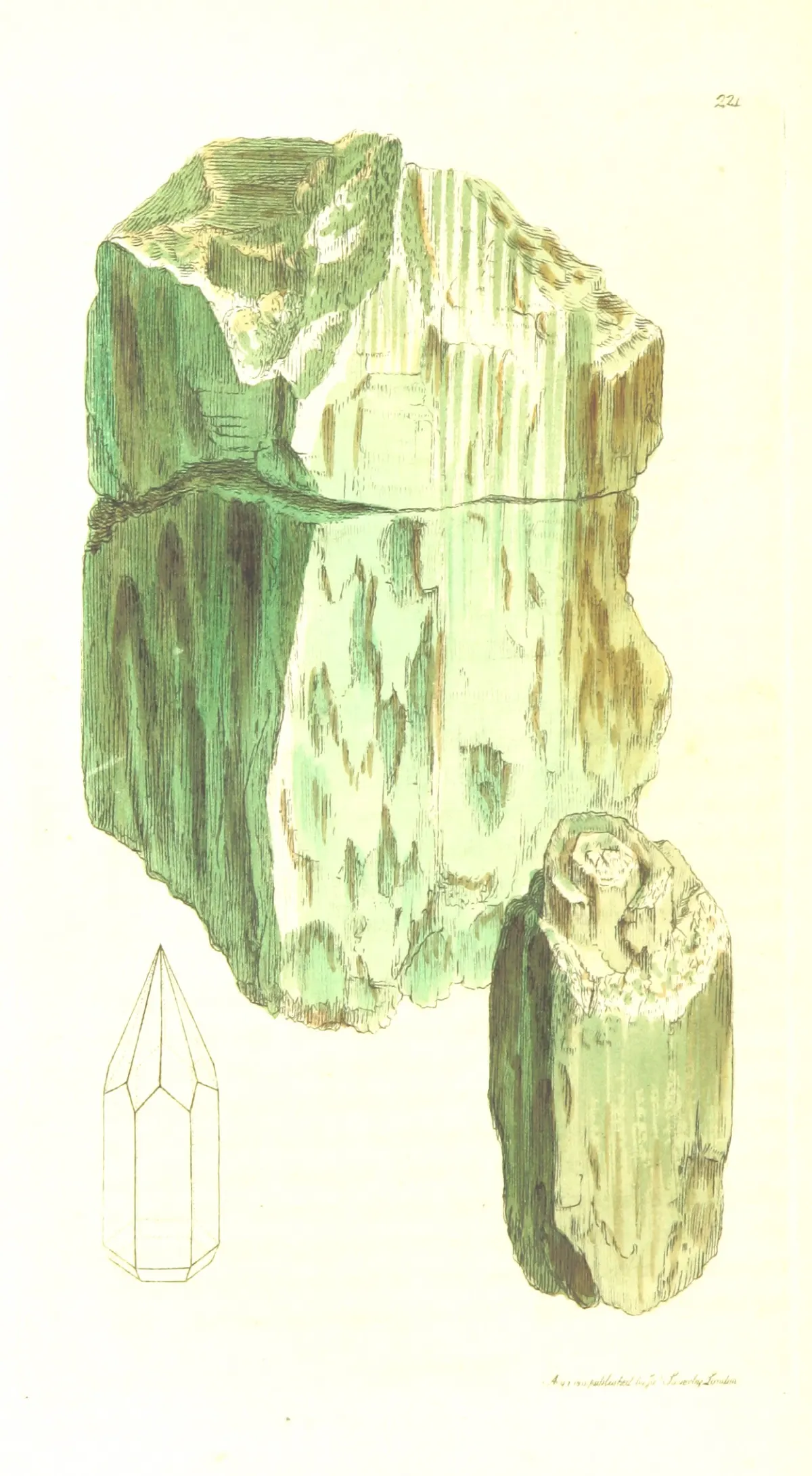
- Colour
- pale blue-green
- Month
- March
- Status
- 1912 and todayOn the list adopted in 1912, as an alternate stone, and still on today's. The two lists compared.
Name and history
The name is the Latin aqua marina, sea water, from aqua, water, and marinus, of the sea. It came into English from French or Provençal, and its first English form, in the 1590s, was agmarine. It is the same mineral as emerald, beryl: iron gives aquamarine its blue, where chromium or vanadium make emerald green.
What it actually is
| Species | Beryl |
|---|---|
| Composition | Be₃Al₂Si₆O₁₈ |
| Crystal system | hexagonal |
| Hardness | 7.5–8 on the Mohs scale. Hard enough for daily wear; dust will not scratch it. |
| Cleavage | imperfect (indistinct) basal cleavage on {0001} |
| What makes the colour | iron — ferrous iron (Fe²⁺) in the structural channels gives the blue, while ferric iron (Fe³⁺) adds the yellow-green cast that heating removes |
| Mined in | Brazil, Nigeria, Madagascar, Mozambique, Pakistan |
Hardness, composition and crystal system are standard mineralogical values. Where published sources disagree, the range given covers them.
How it gets damaged
Durable enough for daily wear, but the basal cleavage and a brittle habit mean a hard knock can chip it; avoid steam cleaning and any stone with surface-reaching fractures in an ultrasonic bath.
What is routinely done to it
Routinely heated to around 400 °C to drive off the yellow-green ferric component and leave a purer blue; the change is permanent and rarely disclosed because it is assumed.
This describes the physical stone. Nothing on this site claims a gemstone has any therapeutic or healing effect — see the disclaimer.
Which list it is on
| Month | The 1912 list | Today's list |
|---|---|---|
| March | Alternate | Yes |