Birthstone
Emerald
Usually described as green.
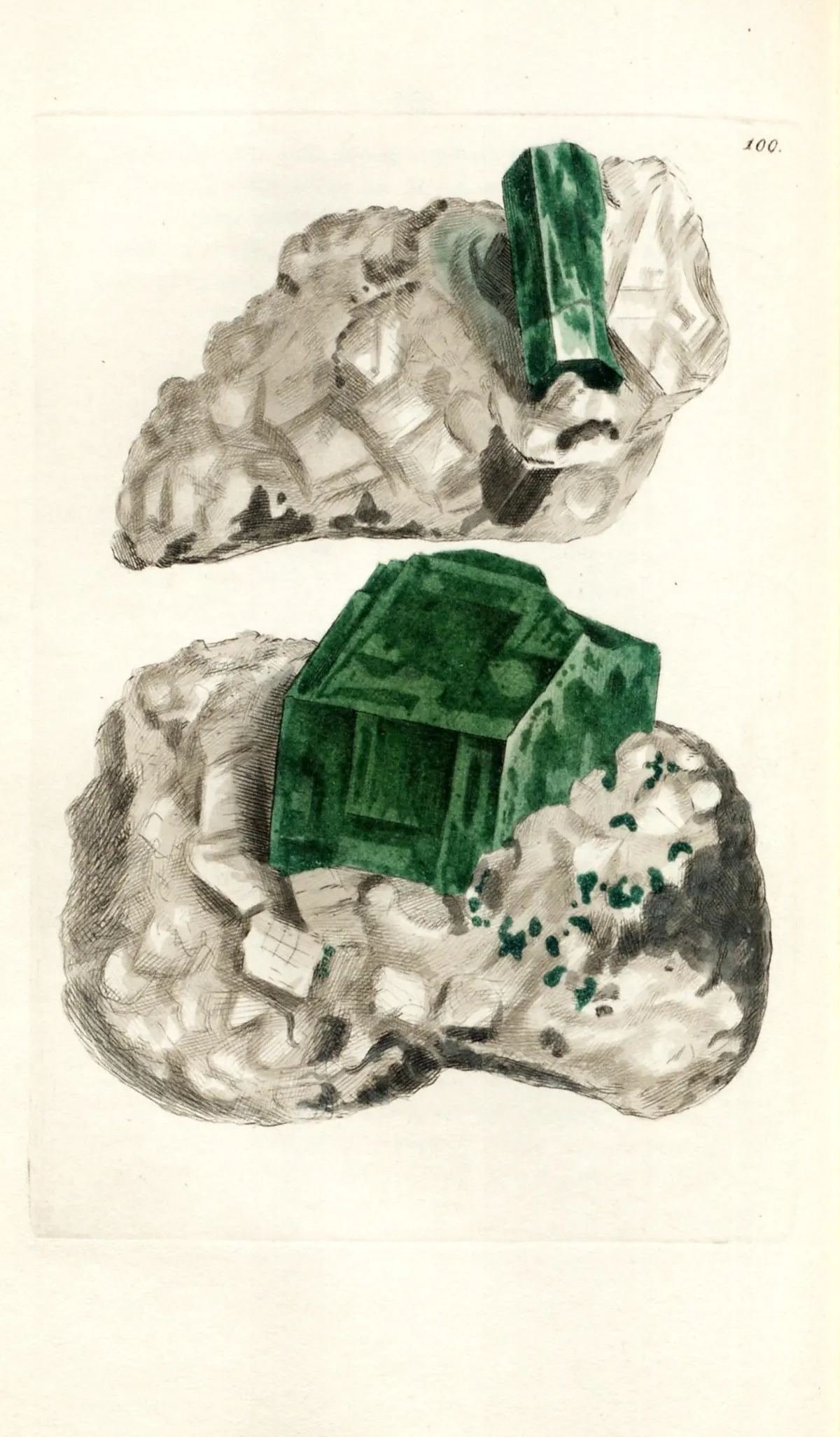
- Colour
- green
- Month
- May
- Status
- 1912 and todayOn the list adopted in 1912, as a birth-stone, and still on today's. The two lists compared.
Name and history
Old French esmeraude gave English the word, through the Medieval Latin esmaraldus and Latin smaragdus, from the Greek smaragdos, a green gem that could be emerald or malachite. That Greek word is traced in turn to a Semitic word for shining; compare the Hebrew bareqeth, emerald, and the Arabic barq, lightning. Emeralds from what is now Colombia were part of the plunder when Spanish explorers invaded the Americas in the sixteenth century.
What it actually is
| Species | Beryl |
|---|---|
| Composition | Be₃Al₂Si₆O₁₈ |
| Crystal system | hexagonal |
| Hardness | 7.5–8 on the Mohs scale. Hard enough for daily wear; dust will not scratch it. |
| Cleavage | imperfect (indistinct) basal cleavage on {0001} |
| What makes the colour | chromium (Cr³⁺), vanadium (V³⁺), or both, substituting for aluminium; iron present alongside them pushes the green towards blue or grey |
| Mined in | Colombia, Zambia, Brazil, Ethiopia, Afghanistan |
Hardness, composition and crystal system are standard mineralogical values. Where published sources disagree, the range given covers them.
How it gets damaged
Hardness is high but emerald is the most fragile of the major gems because it is almost always heavily fractured; ultrasonic and steam cleaners, heat, and solvents such as acetone or alcohol strip or cloud the filling and can open the fractures further.
What is routinely done to it
Filling surface-reaching fractures with cedarwood oil, other oils or polymer resin is near-universal in the trade and must be disclosed; the filler is not permanent.
This describes the physical stone. Nothing on this site claims a gemstone has any therapeutic or healing effect — see the disclaimer.
Which list it is on
| Month | The 1912 list | Today's list |
|---|---|---|
| May | Birth-stone | Yes |