Birthstone
Garnet
Usually described as deep red.
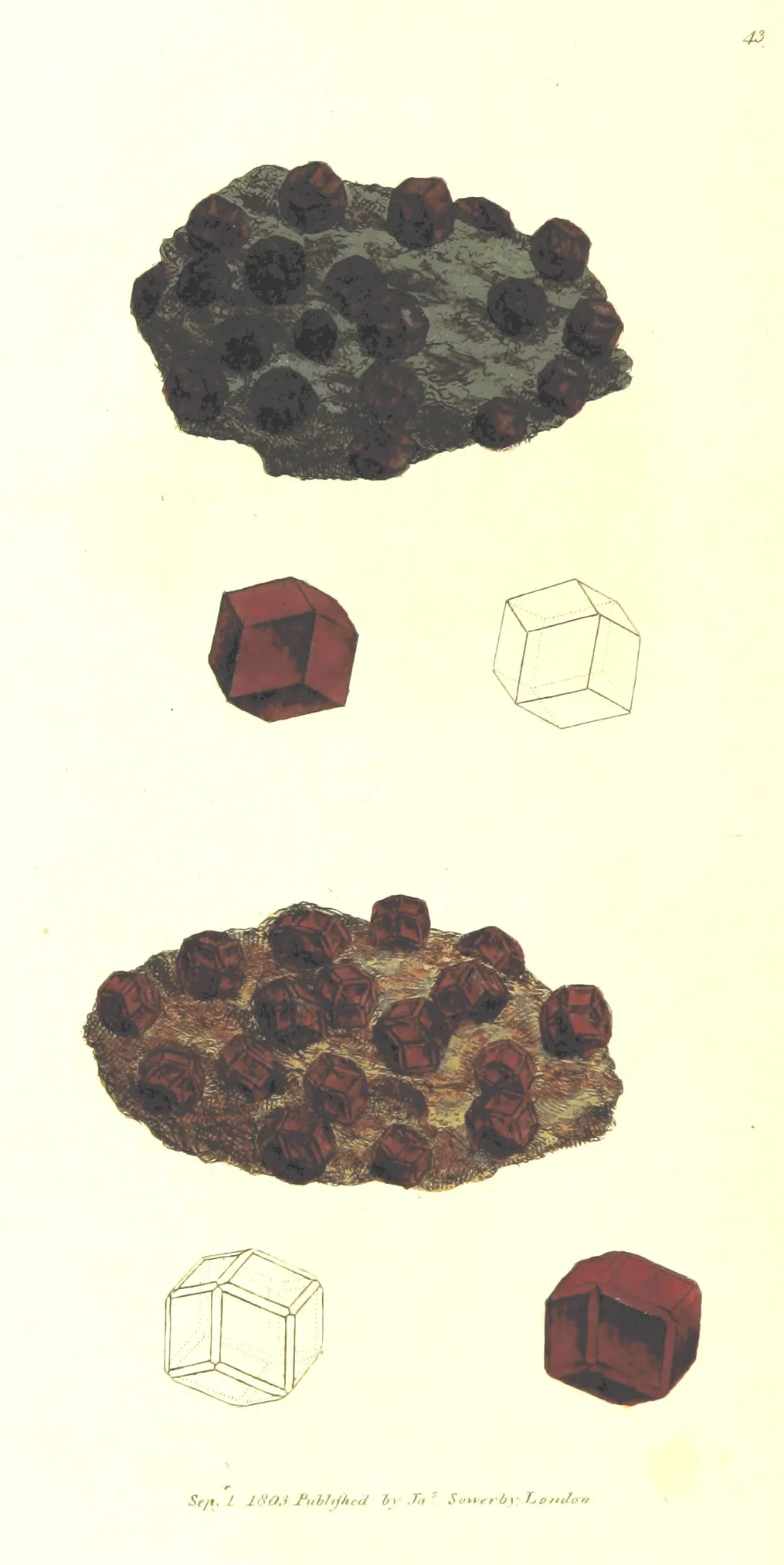
- Colour
- deep red
- Month
- January
- Status
- 1912 and todayOn the list adopted in 1912, as a birth-stone, and still on today's. The two lists compared.
Name and history
The name reached English through Old French grenate from the Medieval Latin granatum, which may have been taken from the words for a pomegranate, whose seeds the red stones resemble. English first had it as gernet, in the early 1300s, before the letters settled into garnet, and there is a second explanation too: the Medieval Latin granum, a grain, the word used for the red dye cochineal.
What it actually is
| Species | Garnet group |
|---|---|
| Composition | X₃Y₂(SiO₄)₃ — almandine Fe₃Al₂(SiO₄)₃, pyrope Mg₃Al₂(SiO₄)₃ |
| Crystal system | cubic |
| Hardness | 6.5–7.5 on the Mohs scale. About as hard as the quartz in household dust. |
| Cleavage | none (indistinct); conchoidal to uneven fracture |
| What makes the colour | iron (Fe²⁺) in almandine and pyrope gives the familiar red, manganese gives the orange of spessartine, vanadium with some chromium gives the green of tsavorite grossular, and chromium the green of demantoid andradite, where the iron of andradite itself adds a yellow cast; in most garnets the colouring element is part of the composition rather than a trace impurity |
| Mined in | Mozambique, Tanzania, Madagascar, Namibia, Sri Lanka |
Hardness, composition and crystal system are standard mineralogical values. Where published sources disagree, the range given covers them.
How it gets damaged
Hard enough for everyday wear and with no cleavage to split along, but it is brittle and can chip on an edge; demantoid and heavily included stones should be kept out of ultrasonic cleaners and away from sudden heat.
This describes the physical stone. Nothing on this site claims a gemstone has any therapeutic or healing effect — see the disclaimer.
Which list it is on
| Month | The 1912 list | Today's list |
|---|---|---|
| January | Birth-stone | Yes |