Birthstone
Moonstone
Usually described as milky with blue sheen.
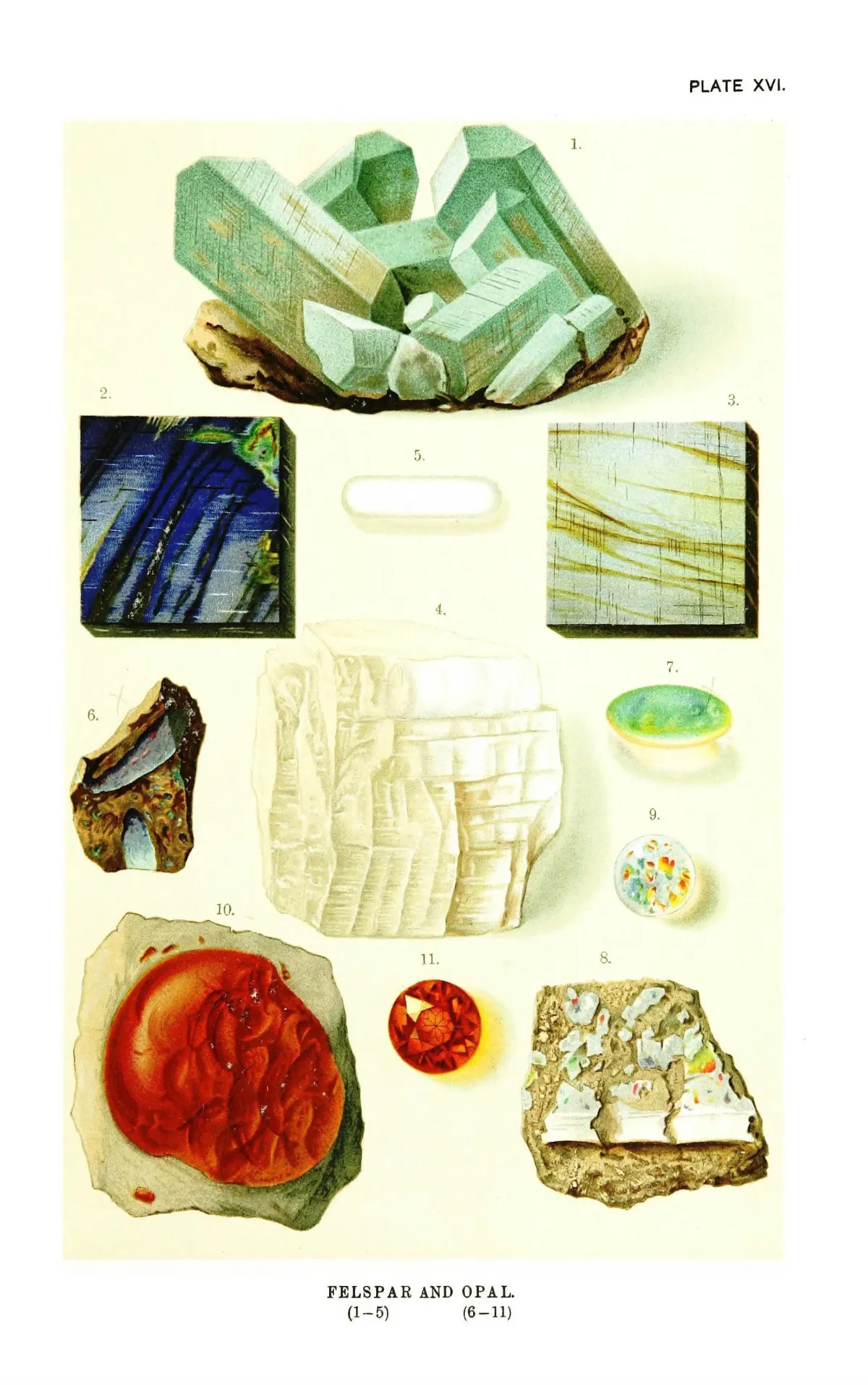
- Colour
- milky with blue sheen
- Month
- June
- Status
- 1912 and todayOn the list adopted in 1912, as an alternate stone, and still on today's. The two lists compared.
Name and history
The English name is simply moon and stone put together. The sheen it is known for is called adularescence, a word taken from adularia, the feldspar that most typically shows the effect, which is named after the Adula Alps in Switzerland, where it was first reported. The Romans and the Greeks both associated it with their lunar deities.
What it actually is
| Species | Feldspar — orthoclase with exsolved albite lamellae |
|---|---|
| Composition | (K,Na)AlSi₃O₈ |
| Crystal system | monoclinic |
| Hardness | 6–6.5 on the Mohs scale. Softer than the quartz in household dust, so it dulls with everyday wear. |
| Cleavage | perfect in one direction and good in a second, the two meeting at about 90° |
| What makes the colour | physical, not chemical — the body is near-colourless, and the blue-to-white adularescence is light scattered and diffracted by alternating submicroscopic lamellae of orthoclase and albite; thinner layers give blue, thicker ones a white sheen |
| Mined in | Sri Lanka, India, Madagascar, Myanmar, Tanzania |
Hardness, composition and crystal system are standard mineralogical values. Where published sources disagree, the range given covers them.
How it gets damaged
Two good-to-perfect cleavages and only moderate hardness make it one of the easiest gems to chip or split; it also carries internal tension cracks, so avoid knocks, ultrasonic and steam cleaners, and sudden temperature change.
This describes the physical stone. Nothing on this site claims a gemstone has any therapeutic or healing effect — see the disclaimer.
Which list it is on
| Month | The 1912 list | Today's list |
|---|---|---|
| June | Alternate | Yes |