Birthstone
Pearl
Usually described as white to cream.
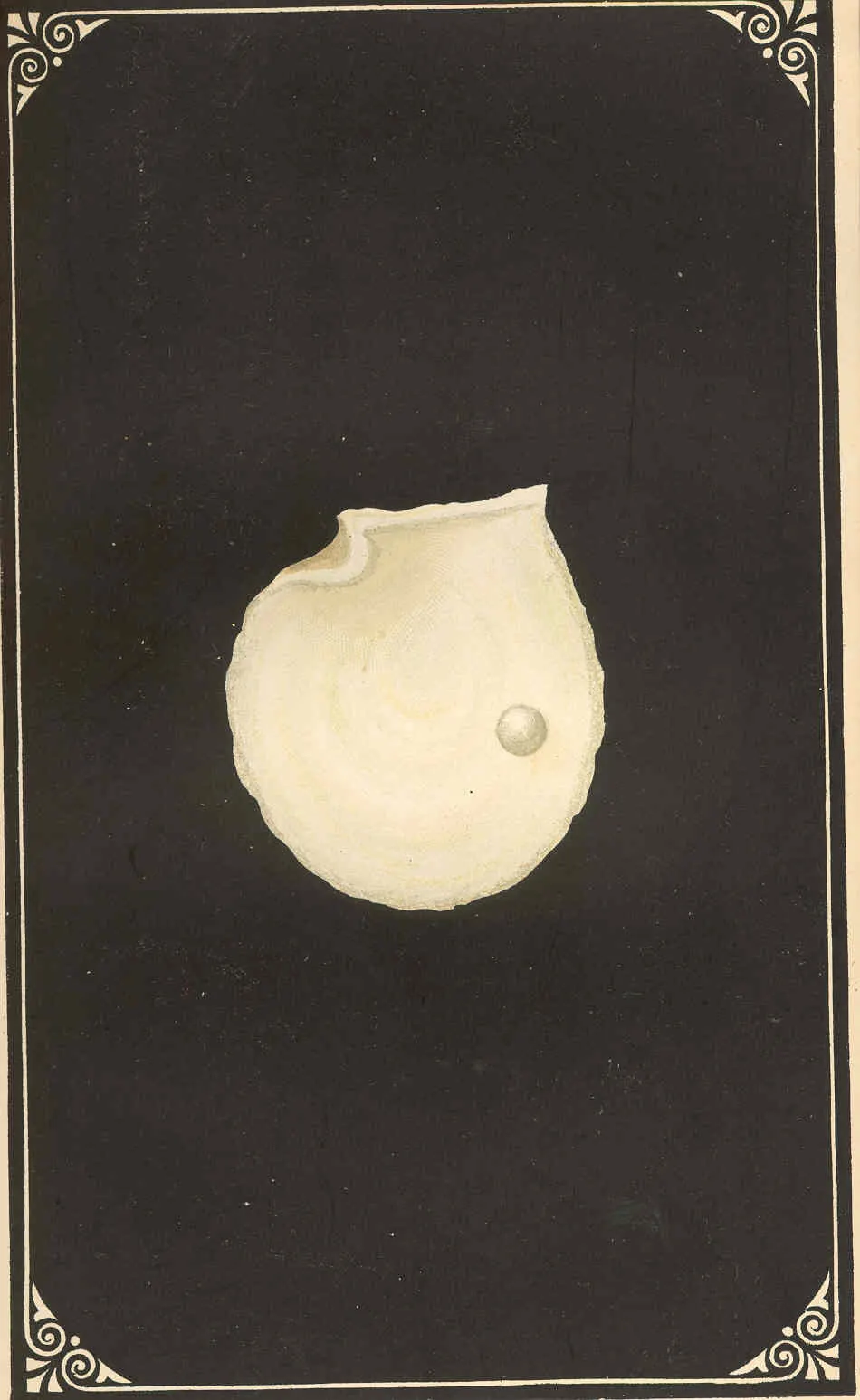
- Colour
- white to cream
- Month
- June
- Status
- 1912 and todayOn the list adopted in 1912, as a birth-stone, and still on today's. The two lists compared.
Name and history
Old French perle and Medieval Latin perla are of unknown origin. One suggestion is a Vulgar Latin pernula, from the Latin perna, which in Sicily meant a pearl and earlier a sea mussel, and literally meant a ham, after the shape of the shell.
What it actually is
| Material | Nacre — a biomineral of aragonite platelets bound by the protein conchiolin, secreted by a mollusc |
|---|---|
| Composition | CaCO₃ (aragonite) with conchiolin |
| Crystal system | none — a biomineral with no crystal habit of its own; the individual aragonite platelets are orthorhombic |
| Hardness | 2.5–4.5 on the Mohs scale. Softer than window glass, and soft enough that ordinary dust will mark it. |
| Cleavage | none (the aragonite platelets are too small and too irregularly stacked for cleavage to express) |
| What makes the colour | physical, not chemical — the orient and overtone are interference and diffraction of light in the stacked aragonite platelets of the nacre, a few hundred nanometres thick; the underlying body colour comes from pigments in the conchiolin and in the host mollusc's shell |
| Mined in | China, Japan, Australia, Indonesia, French Polynesia |
Hardness, composition and crystal system are standard mineralogical values. Where published sources disagree, the range given covers them.
How it gets damaged
The softest gem in common use and made of calcium carbonate, so it dissolves in acid — perfume, hairspray, cosmetics, vinegar and even perspiration etch the nacre; ultrasonic and steam cleaners crack it, dry heat shrinks the conchiolin, and solvents lift dye.
What is routinely done to it
Bleaching with hydrogen peroxide is routine on virtually all cultured pearls, and dyeing, irradiation and lustre treatments are common.
This describes the physical stone. Nothing on this site claims a gemstone has any therapeutic or healing effect — see the disclaimer.
Which list it is on
| Month | The 1912 list | Today's list |
|---|---|---|
| June | Birth-stone | Yes |