Birthstone
Sardonyx
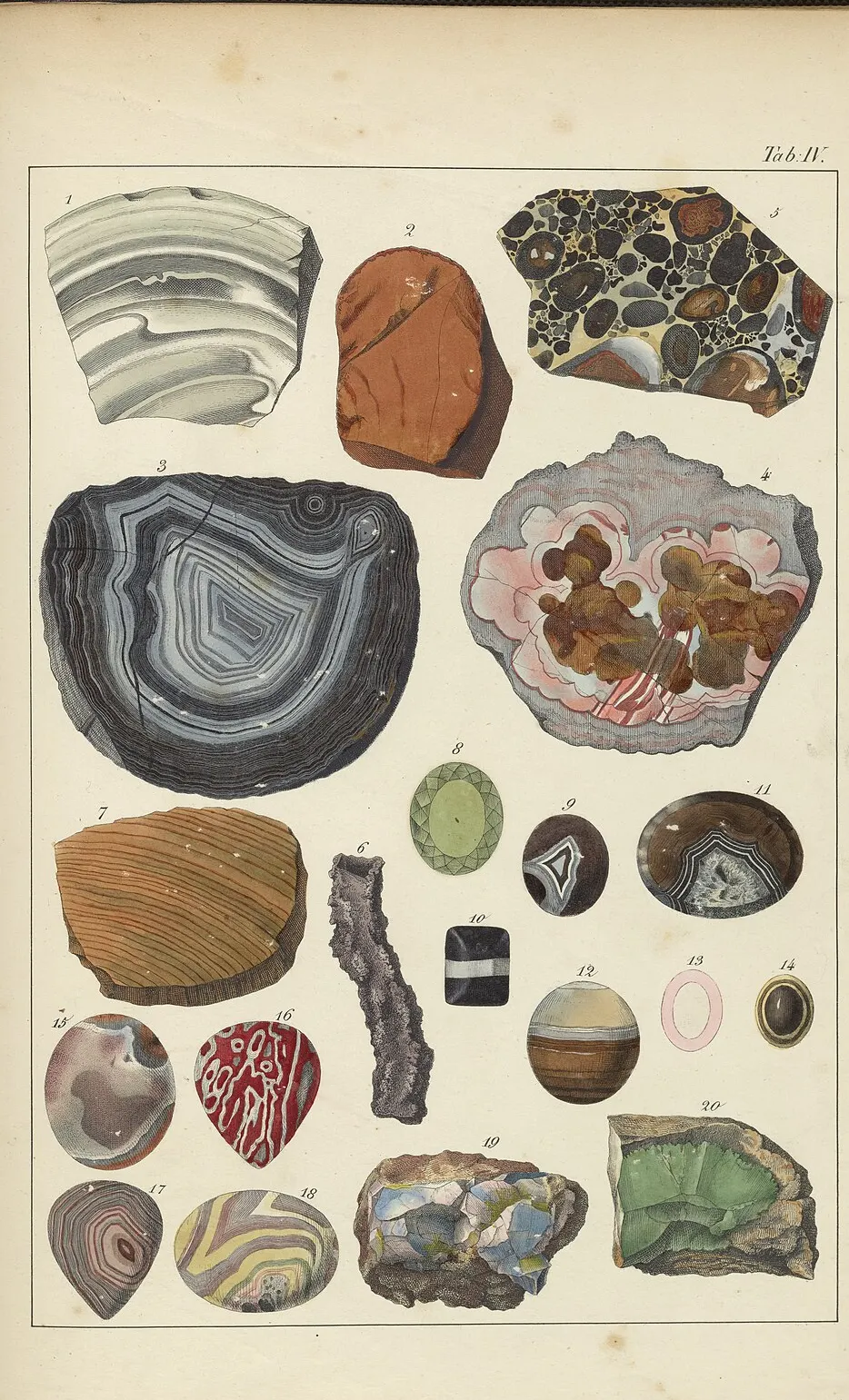
Usually described as banded red-brown and white.
- Colour
- banded red-brown and white
- Month
- August
- Status
- 1912 and todayOn the list adopted in 1912, as a birth-stone, and still on today's. The two lists compared.
Name and history
The word came into Middle English from Latin sardonyx and, before that, the Ancient Greek sardonux. Sardonyx is onyx whose coloured bands are sard, a stone Pliny said was named after Sardis in Lydia, where it came from, and the largest cameo from antiquity, the Great Cameo of France, is cut in five layers of it.
What it actually is
| Species | Quartz (cryptocrystalline — banded chalcedony: sard alternating with onyx) |
|---|---|
| Composition | SiO₂ |
| Crystal system | trigonal |
| Hardness | 6.5–7 on the Mohs scale. About as hard as the quartz in household dust. |
| Cleavage | none; conchoidal to splintery fracture |
| What makes the colour | iron oxide disseminated through the sard layers gives the brown to orange-red bands, while the alternating bands are near-colourless to white chalcedony; the banding is a growth structure, not a single chromophore |
| Mined in | India, Brazil, Uruguay, Madagascar, Germany |
Hardness, composition and crystal system are standard mineralogical values. Where published sources disagree, the range given covers them.
How it gets damaged
Tough and uncleavable, which is why it has been carved into cameos for two thousand years, but it scratches against harder stones, and dyes can fade in sunlight or be lifted by solvents such as alcohol and acetone.
What is routinely done to it
Dyeing banded chalcedony is an ancient and still routine trade practice — Idar-Oberstein perfected it in the 1820s — so band colours and contrast frequently are not natural.
This describes the physical stone. Nothing on this site claims a gemstone has any therapeutic or healing effect — see the disclaimer.
Which list it is on
| Month | The 1912 list | Today's list |
|---|---|---|
| August | Birth-stone | Yes |