Wands · minor arcana
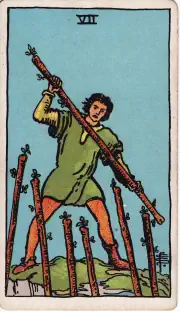
Seven of Wands
One of the fourteen wands. Drawn by Pamela Colman Smith for the deck first published in London in December 1909.
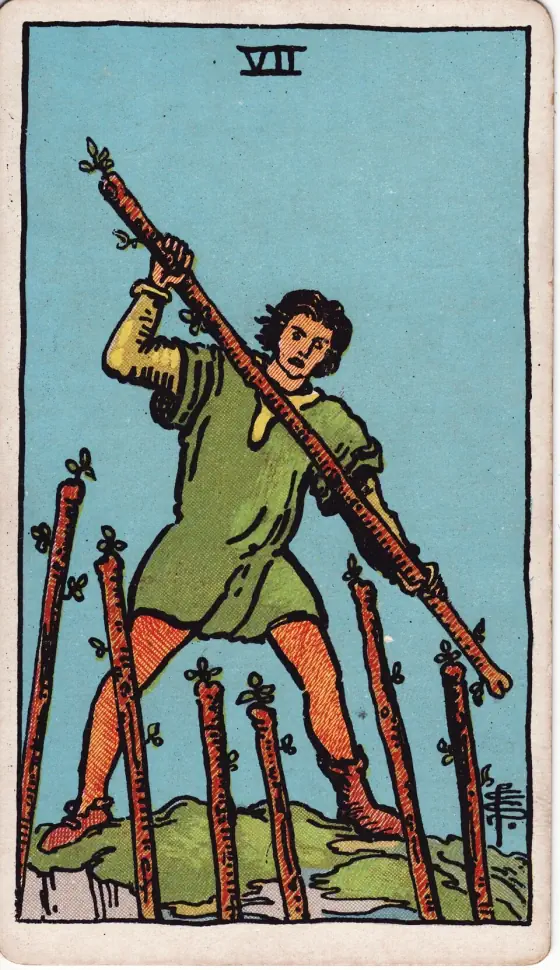
What is drawn on it
A young man on a craggy eminence brandishing a staff; six other staves are raised towards him from below.
A. E. Waite, The Pictorial Key to the Tarot, 1911, Part III, § 2, where the meanings below follow it in the same paragraph.
What Waite says it means
These are the divinatory meanings printed in 1911, quoted as he wrote them. They are reported here as what one named book says, not as a claim that a card means anything or predicts anything.
- Upright
- It is a card of valour, for, on the surface, six are attacking one, who has, however, the vantage position. On the intellectual plane, it signifies discussion, wordy strife; in business—negotiations, war of trade, barter, competition. It is further a card of success, for the combatant is on the top and his enemies may be unable to reach him.
- Reversed
- Perplexity, embarrassments, anxiety. It is also a caution against indecision.
A. E. Waite, The Pictorial Key to the Tarot, London, 1911, Part III, § 2. Out of copyright.
Its suit
Wands is one of the four suits of the minor arcana. The Golden Dawn attributed it to fire, and in the tradition Waite worked in it is taken to cover work, enterprise and the will to begin things. Its counterpart in an ordinary playing-card pack is clubs: the two packs share an ancestor, rather than one descending from the other.
The wands
Read on
Card face: Pamela Colman Smith, from the first printing published by William Rider & Son. Public domain. Source file. Full list on the credits page.
