Wands · minor arcana
Two of Wands
One of the fourteen wands. Drawn by Pamela Colman Smith for the deck first published in London in December 1909.
What is drawn on it
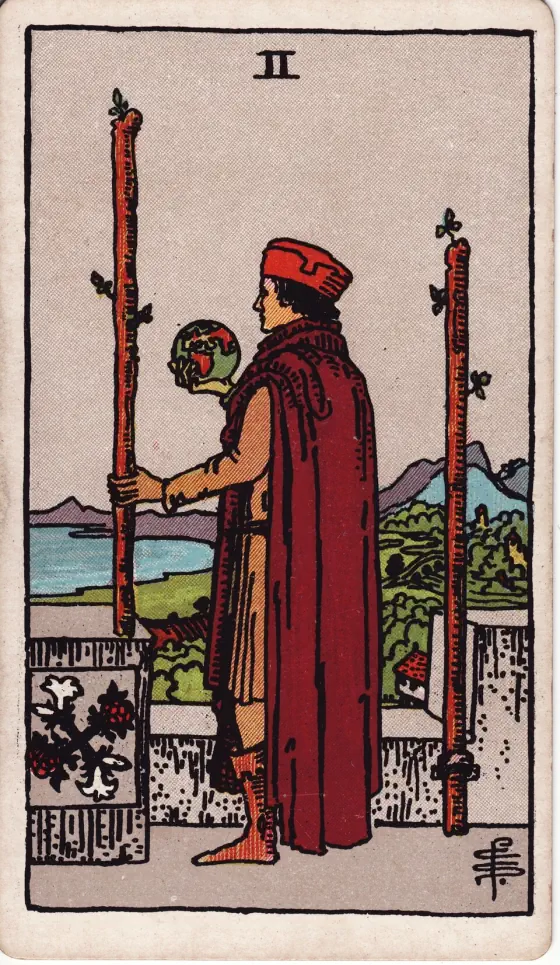
A tall man looks from a battlemented roof over sea and shore; he holds a globe in his right hand, while a staff in his left rests on the battlement; another is fixed in a ring. The Rose and Cross and Lily should be noticed on the left side.
A. E. Waite, The Pictorial Key to the Tarot, 1911, Part III, § 2, where the meanings below follow it in the same paragraph.
What Waite says it means
These are the divinatory meanings printed in 1911, quoted as he wrote them. They are reported here as what one named book says, not as a claim that a card means anything or predicts anything.
- Upright
- Between the alternative readings there is no marriage possible; on the one hand, riches, fortune, magnificence; on the other, physical suffering, disease, chagrin, sadness, mortification. The design gives one suggestion; here is a lord overlooking his dominion and alternately contemplating a globe; it looks like the malady, the mortification, the sadness of Alexander amidst the grandeur of this world's wealth.
- Reversed
- Surprise, wonder, enchantment, emotion, trouble, fear.
A. E. Waite, The Pictorial Key to the Tarot, London, 1911, Part III, § 2. Out of copyright.
Its suit
Wands is one of the four suits of the minor arcana. The Golden Dawn attributed it to fire, and in the tradition Waite worked in it is taken to cover work, enterprise and the will to begin things. Its counterpart in an ordinary playing-card pack is clubs: the two packs share an ancestor, rather than one descending from the other.
The wands
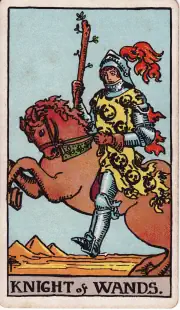
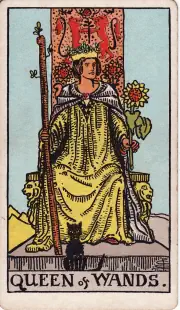
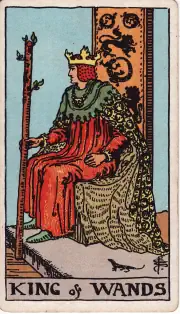
Read on
Card face: Pamela Colman Smith, from the first printing published by William Rider & Son. Public domain. Source file. Full list on the credits page.
