Fire · Cardinal
Aries
The Ram, the 1st sign of the zodiac year, usually printed as 21 March – 19 April.
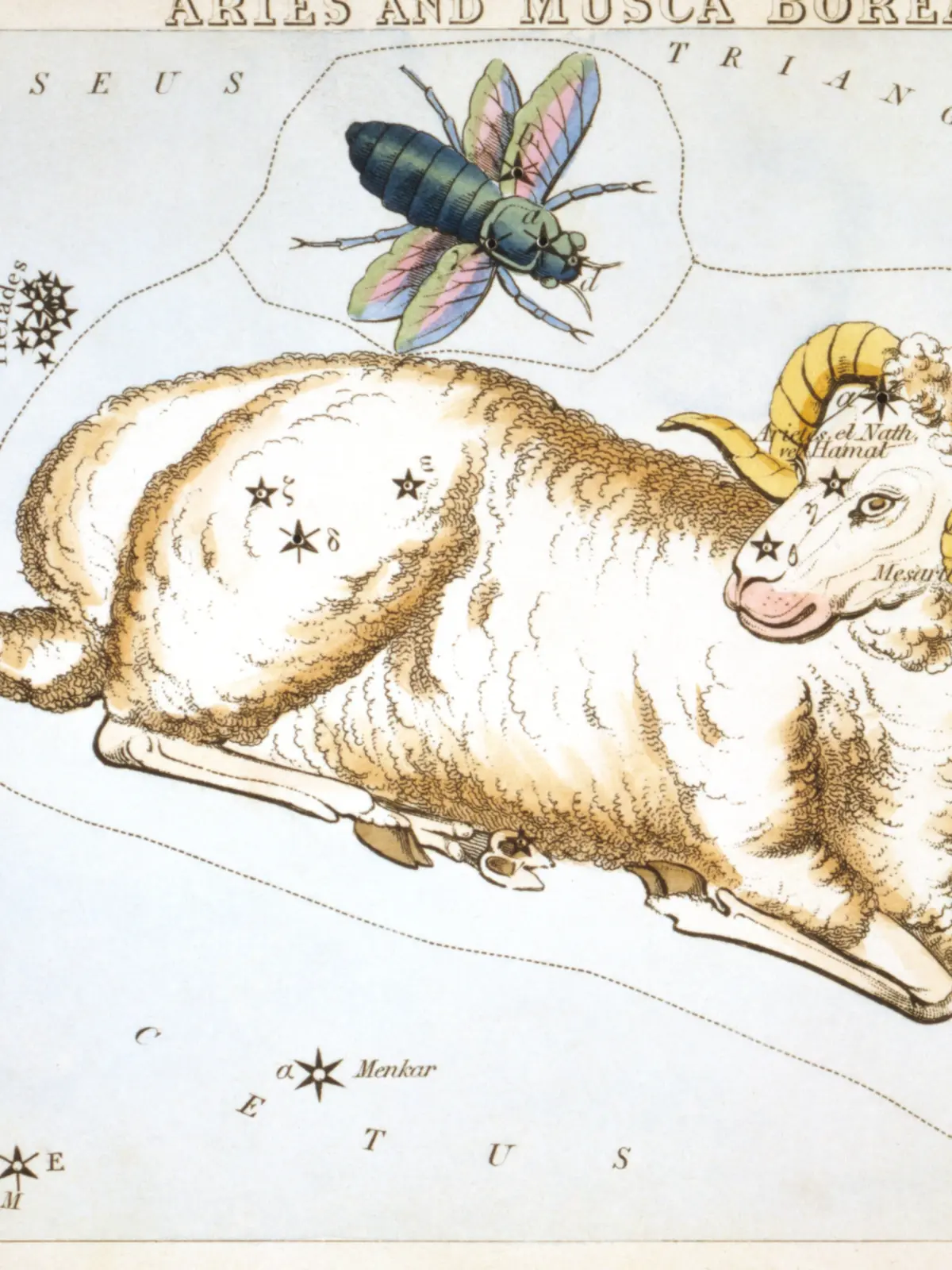
- Element
- Fireenergy, initiative and self-assertion, in the tradition
- Modality
- Cardinalthe signs that open a season, traditionally read as initiators
- Traditional ruler
- MarsAssigned before the outer planets were found
- Modern ruler
- MarsSame as the traditional ruler.
When the sun actually crosses
The moment the sun enters Aries and the moment it leaves for Taurus, each year from 2015 to 2026, in UTC to the minute.
| Year | Sun enters Aries | Sun leaves for Taurus |
|---|---|---|
| 2015 | 20 March, 22:45 UTC | 20 April, 09:42 UTC |
| 2016 | 20 March, 04:30 UTC | 19 April, 15:29 UTC |
| 2017 | 20 March, 10:29 UTC | 19 April, 21:27 UTC |
| 2018 | 20 March, 16:15 UTC | 20 April, 03:12 UTC |
| 2019 | 20 March, 21:58 UTC | 20 April, 08:55 UTC |
| 2020 | 20 March, 03:50 UTC | 19 April, 14:46 UTC |
| 2021 | 20 March, 09:37 UTC | 19 April, 20:33 UTC |
| 2022 | 20 March, 15:33 UTC | 20 April, 02:24 UTC |
| 2023 | 20 March, 21:24 UTC | 20 April, 08:13 UTC |
| 2024 | 20 March, 03:06 UTC | 19 April, 14:00 UTC |
| 2025 | 20 March, 09:01 UTC | 19 April, 19:56 UTC |
| 2026 | 20 March, 14:46 UTC | 20 April, 01:39 UTC |
VSOP87, checked against published equinox and solstice times.
Which dates can be Aries
Since 1920 the sun has entered Aries on 20 March or 21 March, and left it for Taurus on 19 April, 20 April or 21 April (UTC). On those dates the sign depends on the year, and in a crossing year on the hour; each date's page gives every year.
In the tradition
In Western astrological tradition, Aries is classed as a cardinal fire sign. Cardinal signs are the signs that open a season, traditionally read as initiators, and fire signs are traditionally associated with energy, initiative and self-assertion. Its ruling planet in that tradition is Mars.
These are associations reported from tradition, not claims about anyone born under the sign.
The ram with the golden fleece
The Astronomica, the Latin handbook to the constellations that goes under the name of Hyginus, says this is the ram that carried Phrixus and his sister Helle away over the sea, and that Hesiod and Pherecydes gave it a fleece of gold. Helle fell from its back into the strait that was named after her, the Hellespont. Phrixus came safely to Aeetes, sacrificed the ram to Jove and hung its fleece in a temple.
Nubes, who had rescued the two children and set them on the ram, put its image among the stars, where it marks the time of year when grain is sown: Ino's sowing of parched grain was the chief reason for their flight. Hyginus also gives Eratosthenes' version, in which the ram took off its own golden fleece, gave it to Phrixus to remember it by and went up to the stars of its own accord, "for this reason it seems somewhat dim."
Hyginus, Astronomica, book 2, in Mary Grant's translation (1960), chapter 2.20, checked .