Earth · Fixed
Taurus
The Bull, the 2nd sign of the zodiac year, usually printed as 20 April – 20 May.
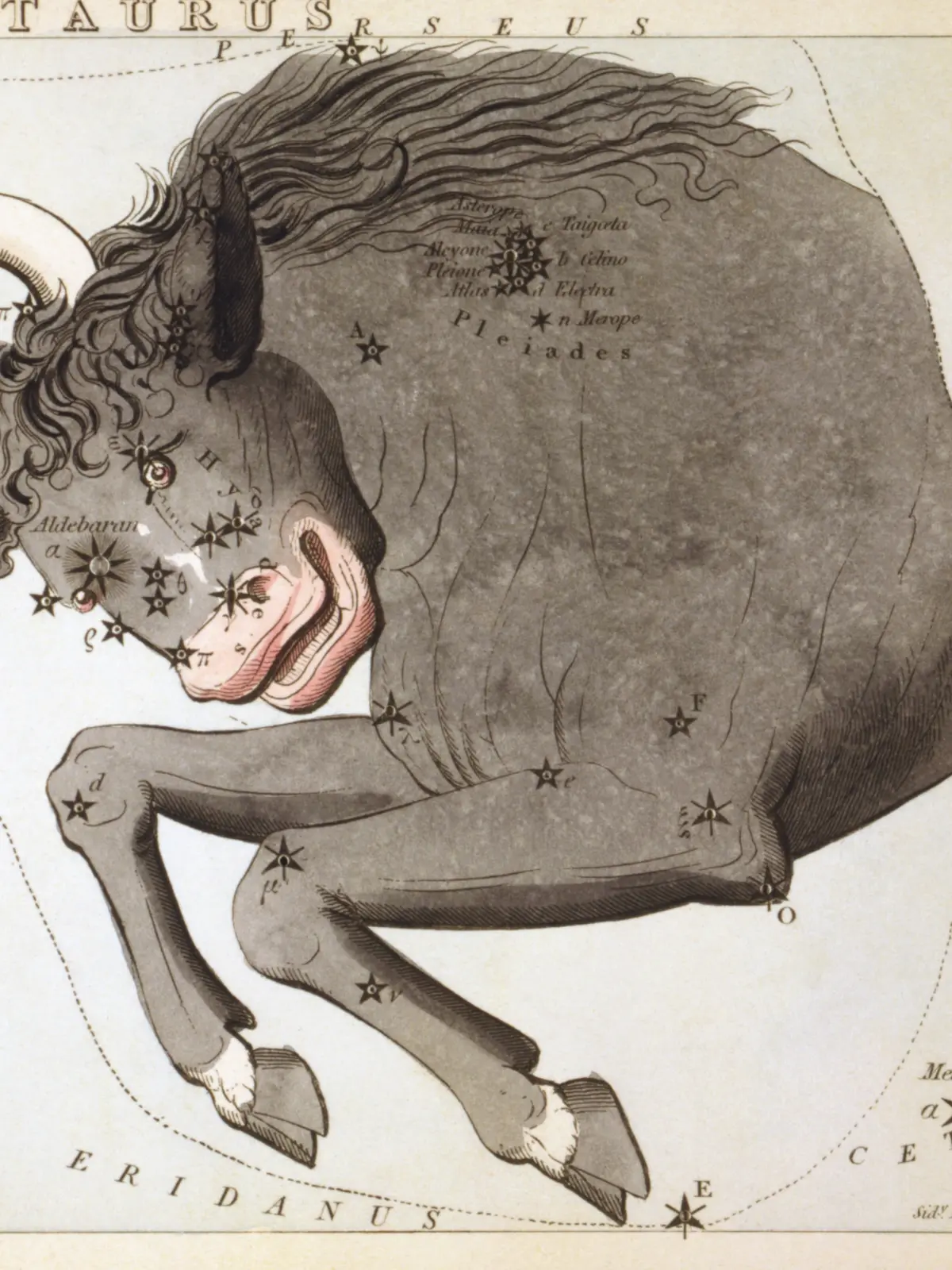
- Element
- Earthpracticality, endurance and the material world, in the tradition
- Modality
- Fixedthe signs that hold the middle of a season, traditionally read as sustainers
- Traditional ruler
- VenusAssigned before the outer planets were found
- Modern ruler
- VenusSame as the traditional ruler.
When the sun actually crosses
The moment the sun enters Taurus and the moment it leaves for Gemini, each year from 2015 to 2026, in UTC to the minute.
| Year | Sun enters Taurus | Sun leaves for Gemini |
|---|---|---|
| 2015 | 20 April, 09:42 UTC | 21 May, 08:45 UTC |
| 2016 | 19 April, 15:29 UTC | 20 May, 14:36 UTC |
| 2017 | 19 April, 21:27 UTC | 20 May, 20:31 UTC |
| 2018 | 20 April, 03:12 UTC | 21 May, 02:15 UTC |
| 2019 | 20 April, 08:55 UTC | 21 May, 07:59 UTC |
| 2020 | 19 April, 14:46 UTC | 20 May, 13:49 UTC |
| 2021 | 19 April, 20:33 UTC | 20 May, 19:37 UTC |
| 2022 | 20 April, 02:24 UTC | 21 May, 01:23 UTC |
| 2023 | 20 April, 08:13 UTC | 21 May, 07:09 UTC |
| 2024 | 19 April, 14:00 UTC | 20 May, 13:00 UTC |
| 2025 | 19 April, 19:56 UTC | 20 May, 18:55 UTC |
| 2026 | 20 April, 01:39 UTC | 21 May, 00:37 UTC |
VSOP87, checked against published equinox and solstice times.
Which dates can be Taurus
Since 1920 the sun has entered Taurus on 19 April, 20 April or 21 April, and left it for Gemini on 20 May, 21 May or 22 May (UTC). On those dates the sign depends on the year, and in a crossing year on the hour; each date's page gives every year.
In the tradition
In Western astrological tradition, Taurus is classed as a fixed earth sign. Fixed signs are the signs that hold the middle of a season, traditionally read as sustainers, and earth signs are traditionally associated with practicality, endurance and the material world. Its ruling planet in that tradition is Venus.
These are associations reported from tradition, not claims about anyone born under the sign.
The bull that carried Europa
The Bull is among the stars, Hyginus says, because it carried Europa safely to Crete, as Euripides tells it. Others said that when Io had been turned into a heifer, Jupiter, to make amends, put up a figure that "resembled a bull in its fore parts, but was dim behind." The stars that outline its face are the Hyades, who were, Pherecydes says, the seven nurses of Liber, placed in the sky by Jove for bringing the god to Thebes.
Some astronomers called the Pleiades the Bull's tail. They are said to be seven, though only six can be seen, and Hyginus gives two reasons: Merope married a mortal, Sisyphus, so her star is dim, or Electra left her sisters in grief after Troy fell and her descendants through Dardanus were overthrown.
Hyginus, Astronomica, book 2, in Mary Grant's translation (1960), chapter 2.21, checked .