Fire · Mutable
Sagittarius
The Archer, the 9th sign of the zodiac year, usually printed as 22 November – 21 December.
- Element
- Fireenergy, initiative and self-assertion, in the tradition
- Modality
- Mutablethe signs that close a season, traditionally read as adapters
- Traditional ruler
- JupiterAssigned before the outer planets were found
- Modern ruler
- JupiterSame as the traditional ruler.
When the sun actually crosses
The moment the sun enters Sagittarius and the moment it leaves for Capricorn, each year from 2015 to 2026, in UTC to the minute.
| Year | Sun enters Sagittarius | Sun leaves for Capricorn |
|---|---|---|
| 2015 | 22 November, 15:26 UTC | 22 December, 04:48 UTC |
| 2016 | 21 November, 21:22 UTC | 21 December, 10:44 UTC |
| 2017 | 22 November, 03:05 UTC | 21 December, 16:28 UTC |
| 2018 | 22 November, 09:01 UTC | 21 December, 22:22 UTC |
| 2019 | 22 November, 14:59 UTC | 22 December, 04:20 UTC |
| 2020 | 21 November, 20:40 UTC | 21 December, 10:03 UTC |
| 2021 | 22 November, 02:34 UTC | 21 December, 15:59 UTC |
| 2022 | 22 November, 08:21 UTC | 21 December, 21:48 UTC |
| 2023 | 22 November, 14:03 UTC | 22 December, 03:28 UTC |
| 2024 | 21 November, 19:56 UTC | 21 December, 09:20 UTC |
| 2025 | 22 November, 01:36 UTC | 21 December, 15:03 UTC |
| 2026 | 22 November, 07:24 UTC | 21 December, 20:50 UTC |
VSOP87, checked against published equinox and solstice times.
Which dates can be Sagittarius
Since 1920 the sun has entered Sagittarius on 21 November, 22 November or 23 November, and left it for Capricorn on 21 December or 22 December (UTC). On those dates the sign depends on the year, and in a crossing year on the hour; each date's page gives every year.
In the tradition
In Western astrological tradition, Sagittarius is classed as a mutable fire sign. Mutable signs are the signs that close a season, traditionally read as adapters, and fire signs are traditionally associated with energy, initiative and self-assertion. Its ruling planet in that tradition is Jupiter.
These are associations reported from tradition, not claims about anyone born under the sign.
Crotus, friend of the Muses
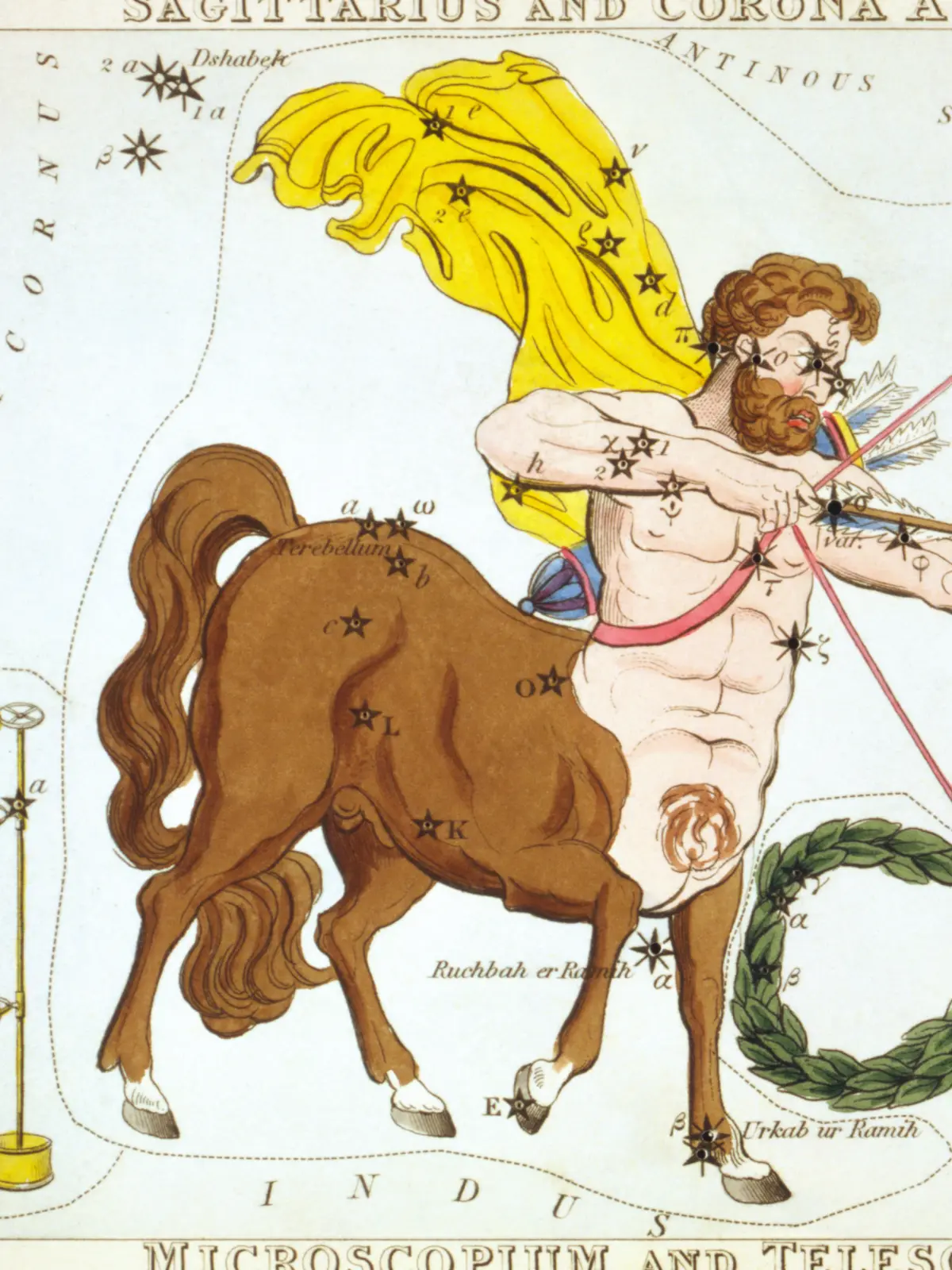
Many called this figure the Centaur, Hyginus writes, and others denied it, because no centaur uses arrows, and asked why he has a horse's flanks but a satyr's tail. The answer he records comes from the tragedian Sositheus: the archer is Crotus, son of Eupheme, the nurse of the Muses, who lived on Mount Helicon in their company, hunted there, and was swift in the woods and clever in the arts.
The Muses asked Jove to place him among the stars, and Jove gave him a body that showed all his skills at once: horse's flanks because he rode a great deal, arrows for his keenness and his speed, and a satyr's tail because the Muses delighted in him as Liber did in the Satyrs. The ring of stars before his feet some said was a wreath, "thrown off as by one at play."
Hyginus, Astronomica, book 2, in Mary Grant's translation (1960), chapter 2.27, checked .