Major arcana
Death
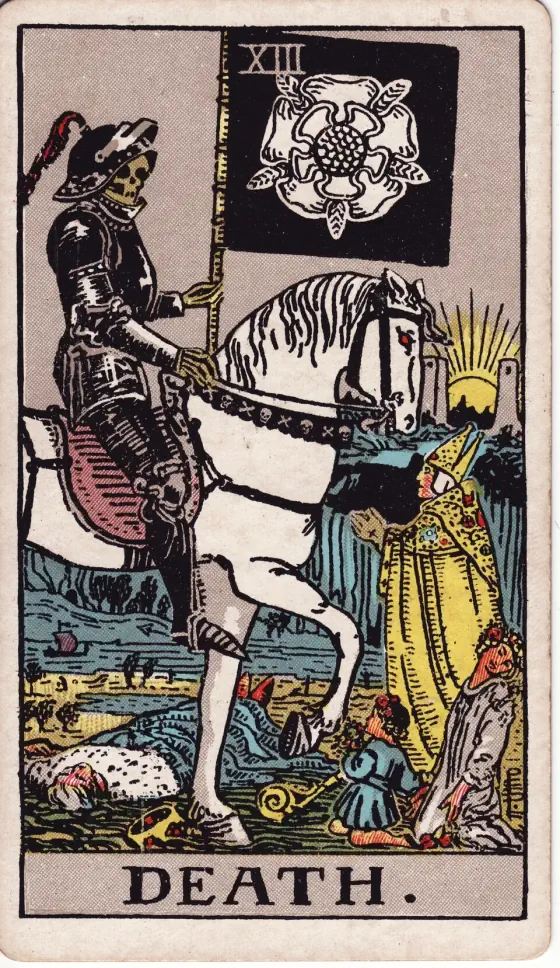
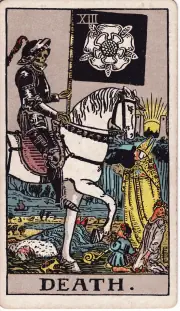
Trump XIII of the twenty-two. Drawn by Pamela Colman Smith for the deck first published in London in December 1909.
Waite on its symbolism
The veil or mask of life is perpetuated in change, transformation and passage from lower to higher, and this is more fitly represented in the rectified Tarot by one of the apocalyptic visions than by the crude notion of the reaping skeleton. Behind it lies the whole world of ascent in the spirit. The mysterious horseman moves slowly, bearing a black banner emblazoned with the Mystic Rose, which signifies life. Between two pillars on the verge of the horizon there shines the sun of immortality. The horseman carries no visible weapon, but king and child and maiden fall before him, while a prelate with clasped hands awaits his end.
There should be no need to point out that the suggestion of death which I have made in connection with the previous card is, of course, to be understood mystically, but this is not the case in the present instance. The natural transit of man to the next stage of his being either is or may be one form of his progress, but the exotic and almost unknown entrance, while still in this life, into the state of mystical death is a change in the form of consciousness and the passage into a state to which ordinary death is neither the path nor gate. The existing occult explanations of the 13th card are, on the whole, better than usual, rebirth, creation, destination, renewal, and the rest.
A. E. Waite, The Pictorial Key to the Tarot, 1911, Part II, § 2: his whole entry for the card, as printed.
What Waite says it means
These are the divinatory meanings printed in 1911, quoted as he wrote them. They are reported here as what one named book says, not as a claim that a card means anything or predicts anything.
- Upright
- End, mortality, destruction, corruption; also, for a man, the loss of a benefactor; for a woman, many contrarieties; for a maid, failure of marriage projects.
- Reversed
- Inertia, sleep, lethargy, petrifaction, somnambulism; hope destroyed.
A. E. Waite, The Pictorial Key to the Tarot, London, 1911, Part III, § 3. Out of copyright.
Where it sits in the trumps
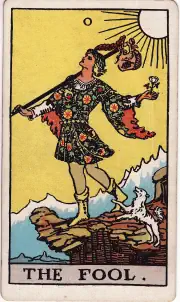
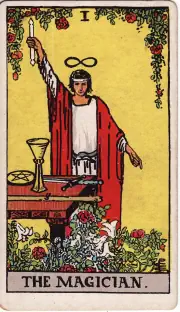
The twenty-two trumps run from The Fool, numbered zero, to The World at twenty-one. Waite moved Strength to eight and Justice to eleven, swapping the order older decks use, so a Marseille deck numbers those two the other way round.
A birth date can be reduced to one of these twenty-two. How the birth card is worked out →
The twenty-two trumps
Read on
Card face: Pamela Colman Smith, from the first printing published by William Rider & Son. Public domain. Source file. Full list on the credits page.
