Major arcana
Strength
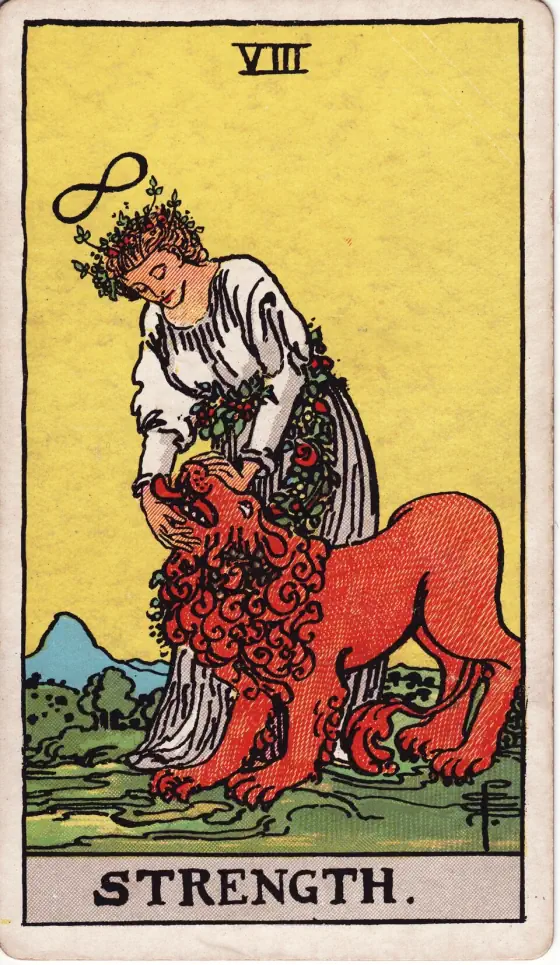
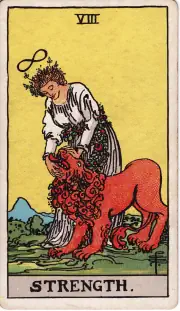
Trump VIII of the twenty-two. Drawn by Pamela Colman Smith for the deck first published in London in December 1909.
Waite on its symbolism
A woman, over whose head there broods the same symbol of life which we have seen in the card of the Hierophant, is closing the jaws of a lion. The only point in which this design differs from the conventional presentations is that her beneficent fortitude has already subdued the lion, which is being led by a chain of flowers. For reasons which satisfy myself, this card has been interchanged with that of Justice, which is usually numbered eight. As the variation carries nothing with it which will signify to the reader, there is no cause for explanation. Fortitude, in one of its most exalted aspects, is connected with the Divine Mystery of Union; the virtue, of course, operates in all planes, and hence draws on all in its symbolism. It connects also with innocentia inviolata, and with the strength which resides in contemplation.
These higher meanings are, however, matters of inference, and I do not suggest that they are transparent on the surface of the card. They are intimated in a concealed manner by the chain of flowers, which signifies, among many other things, the sweet yoke and the light burden of Divine Law, when it has been taken into the heart of hearts. The card has nothing to do with self-confidence in the ordinary sense, though this has been suggested—but it concerns the confidence of those whose strength is God, who have found their refuge in Him. There is one aspect in which the lion signifies the passions, and she who is called Strength is the higher nature in its liberation. It has walked upon the asp and the basilisk and has trodden down the lion and the dragon.
A. E. Waite, The Pictorial Key to the Tarot, 1911, Part II, § 2: his whole entry for the card, as printed.
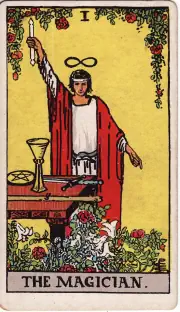
Waite writes that the symbol above her head is the one 'we have seen in the card of the Hierophant'. It is not: the lemniscate is drawn above the Magician, and the Hierophant has no such symbol. Some later editions print 'Magician' here. The 1911 wording is kept because this is a quotation, not a summary.
What Waite says it means
These are the divinatory meanings printed in 1911, quoted as he wrote them. They are reported here as what one named book says, not as a claim that a card means anything or predicts anything.
- Upright
- Power, energy, action, courage, magnanimity; also complete success and honours.
- Reversed
- Despotism, abuse of power, weakness, discord, sometimes even disgrace.
A. E. Waite, The Pictorial Key to the Tarot, London, 1911, Part III, § 3. Out of copyright.
Where it sits in the trumps
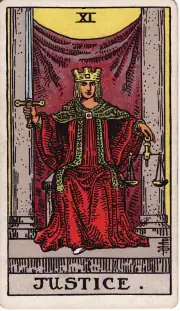
The twenty-two trumps run from The Fool, numbered zero, to The World at twenty-one. Waite moved Strength to eight and Justice to eleven, swapping the order older decks use, so a Marseille deck numbers those two the other way round.
A birth date can be reduced to one of these twenty-two. How the birth card is worked out →
The twenty-two trumps
Read on
Card face: Pamela Colman Smith, from the first printing published by William Rider & Son. Public domain. Source file. Full list on the credits page.
