Day of the week
Wednesday
“Wednesday's child is full of woe.”
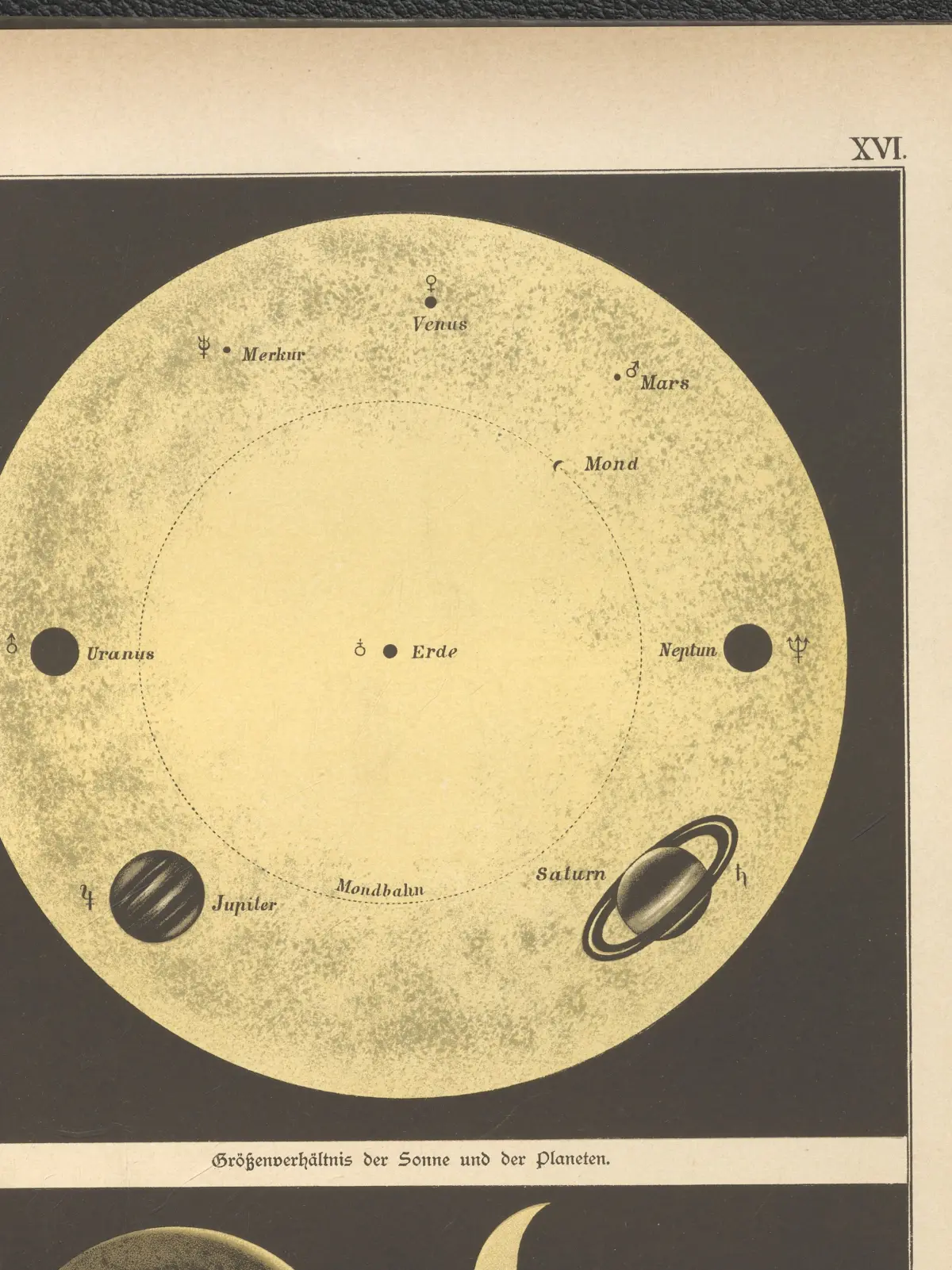
Named for Woden, matched to Mercury — the Latin is dies Mercurii, Mercury's day. The plate above is Weiss's diagram of the Sun and the planets drawn to one scale, where Mercury, the smallest planet, is a dot at the upper left of the Sun's disc.
The line above is Wednesday's from “Monday's Child” as it is usually printed today, as given in Iona and Peter Opie, The Oxford Dictionary of Nursery Rhymes (1951).
The rhyme was first printed by A. E. Bray in A Description of the Part of Devonshire Bordering on the Tamar and the Tavy (1836), and is older than that in speech. Her line for Wednesday reads: “Wednesday's child is full of woe,”
In some printings this line and Thursday's line trade places, so a version you find elsewhere may give the two the other way round.
This is folklore recorded from oral tradition, not a claim about anyone born on a Wednesday.
Where the name comes from
Old English wodnesdæg, Woden's day, is a Germanic loan-translation of the Latin dies Mercurii, the day of Mercury. Woden is the Old English name for Odin, the chief Germanic god, and his pairing with Mercury is an old one: it is already in Tacitus, and it has puzzled historians.
Word history from the Online Etymology Dictionary's entry for Wednesday.
Which dates are a Wednesday in 2026
52 dates fall on a Wednesday in 2026.